Chapter 4: Sterile Whites and Shattered Bone
The transition from the oppressive, suffocating chaos of the Ellison home to the clinical efficiency of the pediatric emergency department happened with whiplash-inducing speed. The universe suddenly shifted on its axis.
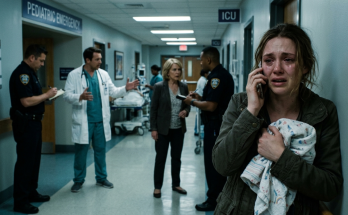
The triage nurse, a hardened veteran with tired eyes, took one sweeping, clinical look at Sophie’s deformed jaw and the mottled bruising blooming across her cheek. The protocol binder was instantly abandoned. She slammed a button on her desk and shouted for a pediatric trauma wheelchair.
Within a matter of minutes, the agonizing wait was over. We were rushed past the crowded waiting room into an isolation exam bay, then rapidly transferred to imaging, and finally deposited into a high-acuity room blindingly illuminated by surgical-grade overhead lights. Medical personnel swarmed us, moving with a fast, choreographed grace.
In this world, nobody cared about “family business.” Nobody cared about Grant’s ego or Diane’s reputation. They operated purely in the currency of data.
When did the blunt force trauma occur?
What was the mechanism of injury?
Did the patient experience a loss of consciousness?
And then, the question that drove a dagger directly into my ribs: Why was the patient not brought in immediately following the impact?
I stood in the corner of the sterile room, my arms crossed tightly over my chest to hide the lingering tremors. “I was only notified after the incident occurred,” I answered, my voice hollow.
The attending nurse paused, stylus hovering over her digital chart. “How long after?”
I looked at the wall clock, the second hand sweeping ruthlessly forward. “I don’t know yet.”
That sentence—I don’t know yet—became my mantra, my shield, and my curse for the remainder of the day.
Dr. Naomi Patel entered the room shortly after the CT scans were uploaded to the mainframe. She possessed a quiet, grounded gravity, radiating the exact frequency of calm I desperately required someone else to hold. She pulled a wheeled stool close to my chair, keeping her voice low.
“Sophie has sustained multiple, complex fractures of the mandible,” Dr. Patel explained, bringing up the glowing 3D imaging on her tablet. “The jaw structure is highly unstable. She has a compound break near the hinge and a secondary fracture along the chin line. We are going to require immediate surgical stabilization.”
I looked through the glass partition into the adjacent room. Sophie was lying in the center of a massive bed, dwarfed by the linens. They had pushed a heavy dose of IV fentanyl, and her eyes were fluttering shut. A pediatric nurse sat vigil beside her, holding a suction tube.
“Are you wiring her jaw shut?” I asked, the words tasting like ash in my mouth.
“Temporary fixation, yes,” Dr. Patel nodded sympathetically. “We will utilize the safest, least invasive method appropriate for her developmental age and this specific fracture pattern. The critical takeaway right now, Mrs. Ellison, is that she is medically stable.”
Stable.
The word was designed to offer comfort. Instead, it stripped away the adrenaline, leaving me violently aware of the precipice we had just walked along. Dr. Patel continued detailing the surgical approach—titanium plates, liquid diets, bone remodeling—but my auditory processing began to fail. My focus tunneled entirely onto Sophie’s small, pale hand resting limply on the blue hospital blanket.
Seven years old. She was just a child. A little girl who, just yesterday morning, had sleepily asked me to carefully cut the crusts off her peanut butter toast because they were “too scratchy.” And now, we were clinically debating how to bolt her facial skeleton back together.
The medical machinery didn’t stop there. Once the diagnosis was confirmed, the institutional protocols engaged automatically. A hospital social worker materialized with a clipboard. A mandatory Child Protective Services report was initiated. Local law enforcement was dispatched to the ER.
With every new form signed, every new badge that entered the room, the circle of consequence widened far beyond the incestuous borders of Grant’s family.
For decades, the Ellisons had survived entirely by pulling their toxicity inward. Their survival mechanism was predictable: force everyone into the living room. Scream until the loudest, most aggressive version of reality won. Bully the victim into submission. And then, aggressively enforce peace before any outsiders could witness the structural damage.
The hospital system did the exact, brutal opposite. It isolated every single variable.
Time of injury.
Time of notification.
Time of extraction.
Observed swelling. Speech impairment. Pain scales. Photographic evidence.
Every passing minute became its own hostile witness against them.
I sat in the dim light of the pre-op holding area, gently brushing the damp, matted hair away from Sophie’s clammy forehead. Her eyes darted anxiously around the room, refusing to meet mine.
“What is it, baby?” I murmured, keeping my tone light.
Her gaze flicked nervously toward the heavy wooden door. “Dad?”
“He isn’t here, sweetheart. It’s just you and me.”
The profound, physical relief that washed over her battered face at that news was a secondary trauma all its own. That hurt, too. The realization that she feared her protector as much as her abuser.
I stepped out into the harsh fluorescent glare of the hallway and dialed Leah Monroe. Leah was a ruthless, brilliant family law attorney who had navigated the grueling final stages of my divorce. She knew better than anyone the agonizing concessions I had made to maintain the illusion of a cooperative co-parenting dynamic.
She answered on the second ring. I delivered the tactical briefing without emotion: Sophie had been violently assaulted during Grant’s custodial weekend. Grant was physically present. Eleven relatives had actively conspired to barricade my vehicle and deny medical access.
Leah went completely silent for two full beats. I could hear the rapid clicking of her keyboard stop.
“Mara,” she said, her voice dropping an octave into absolute lethality. “Do not communicate with them in any capacity unless it concerns immediate, life-or-death medical necessity. Document everything. Screenshot every text. I am filing for emergency ex parte protective orders before the courts close today.”
“I haven’t seen the video footage yet,” I interjected, rubbing my aching temples.
“What video footage?”
“When I breached the living room, Grant was gripping his phone like a lifeline. The lens was pointed at the hearth. I am almost certain he recorded the incident, or at least the aftermath.”
“Do not ask him for it,” Leah commanded instantly. “Let the police detectives execute a digital warrant and recover it properly. If you tip him off that you know, you give him a reason to scrub his cloud storage. Let him think he’s safe.”
That advice was excruciating to swallow. Every violent, maternal instinct in my biology was screaming to drive back to that house, kick the door off its hinges, and beat the truth out of Grant with my bare hands.
But I didn’t. For the first time in my life, silence wasn’t a form of conflict avoidance.
It was a loaded weapon.