Nathan stood outside Emma’s apartment with his hands at his sides, trying not to look like a man who had spent the last three days rehearsing every possible version of this conversation.
The hallway smelled faintly of laundry detergent and someone’s evening dinner. Somewhere above them, a child laughed. A television murmured behind another door.
Emma watched him from the threshold.
She had changed since the bakery. Not in appearance, but in the way she held herself. At the bakery, he had seen exhaustion. Now he saw control—carefully gathered, firmly locked in place.
Behind her, the apartment was small but orderly. A narrow bookshelf leaned against one wall. Two child-sized backpacks rested near a radiator. On the refrigerator, colorful drawings were held up with magnets shaped like planets.
Nathan noticed one of the drawings immediately.
A tall building rose beneath a crooked yellow sun. At the top, in large, uneven letters, someone had written:
**HARRISON TOWER.**
His breath caught.
Emma followed his gaze.
“Ethan drew that,” she said. “He likes buildings.”
Nathan looked at the picture again.
“Does he know my name?”
“He knows the name of the school’s donor.”
“That’s all?”
“That’s all he needs to know right now.”
There was no anger in her voice, which somehow made it more difficult to hear.
Nathan stepped inside only after she moved aside.
The apartment was warm, but he felt cold.
“Where are they?” he asked.
“Asleep.”
“Do they know I’m here?”
“No.”
He nodded, though he wasn’t sure whether he was relieved.
Emma closed the door and leaned against it.
“You gave five million dollars to my school.”
“I gave it to the students.”
“You used your company to hide your name.”
“I didn’t want you to feel obligated.”
She gave a short, humorless smile.
“Obligated? Nathan, you had contractors installing equipment in a building where I work. You paid off my medical debt without telling me. You’ve been looking into my children’s lives.”
“I was trying to help.”
“You were trying to enter my life without asking permission.”
The words landed quietly, but they landed.
Nathan took off his coat and held it over one arm.
“I saw you at the bakery.”
“I know.”
“You know?”
“Mr. Russo called me the next morning. He said a man had been standing outside for ten minutes, staring at us through the window.”
Nathan looked down.
“I didn’t mean to frighten you.”
“You didn’t frighten me.” Emma folded her arms. “You confused me. There’s a difference.”
He looked at her then.
For four years, he had imagined every possible reunion. In some versions, she shouted. In others, she cried. Sometimes she walked away without saying anything.
He had never imagined that she would sound tired.
“You should have told me,” he said.
Emma’s expression tightened.
“Told you what?”
“About the boys.”
Her eyes did not leave his.
“I didn’t know they were yours.”
The room seemed to contract around them.
Nathan stared at her.
“What do you mean?”
“I mean exactly what I said.”
“You were pregnant when we divorced.”
“No.”
The answer came so quickly that it stopped him.
“You weren’t?”
“I was seven weeks pregnant when the divorce became final,” Emma said. “But I didn’t know that at the time.”
Nathan’s mouth went dry.
He remembered the winter their marriage had ended. The arguments that had begun over small things and expanded until neither of them could remember how they had started. His company had been growing rapidly then, and he had spent more nights in hotel rooms than at home.
Emma had said he cared more about buildings than people.
He had told her she was trying to punish him for being ambitious.
Neither of them had understood how close they were to losing everything that mattered.
“Why didn’t you tell me when you found out?” he asked.
Emma looked toward the hallway leading to the boys’ room.
“Because by then, you had already made your decision.”
“That isn’t fair.”
“No,” she said softly. “It wasn’t fair.”
The words held no accusation, only history.
Nathan placed his coat over the back of a chair.
“Emma, if I had known—”
“You would have come back?”
“Yes.”
“You don’t know that.”
“I do.”
“You say that now because you’ve seen them.”
He had no answer.
She walked to the kitchen and filled a glass of water. Her hand trembled slightly as she set it on the counter.
Nathan noticed.
“Are you all right?”
“I’m fine.”
“You don’t have to be.”
“That’s the problem, Nathan. I always had to be.”
He stood several feet away, unwilling to cross the space between them without permission.
Emma took a breath.
“When we divorced, I believed you were done with me. Completely. You had already moved out. Your attorney had sent the papers. Your mother had told half of Chicago that I was unstable and couldn’t handle the pressure of being married to you.”
Nathan frowned.
“My mother said that?”
“She said I was keeping you from becoming the man you were meant to be.”
He remembered his mother’s cold disapproval, but not those exact words. He had been too consumed with work and resentment to ask what had happened in the rooms he wasn’t in.
“Why didn’t you tell me?”
“Tell you what? That your family despised me? You knew.”
“I didn’t know everything.”
“No,” Emma said. “You knew what was convenient.”
The truth of it made him lower his eyes.
She continued.
“When I discovered I was pregnant, I called your office. You were in London. I left a message.”
“I never received one.”
“I know. Your assistant at the time told me you were unavailable and that I shouldn’t create another complication.”
Nathan looked up sharply.
“Who?”
“Daniel Mercer.”
His former chief of staff.
Daniel had worked for him for nearly twelve years before leaving to run a private investment firm. Nathan remembered that period clearly: the divorce, the expansion into Europe, the endless legal meetings.
“Daniel told you not to contact me?”
“He said you were under enormous pressure and that you had made it clear you wanted a clean separation.”
“That’s not what I said.”
“Perhaps not in those words.”
Nathan paced once across the room, then stopped.
“Why didn’t you call again?”
“I did.”
“How many times?”
“Three. The last time, you answered.”
He searched his memory.
A phone call from Emma, late at night. He had been in a hotel in London, furious after a meeting with investors. He remembered her asking if he had received a message. He remembered saying he couldn’t do this anymore.
But he could not remember what “this” had meant.
He had assumed she was asking him to reconsider the divorce.
She had perhaps been asking him to listen.
“What did I say?” he asked.
Emma’s gaze moved to the floor.
“You said, ‘Emma, please stop looking for reasons to keep us tied together.’”
Nathan closed his eyes.
The sentence returned to him now, stripped of the anger that had once hidden its meaning.
He had said it.
He remembered.
“I was wrong,” he whispered.
“Yes.”
“I didn’t know.”
“I know.”
That was somehow worse.
From the hallway came a soft rustle. Both of them turned.
A small figure stood in the doorway, rubbing his eyes.
Noah.
His hair was tousled, and one sleeve of his pajama shirt had ridden up his arm. He looked from Emma to Nathan with sleepy curiosity.
“Mom?”
Emma immediately softened.
“Hey, sweetheart. Why are you awake?”
“I had a dream about the moon falling.”
“Did it fall all the way?”
Noah shook his head. “It got stuck on a tree.”
“Then we should probably help it down.”
He nodded seriously.
Nathan stood perfectly still.
Noah looked at him.
“Are you the man from school?”
Nathan knelt so he wouldn’t seem so tall.
“I might be.”
“The one who gave us the new telescopes?”
Nathan glanced at Emma.
She gave a small nod.
“Yes,” he said. “I helped with those.”
Noah considered him.
“Do you like space?”
“I do.”
“What’s your favorite planet?”
Nathan thought of Ethan’s drawing on the refrigerator.
“Saturn.”
“Mine too. Ethan likes Mars.”
“Because it’s red,” Emma said.
Noah yawned.
“Are you a friend of Mommy’s?”
The question was innocent. Nathan felt its weight immediately.
Emma stepped closer to her son.
“He’s someone I used to know.”
Noah nodded as if this made perfect sense.
“Are you staying for breakfast?”
“Noah,” Emma said gently.
“But we have pancakes tomorrow.”
Nathan looked at Emma.
“I should go.”
Noah seemed disappointed, but Emma guided him back toward the bedroom.
“Go back to bed, astronaut.”
“Can he come tomorrow?”
“Go to bed.”
Noah glanced over his shoulder at Nathan.
“Good night, Saturn man.”
“Good night, Noah.”
When Emma returned, her eyes were bright but her expression remained guarded.
“You need to leave,” she said.
Nathan nodded.
At the door, he turned.
“I want a paternity test.”
Emma’s face became still.
“I know.”
“I’m not saying that because I doubt you.”
“You should say it because you need certainty.”
“I need to know the truth.”
“So do I.”
He studied her.
“What does that mean?”
She reached for the doorknob.
“It means there are things I never understood about the night they were born.”
Nathan waited.
Emma looked toward the boys’ room.
“They were premature,” she said. “Very premature. The hospital records said thirty-one weeks. But when the doctors examined them, one of them measured closer to thirty-four.”
Nathan’s brow furrowed.
“What are you saying?”
“I’m saying the dates never made sense.”
“Why didn’t you tell me?”
“Because I had no proof of anything. And because I was alone, terrified, and trying to keep two babies alive.”
He softened at once.
“Emma…”
“I’m not accusing anyone,” she said. “I’m telling you why I never trusted the report I received.”
“What report?”
She opened the door.
“Come back tomorrow. We’ll arrange the test properly.”
Nathan stepped into the hallway.
“And the report?”
Emma hesitated.
“I’ll show you.”
The door closed.
Nathan remained there for several seconds, staring at the peeling paint on the opposite wall.
Then he walked downstairs into the cool Chicago night.
He did not return to his office.
Instead, he drove to the lake.
The city glittered across the water, all glass and steel and carefully engineered light. He had spent his life believing that anything could be solved with enough research, enough money, enough determination.
But the question waiting inside him was not financial.
It was personal.
At six the next morning, Nathan called his attorney.
“I need a discreet paternity test arranged,” he said. “For two children.”
His attorney paused.
“Is there a legal dispute?”
“No.”
“Custody?”
“No.”
“Then what is the issue?”
Nathan looked out over the lake.
“I don’t know yet.”
The test was arranged through a private medical practice Emma selected herself. She refused to use any laboratory connected to Harrison Development, and Nathan did not argue.
They met there two days later.
Emma arrived with the boys after school. Ethan carried the same space notebook he had held in the bakery. Noah held a small plastic dinosaur.
Nathan had expected to feel nervous.
He had not expected the boys to walk in wearing matching blue jackets, their faces bright from the cold, so clearly different in personality and so alike in every feature.
Ethan noticed Nathan first.
“Saturn man.”
Nathan smiled despite himself.
“Hello, Ethan.”
Noah lifted the dinosaur.
“This is Captain Green.”
“Does Captain Green like Saturn?”
“No. He likes the jungle.”
“That makes sense.”
Emma watched the exchange carefully.
A nurse collected the samples with gentle efficiency. The boys were told it was simply a cheek swab for a health record. They accepted this without concern.
When it was finished, Ethan asked whether they could get hot chocolate.
“There’s a café downstairs,” Nathan said.
Emma looked at him.
He immediately added, “Only if your mother says it’s all right.”
Emma studied his face, perhaps searching for some hidden strategy.
Then she nodded.
“One cup each. And no whipped cream.”
The boys groaned together.
It was the first time Nathan had heard them speak in unison.
At the café, they sat at a small corner table. Ethan talked about a model rocket he wanted to build. Noah explained that Captain Green had once defeated a shark, a robot, and a very rude pigeon.
Nathan listened.
He learned that Ethan hated bananas but liked banana bread. Noah was afraid of automatic hand dryers. Ethan drew planets when he felt overwhelmed. Noah hummed while he read.
Small details.
Ordinary details.
The kind of details a father was supposed to know because he had been there for them.
Nathan felt the loss of those years settle heavily inside him.
Emma noticed.
“You don’t have to look so guilty,” she said quietly.
“I’m not sure I have a choice.”
“Guilt is useful only if it becomes responsibility.”
He looked at her.
“What does responsibility look like to you?”
“For now? Patience.”
He nodded.
“And honesty.”
“Yes.”
“And not buying your way into their lives.”
“I understand.”
“Do you?”
“I’m trying to.”
She stirred her coffee.
“Then start by understanding that they are not a second chance for you and me.”
Nathan glanced toward the boys.
“I know.”
“They’re not proof that we were meant to stay together.”
“I know.”
“They’re not a project.”
He looked back at her.
“No. They’re my sons.”
Emma’s fingers tightened around the paper cup.
The word hung between them.
She didn’t correct him.
That small mercy meant more than he expected.
The results arrived forty-eight hours later.
Nathan was in a meeting when his attorney called. He stepped into the corridor, expecting a brief update.
Instead, the attorney said, “The results are conclusive.”
Nathan’s heart began to pound.
“Both?”
“Both children are biologically yours.”
He leaned against the wall.
For several seconds, he heard nothing but the quiet hum of the building’s ventilation system.
Two sons.
His sons.
The knowledge should have felt like an answer.
Instead, it opened a door onto four years of absence.
He thanked the attorney and ended the call.
Then he stood there, unable to return to the meeting.
That evening, he went to Emma’s apartment with the report in a sealed envelope.
She opened the door before he knocked a second time.
“You got them.”
He nodded.
“They’re mine.”
Emma closed her eyes briefly.
“I know.”
Nathan handed her the envelope.
She didn’t take it.
“You should read it.”
“I don’t need to.”
“Emma.”
“I believed you the first time you said it.”
He swallowed.
“What happens now?”
“That depends on whether you’re asking as their father or as the man who used to be my husband.”
“Both, I suppose.”
“That’s dangerous.”
“I know.”
She looked past him toward the stairwell.
“The boys are at Mrs. Alvarez’s downstairs. She watches them when I work late.”
“Can I see them?”
“Not tonight.”
The disappointment crossed his face before he could hide it.
“Why?”
“Because this isn’t a switch we flip. They don’t know you. You don’t know them. If you suddenly appear every day, give them gifts, and then disappear because work becomes demanding, they’ll be the ones who pay for it.”
“I won’t disappear.”
“You’ve said that before.”
Nathan accepted the blow.
“What can I do?”
“Show up consistently.”
“How often?”
“Start with one afternoon a week.”
“One?”
“Do you have a better offer?”
He almost smiled.
“No.”
“Then one afternoon.”
“May I take them somewhere?”
“Not yet. We’ll begin here. In the apartment. With me present.”
Nathan nodded.
“Saturday?”
“Saturday at ten.”
“I’ll be here.”
Emma’s expression remained cautious.
“Don’t promise lightly.”
“I’m not.”
For the first time since he had entered her apartment, she looked directly into his eyes.
“You need to understand something else. I don’t want money.”
“I can help with the debt.”
“I don’t want money.”
“The medical debt is already paid.”
“Without my consent.”
“I thought—”
“You thought your money could erase the years when I had to choose between buying medication and paying rent.”
Nathan went silent.
Emma’s voice softened, but the hurt beneath it remained.
“I know you meant well. I know you saw a problem and tried to solve it. But the boys don’t need a rich father. They need a reliable one.”
“I can be that.”
“Then be patient long enough to prove it.”
Nathan nodded.
He started down the stairs.
“Saturday,” Emma called.
He turned.
“Bring nothing.”
He understood.
“No gifts.”
“No gifts.”
He left.
At Mrs. Alvarez’s apartment, Ethan and Noah were lying on the floor surrounded by colored pencils. They had no idea that a man upstairs had just received the most important news of his life.
Emma sat beside them and watched as Ethan drew a rocket with three windows.
“Is that you and Noah?” she asked.
Ethan shook his head.
“No. It’s our family.”
Emma’s breath caught.
“Who’s in the third window?”
Ethan added another small figure with a pencil.
“This is the man from the café.”
Noah leaned over.
“He’s Saturn man.”
Emma looked at the drawing.
Four figures inside a rocket.
She wanted to tell Ethan that families were not built from drawings or wishes. They were built from time, trust, and the courage to remain when things became difficult.
But she also knew hope had a way of entering a home quietly.
Sometimes it arrived before anyone was ready.
Later that night, after the boys fell asleep, Emma opened the old metal box she kept beneath her bed.
Inside were hospital bracelets, discharge papers, a faded photograph, and a sealed envelope she had not touched in four years.
She placed the paternity report beside it.
The envelope bore a hospital logo from the night the twins were born.
On the front, in handwriting she recognized immediately, were six words:
**Do not let Nathan see this.**
Emma had never known who wrote them.
But now, for the first time, she noticed the initials beneath the warning.
**D.M.**
Daniel Mercer.
And beneath the envelope, hidden under the hospital records, was a second document—one that listed a birth date different from the date she had always believed.
PART 3: The Question Emma Had Kept Buried for Four Years 019
Emma held the envelope beneath the lamp, afraid that opening it might change the shape of the life she had spent four years protecting.
The handwriting belonged to Daniel Mercer.
She had seen it on legal forms, hospital paperwork, and the occasional note he had left for Nathan’s office staff. Precise letters. Narrow slant. A firm pressure that made every word look deliberate.
She turned the envelope over.
There was no return address. No date. Only the warning and those initials.
**Do not let Nathan see this.**
For four years, Emma had assumed the message was connected to Nathan’s family. Perhaps Nathan’s mother had wanted to hide something. Perhaps Daniel had discovered that Emma was pregnant and, for reasons she still could not understand, decided to keep Nathan away.
But the second document beneath the envelope changed the question.
Emma lifted it carefully.
The paper was thin and yellowed at the edges, stamped with the seal of Lakeshore Women’s Hospital. At the top, beneath her name, was a line marked:
**Date of delivery: October 14**
Emma stared at it.
The twins had been born on October 21.
She knew that date as surely as she knew her own name. October 21 was on every insurance form, every birth certificate, every hospital bill, every school record. It was the date she had repeated to doctors, teachers, and the children whenever their birthday came around.
October 21.
But the document in her hand said October 14.
She read it again.
Then a third time.
Her pulse began to beat heavily in her throat.
The page contained other information: two male infants, delivered by cesarean section; birth weights; medical observations; names of attending staff. One line had been crossed out, then rewritten.
**Infant A: Ethan Parker.**
**Infant B: Noah Parker.**
The handwriting on the revised line was not hers.
Emma sank slowly onto the edge of the bed.
For several minutes, she did nothing but listen to the apartment.
The refrigerator clicked on. Pipes murmured behind the wall. In the boys’ room, Noah turned over in his sleep and mumbled something about a jungle.
The ordinary sounds made the document feel impossible.
She had gone into labor on October 21.
She remembered the rain striking the windows of the apartment. She remembered the ambulance driver asking her questions while she held her stomach. She remembered the hospital lights and the nurse who told her to breathe.
Most of all, she remembered the fear.
The twins had been so small. Their cries had sounded thin and distant as doctors moved quickly around them. Emma had barely seen their faces before they were taken to the neonatal unit.
But if they had been born on October 14, where had the missing week gone?
And why had every official record carried October 21?
She returned the document to the metal box, then took it out again.
Her hands were no longer steady.
At seven the next morning, she called the hospital.
The switchboard connected her to medical records, where a polite woman named Gloria asked for identification, dates, and the reason for the request.
“I need the complete file from my delivery,” Emma said. “Not a summary. Everything.”
There was a pause while Gloria typed.
“Your records were transferred to the hospital archive when Lakeshore merged with Northview.”
“Can I access them?”
“Some portions, yes. Certain documents require a formal request.”
“I’m the patient.”
“That helps, but neonatal records can involve privacy restrictions.”
“They’re my children.”
“I understand. I’m only explaining the process.”
Emma closed her eyes.
“I need an appointment.”
Gloria gave her a date three weeks away.
“I can’t wait three weeks.”
“I’m sorry, Ms. Parker.”
“Please. Something in my file is wrong.”
The woman’s voice softened.
“Is there a medical emergency?”
“No.”
“Then the earliest appointment I can offer is November sixth.”
Emma looked at the calendar.
It was a Wednesday.
She thought of work, the boys, rent, and the carefully balanced schedule that could collapse if one piece shifted.
“Book it,” she said.
After ending the call, she sat at the kitchen table with both hands wrapped around a mug of coffee she had forgotten to drink.
She considered calling Nathan.
Then she remembered his promise to show up without gifts, without demands, and without trying to solve every problem with money.
This was not a problem he could solve.
Not yet.
At ten o’clock, he arrived exactly on time.
Emma watched from the window as he crossed the street. He wore a dark sweater instead of a suit and carried nothing but a paper cup of coffee. He stopped outside the building, checked the number, and looked up at her window.
He seemed to sense her there.
For a moment neither moved.
Then Emma opened the door downstairs.
“Come up,” she called through the intercom.
The boys were sitting at the table eating toast when Nathan entered. Ethan had arranged three crayons beside his plate according to color. Noah was attempting to balance a grape on the back of his hand.
“Saturn man,” Noah announced.
Nathan smiled.
“Captain Green.”
The dinosaur was placed proudly on the table.
“Captain Green says you’re late.”
Nathan looked at the clock.
“I’m exactly on time.”
“That’s late for a dinosaur.”
“I’ll try to improve.”
Emma watched him remove his shoes without being asked. It was a small thing, but she noticed. The old Nathan would have walked into a room as if it had been designed for him.
This Nathan waited for directions.
“Would you like breakfast?” she asked.
“Yes, thank you.”
“Coffee?”
“Yes, please.”
The boys immediately began showing him their drawings. Ethan had designed a spacecraft with six engines. Noah had drawn a green dinosaur wearing a crown.
Nathan listened to both explanations with the seriousness of someone reviewing an important contract.
“Captain Green is the king of the jungle,” Noah said.
“Does he have a castle?”
“He has a volcano.”
“Of course.”
“It’s not a real volcano,” Ethan corrected. “It’s a pretend one.”
Nathan nodded gravely.
“That’s probably safer.”
Noah considered this.
“Maybe.”
Emma poured coffee and stood at the counter.
She had expected the morning to feel awkward. Instead, it felt strangely ordinary. Nathan helped the boys build a tower from wooden blocks. He let Noah knock it over three times. When Ethan became frustrated because one of the pieces wouldn’t fit, Nathan did not reach across and fix it. He waited until Ethan asked for help.
Emma noticed everything.
The patience.
The restraint.
The way Nathan kept glancing toward her before making even simple decisions.
At eleven, Noah asked if they could go to the park.
Emma hesitated.
The weather was cold but clear, and the park was only two blocks away. She had told herself the first visit would remain inside, but the boys were restless, and Nathan had already spent an hour proving that he would not force the moment.
“Half an hour,” she said. “And you stay where I can see you.”
Nathan nodded.
The park had wet benches and bare trees. Ethan carried a small magnifying glass, searching for signs of spring that would not appear for months. Noah marched ahead with Captain Green tucked into his coat pocket.
Nathan followed at the boys’ pace.
A pair of mothers sat near the playground, and one of them recognized him. Emma saw the flicker of recognition, the quick glance toward his expensive watch, then the whisper to the other woman.
She expected Nathan to react.
He didn’t.
He pushed Noah on the swing and counted slowly. Ethan climbed onto the lowest platform of the jungle gym, then stopped.
“I can’t get down,” he said.
Nathan stood beneath him but did not lift his arms.
“Would you like me to help, or would you like to try?”
“Help.”
Nathan held out one hand.
Ethan stepped onto it carefully. Nathan lowered him to the ground.
“Thank you.”
“You’re welcome.”
Ethan looked up at him.
“Are you really rich?”
Emma stiffened.
Nathan did not.
“I have enough money to pay for things.”
“That means rich.”
“I suppose it does.”
“Do you have a castle?”
“No.”
“A swimming pool?”
“Yes.”
“Is it bigger than our whole building?”
Nathan considered.
“Yes.”
Noah abandoned the swing and hurried over.
“Do you have a dinosaur?”
“Not a real one.”
“A pretend one?”
“No.”
“Then we don’t want to live there.”
Nathan laughed, and the sound surprised Emma. She had not heard him laugh freely in years.
“Fair enough,” he said.
On the walk home, Ethan held one of Nathan’s hands and Noah held the other.
Emma followed behind them, watching the three shadows stretch across the sidewalk.
She had imagined this moment in nightmares and daydreams. She had imagined Nathan taking the boys away, or spoiling them, or teaching them to look down on the small life she had built.
She had not imagined him asking Noah whether Captain Green needed a nap.
At the apartment, the boys fell asleep quickly.
Nathan stood near the door, uncertain whether to leave.
“They had a good time,” Emma said.
“So did I.”
“You did well.”
His eyes moved toward the bedroom.
“I keep thinking about everything I missed.”
“You’ll keep thinking about it.”
“Does it ever stop hurting?”
“No.”
He accepted that.
“Does it become easier?”
“Sometimes. If you stop making the pain about yourself.”
Nathan looked at her.
“I’m trying to understand how.”
“By staying focused on them.”
“And on you?”
Emma folded the children’s jackets over the back of a chair.
“That’s more complicated.”
“I’m not asking you to forgive me today.”
“Good.”
“I’m asking what I can do.”
“Keep doing what you said you would do.”
“I will.”
She studied him for a long moment.
“There’s something I need to tell you.”
Nathan waited.
“I found a document last night. It says the boys were born on October fourteenth.”
He frowned.
“That’s not possible.”
“I know.”
“Are you sure it wasn’t an error?”
“Every other record says October twenty-first.”
“Then it probably is.”
“It was in an official hospital file.”
Nathan’s expression changed. The businessman disappeared, replaced by the man who had spent his life noticing details other people missed.
“Where did you get it?”
“It was in a box under my bed. I didn’t know it existed.”
“Who gave it to you?”
“I don’t know.”
He looked toward the hallway, then back at her.
“Does this have anything to do with Daniel?”
“There was a sealed envelope with his initials on it. The warning says not to let you see it.”
Nathan’s jaw tightened.
“Did you open it?”
“No.”
“Why not?”
“Because I don’t know what’s inside.”
“I can find out.”
Emma’s expression sharpened.
“That’s exactly what I’m afraid of.”
“I’m not suggesting I send people after him.”
“You’re suggesting you take control.”
“I’m suggesting we learn the truth.”
“We will. Together. Carefully.”
Nathan looked down at his hands.
The old instinct rose in him—to call an investigator, obtain records, locate Daniel, and force the unanswered questions into daylight. He could already imagine the sequence. A private firm. A medical archivist. A former employee contacted discreetly.
But Emma was watching him.
Not trustingly.
Not yet.
He took a breath.
“Together,” he said.
“Together.”
He left shortly afterward.
Emma waited until his footsteps faded down the stairs before returning to the metal box.
The envelope remained unopened.
She carried it into the kitchen and placed it on the table. For several minutes, she stared at Daniel’s warning.
Then she called the only person she knew who might understand why his name was there.
Daniel answered on the fifth ring.
“Emma?”
His voice had aged. It sounded rougher than she remembered.
“You knew I might call.”
“I wondered when you would.”
The words sent a chill through her.
“Why did you leave that envelope?”
“Where did you find it?”
“In my hospital records.”
Daniel was silent.
“What did you put in it?”
“Nothing that belongs to me.”
“That isn’t an answer.”
“No. It isn’t.”
She gripped the edge of the table.
“Were my children born on October fourteenth?”
Another silence.
Then Daniel exhaled slowly.
“Yes.”
Emma’s eyes closed.
“Why have I been told October twenty-first for four years?”
“Because October twenty-first is the date on the amended records.”
“Who amended them?”
“I don’t know.”
“You signed the envelope.”
“Yes.”
“You told someone not to let Nathan see it.”
“I did.”
“Why?”
Daniel’s voice lowered.
“Because I believed Nathan would destroy the evidence before he understood what it meant.”
Emma stood so quickly that the chair scraped the floor.
“Destroy it?”
“Not intentionally. Nathan trusted the wrong people. He would have confronted them before we knew how deep the problem went.”
“Who are ‘they’?”
“I can’t explain this over the phone.”
“You’ve had four years.”
“I know.”
“Four years, Daniel.”
“I know.”
Her anger trembled into the room.
“You let me believe Nathan abandoned us.”
“I never told you that.”
“You told me he didn’t want complications. You told me he wanted a clean separation.”
“He did say those things.”
“He said them to you?”
“He said he wanted the divorce finalized. He said he didn’t want another child brought into the dispute.”
Emma’s breath caught.
“I was pregnant when I called him.”
“I know.”
“You knew?”
“Yes.”
“Why didn’t you tell him?”
“Because I was told not to.”
“By whom?”
Daniel hesitated.
When he answered, his voice was almost inaudible.
“By Nathan’s mother.”
Emma sat again.
For a moment, the room seemed to tilt.
“Why would she do that?”
“I don’t know all of it.”
“You know enough.”
“I know she believed you were damaging Nathan’s future. She believed a child would tie him to you permanently. She also knew the company was negotiating a major merger, and she thought any scandal would weaken his position.”
Emma looked at the sealed envelope.
“Did she change the hospital records?”
“I don’t know.”
“But you suspect her.”
“I suspect someone with access to the records and a reason to keep the birth date uncertain.”
“Why would the date matter?”
“I don’t know.”
“Daniel, stop saying that.”
“I’m trying to be honest.”
“Honesty would have been telling me four years ago.”
“Yes.”
The simplicity of his admission disarmed her.
“Why didn’t you?”
“Because I was afraid.”
“Of Nathan?”
“Of what would happen if the company’s merger collapsed. Of what Nathan’s mother might do. Of how Nathan would react if he learned I had concealed your pregnancy.”
“You chose his career over my children.”
“I chose what I thought would protect everyone.”
“You were wrong.”
“Yes.”
Emma looked toward the boys’ room.
“What was in the envelope?”
“A copy of the original neonatal intake form. A list of visitors to the unit. And a note from a nurse.”
“What note?”
“She wrote that one of the infants had been moved to another ward for several hours without the usual authorization.”
Emma’s hand rose to her mouth.
“Moved?”
“Not out of the hospital. The records say the boys were transferred temporarily because the neonatal unit was overcrowded.”
“Which boy?”
“I don’t know.”
“You don’t know?”
“I saw the note after the fact. It didn’t identify the infant clearly.”
Emma’s mind raced through memories of those first days. She had been sedated and recovering from surgery. Nurses had brought updates, but the twins had remained behind glass, surrounded by wires and monitors. She had trusted every person in a white coat because she had no other choice.
“Are you saying the boys were switched?”
“No.”
“Then what are you saying?”
“That the records were altered, and someone wanted the original documents hidden.”
“Who?”
“I’m meeting someone tomorrow.”
“Who?”
“Dr. Helen Whitcomb.”
Emma recognized the name.
The physician had been listed on the twins’ discharge summary as a consulting neonatologist. Emma remembered meeting her once, briefly, in the hospital corridor.
“Is she still practicing?”
“Retired. She lives in Evanston.”
“Why are you meeting her?”
“Because she kept a private copy of her notes.”
Emma felt the room go very quiet.
“Why didn’t she come forward?”
“Perhaps she tried.”
“Did she know about the envelope?”
“I don’t know.”
“Daniel, I need to be there.”
“No.”
The refusal was immediate.
“Why not?”
“Because if she agrees to speak, she should not feel pressured.”
“I’m their mother.”
“And Nathan is their father.”
Emma’s grip tightened around the phone.
“Did you tell him?”
“Not yet.”
“You must not tell him anything until I understand what happened.”
“I agree.”
That answer unsettled her more than an argument would have.
“Send me the address,” she said.
“Emma—”
“Send it.”
He was silent for a long moment.
Then he said, “Tomorrow at two.”
The call ended.
Emma remained at the kitchen table until the light outside began to fade.
When Nathan arrived for his next visit, she did not mention the meeting immediately. The boys were excited to show him a cardboard rocket they had built with Mrs. Alvarez. Nathan crouched beside them, helping reinforce the wings with tape.
He never asked why Emma was distracted.
He only glanced at her once and said, “You look tired.”
“I am.”
“Do you want me to leave?”
“No.”
The answer surprised them both.
They spent the afternoon on the living-room floor. Ethan read aloud from a book about stars while Noah colored outside the lines of a page showing Saturn’s rings.
At one point, Nathan reached for a pencil at the same time Emma did. Their hands touched.
Both pulled back.
The moment was small, but it carried the memory of another life—their kitchen, late evenings, shared meals, the ease they had once taken for granted.
That ease was gone.
Perhaps it would never return.
But something quieter was beginning in its place.
After the boys went to bed, Emma told Nathan about Daniel’s call.
He listened without interrupting.
When she finished, he stood at the window.
“My mother is still alive,” he said.
“I know.”
“She lives in Palm Beach.”
“I know.”
“You’ve looked into her.”
“I looked into everyone connected to the hospital records.”
He turned.
“Did you contact her?”
“No.”
“Thank you.”
“I’m not doing this for you.”
“I know.”
For a moment, neither spoke.
Then Nathan said, “I remember the week before the divorce. My mother came to the house.”
“What did she say?”
“She told me you were using a possible pregnancy to keep me trapped.”
Emma’s face went pale.
“I never told her I was pregnant.”
“I know that now.”
“She knew.”
“Yes.”
“How?”
Nathan looked toward the boys’ room.
“I don’t know.”
Emma crossed her arms.
“You need to ask her.”
“I will.”
“Not tonight.”
“I wasn’t planning to.”
“Not alone.”
His eyes met hers.
“You want to come?”
“I want the truth.”
“So do I.”
The following afternoon, Emma drove to Evanston alone.
Dr. Helen Whitcomb’s home stood on a quiet street lined with old trees and modest brick houses. A ceramic birdbath sat near the front steps. Wind chimes moved softly beneath the porch roof.
Daniel’s car was already parked at the curb.
He stood when Emma approached.
He looked older than Nathan, though they were close in age. His hair had gone almost entirely gray, and he held himself with the careful posture of someone who had learned to carry regret without expecting it to disappear.
“You came,” he said.
“You knew I would.”
“I hoped.”
“I’m not here to forgive you.”
“I’m not asking.”
They entered the house.
Dr. Whitcomb waited in a sunlit sitting room with a blanket over her knees. She was in her late seventies, with silver hair and sharp, observant eyes.
When she saw Emma, she stood slowly.
“You’re the mother.”
“Yes.”
“I remember you.”
Emma stopped.
“You remember me?”
“I remember a young woman who kept asking whether her babies were breathing on their own.”
The memory struck with such force that Emma gripped the back of a chair.
Dr. Whitcomb continued.
“You were exhausted. You had just come out of surgery. But you kept asking.”
“What happened?”
The doctor looked at Daniel.
He nodded.
Dr. Whitcomb walked to a cabinet and removed a thin folder.
“The date on the boys’ birth records is wrong,” she said. “They were born on October fourteenth.”
Emma’s knees weakened.
“Why?”
“I entered the date correctly in my notes. Someone changed the hospital chart later.”
“Who?”
“I don’t know.”
“But you knew it had been changed.”
“I knew something was wrong. The infants’ medical progression did not match the dates on the revised record. One week matters greatly for premature babies.”
Emma’s voice trembled.
“Were they ever separated?”
“Yes.”
She closed her eyes.
“Why?”
“An emergency involving another patient required additional equipment. One of your sons was temporarily moved to a monitored room in the pediatric wing. He remained under hospital care. He was not alone.”
“Which son?”
Dr. Whitcomb opened the folder.
“Infant B.”
“Noah?”
The doctor nodded.
“What does that mean?”
“It means Noah was moved for approximately six hours. During that time, the transfer sheet was signed by a hospital administrator rather than the attending nurse.”
“Why?”
“I questioned it. I was told the paperwork would be corrected.”
“But it wasn’t.”
“No.”
Emma looked at Daniel.
“What does any of this have to do with Nathan?”
Dr. Whitcomb’s expression changed.
“Two days before the transfer, a woman came to the hospital asking about you.”
“Who?”
“She said she was a relative.”
“What did she look like?”
The doctor’s gaze dropped to the folder.
“Elegant. Dark hair. Perhaps in her fifties. She carried herself like someone accustomed to being obeyed.”
Emma felt the room grow colder.
“Was it Nathan’s mother?”
“I cannot be certain.”
“Did she say my name?”
“She asked whether the father had been notified.”
“Was he?”
“No.”
“Why not?”
“Because the woman told the administrator that the father was overseas and did not wish to be contacted.”
Nathan had been in London.
Emma’s hand began to shake.
“What else?”
Dr. Whitcomb removed a photograph from the folder. It showed a clipboard beside two infant bracelets. The image was faded, but the labels were visible.
**Infant A: Parker, Ethan.**
**Infant B: Parker, Noah.**
Beneath the photograph was a handwritten note.
Emma leaned closer.
“Why did you keep this?”
“Because the following morning, the bracelets were replaced.”
“Replaced with what?”
Dr. Whitcomb looked directly at her.
“With bracelets bearing different initials.”
Emma stopped breathing.
“Whose initials?”
The doctor turned the photograph over.
On the back, written in blue ink, were two letters.
**E.H.**
Emma stared at them.
Nathan’s initials.
Not the boys’ names.
Not Parker.
**E.H.**
The same initials that appeared on every original intake page as the designated father identification.
Dr. Whitcomb’s voice was quiet.
“I believe someone wanted the hospital to record that the children’s father had been identified and notified.”
“But he hadn’t.”
“No.”
Emma looked at Daniel.
“Who changed the bracelets?”
Daniel said nothing.
Dr. Whitcomb reached for one final sheet.
“This was found in the archive last year, after the hospital closed.”
Emma took it.
It was a visitor log dated October 14.
At the bottom, beneath the names of nurses and administrators, was a single entry.
**Eleanor Harrison — authorized by family.**
Emma read the name twice.
Nathan’s mother.
Beneath it, in a different
PART 4 (THE END): The Question Emma Had Kept Buried for Four Years 019
Different handwriting beneath it read:
**Release approved by D. Mercer.**
Emma looked up slowly.
“What does this mean?”
Daniel’s face had lost what little color remained in it.
“It means I was there.”
“You were there?”
“Not in the delivery room. At the hospital later that day.”
“Why?”
He took a breath.
“Eleanor called me. She said Nathan needed me to handle a private family matter.”
Emma’s voice tightened. “And you believed her?”
“I believed Nathan had authorized it.”
“You didn’t call him?”
“He was in London. The merger was at a critical stage. Eleanor told me you had refused to let him know where you were.”
“That’s a lie.”
“I know that now.”
Dr. Whitcomb folded her hands over the blanket.
“Mr. Mercer came to me after he noticed the discrepancy in the records. He asked whether the father had been notified. I told him no. He looked very troubled.”
“What did you do?” Emma asked.
Daniel swallowed.
“I asked the administrator to restore the original date and identify the infants correctly.”
“But you didn’t.”
“The administrator said the matter had already been handled by the family’s legal counsel. He told me further questions could put your privacy at risk.”
Emma stared at him.
“You left.”
“Yes.”
“And afterward?”
“I went back to Nathan’s office. Eleanor was there. She told me the divorce would be finalized the next day and that you had decided not to involve Nathan.”
“I never said that.”
“I know.”
“Then why did you keep silent?”
Daniel lowered his eyes.
“Because I was ashamed. At first, I thought I was protecting Nathan from a complicated situation. Then I realized I had helped separate him from his children. But by then the records were changed, and I was afraid that if I spoke, I would be blamed for everything.”
Emma’s anger was still present, but beneath it lay something more exhausting.
“You let fear make decisions for all of us.”
“Yes.”
Dr. Whitcomb reached for Emma’s hand.
“I am sorry. I should have reported the irregularities formally. I told myself the babies were safe and that someone else would correct the paperwork. That was not enough.”
Emma looked at the old doctor.
“Were they ever in danger?”
“No,” Dr. Whitcomb said firmly. “They were cared for. Their medical records were wrong, but their treatment was not neglected. I would never allow that.”
The assurance mattered.
Emma had spent years wondering whether some invisible failure had begun the night her sons were born. Now she understood that the mystery was not a secret illness or a hidden catastrophe. It was a chain of frightened, compromised choices made by adults who had believed they could postpone the truth.
“What happened to the original bracelets?” she asked.
“Archived with the photograph,” Dr. Whitcomb replied. “I kept copies because I did not trust the amended file.”
Emma looked again at the image.
The boys had been so tiny. Their names had been written correctly. Someone had known the truth from the beginning.
She turned to Daniel.
“Why did you write that I shouldn’t let Nathan see the envelope?”
“Because I thought he would confront Eleanor before we had evidence. I had already seen how quickly she could influence people around him. I believed if I waited, I could gather enough proof to protect you.”
“You didn’t protect me.”
“No,” he said. “I protected myself from making another difficult choice.”
His honesty did not absolve him, but it gave Emma nothing left to argue against.
She left the house with copies of the original records, the photograph, and a statement from Dr. Whitcomb.
Daniel followed her to the porch.
“Emma,” he said.
She turned.
“I want to correct the record.”
“You should.”
“I’ll cooperate with whatever legal process is necessary.”
“You should have done that four years ago.”
“I know.”
She looked at him for a long moment.
“I’m not ready to forgive you.”
“I understand.”
“But I don’t want to carry your fear for you anymore.”
Daniel nodded.
“That’s fair.”
When Emma reached her car, she saw Nathan standing across the street.
He had not approached the house. He stood beside his car with both hands in his coat pockets, waiting.
She walked toward him.
“How much did you hear?” she asked.
“Enough.”
“Did Daniel call you?”
“No. I called him after you told me where you were going.”
Her expression hardened.
“You said we would do this together.”
“I know. I didn’t go inside. I waited because I thought you deserved to hear it first.”
That distinction mattered.
He looked at the folder in her hands.
“Is it true?”
“The boys were born on October fourteenth.”
Nathan closed his eyes.
“Why did the hospital records say otherwise?”
“Your mother visited the hospital.”
His eyes opened.
“Eleanor?”
“She told them you were overseas and didn’t want to be contacted.”
“I was never told.”
“I know.”
“They changed the records?”
“Someone did. Daniel failed to stop it. Dr. Whitcomb kept copies.”
Nathan stared down the street, where bare branches moved against the gray sky.
For a moment, Emma saw not the powerful developer, but a son confronting the possibility that his mother had shaped the most important absence in his life.
“What else?” he asked.
“Your initials were placed on replacement bracelets. The hospital was made to believe you had been identified as the father.”
He looked at her.
“Why would she do that?”
“Daniel thinks she wanted the divorce to remain clean. She believed I was a complication.”
Nathan’s face tightened.
“My mother told me you were refusing to tell me where you were.”
“I was in the hospital.”
He looked away.
“Eleanor said you had decided to raise the children without me.”
“I called your office three times.”
“I know.”
“No, Nathan. You know now.”
He nodded, accepting the correction.
A car passed behind them, tires hissing over damp pavement.
“I’m going to ask her,” he said.
“You don’t have to do it today.”
“I need to.”
“You need to do it carefully.”
He looked at the folder.
“Will you come with me?”
Emma almost said no.
The question carried too much history. Yet she understood that Nathan needed to face his mother not as a wounded son seeking an explanation, but as a father who had finally learned what had been taken from him.
“I’ll come,” she said. “But I won’t be there to fight your battle.”
“I don’t want you to.”
They drove to Evanston in separate cars.
Eleanor Harrison lived in a large white house overlooking the lake, surrounded by clipped hedges and winter roses. When Nathan called from the driveway, she told him to come in.
Emma waited near the entrance while he entered the sitting room.
Eleanor wore a pale blue sweater and a strand of pearls. Age had softened her features but not her posture.
“Nathan,” she said. “This is unexpected.”
“You knew Emma was pregnant.”
Eleanor’s eyes moved toward the doorway.
“I knew she was upset. I did not know—”
“Don’t.”
The single word stopped her.
Nathan placed a copy of the hospital document on the table.
Eleanor read it without touching it.
“Where did you get this?”
“From the doctor who kept it.”
Her face changed slightly.
“After all these years, you choose to believe an old physician and a disgruntled former employee?”
“I choose to believe records.”
“You were under enormous pressure then.”
“I asked you a question.”
Eleanor sat down.
Emma remained standing.
“I made a decision,” Eleanor said quietly.
“What decision?”
“I believed your marriage was destroying you. You were exhausted, distracted, and losing control of the company. Emma wanted a life you could not give her, and you resented her for it.”
Nathan’s voice was low.
“That doesn’t explain the hospital.”
“She was pregnant. I knew a child would make the divorce impossible.”
“You knew she was pregnant before I did?”
“She told me.”
Emma felt the room narrow.
“I never told you.”
“You called the house,” Eleanor replied. “You asked whether Nathan had spoken about reconciliation. I understood what you meant.”
“I was asking about my husband.”
“You were trying to hold on to him.”
“I was carrying his children.”
Eleanor looked away.
Nathan stepped closer to the table.
“You told the hospital not to contact me.”
“I told them you were unreachable.”
“I was in London. You could have called my hotel.”
“You would have abandoned the merger.”
“I would have come home.”
“I don’t know that.”
“You didn’t give me the chance.”
Eleanor’s composure cracked.
“You were becoming someone important. I had watched your father sacrifice everything for a family that eventually betrayed him. I would not let you lose your future because of a marriage that had already failed.”
Emma looked at her.
“You decided my children were the price of his future.”
Eleanor lowered her gaze.
“I believed they would be better away from this family.”
“That was not your decision to make.”
“No,” Eleanor said. “It was not.”
The admission settled heavily.
Nathan picked up the document.
“Did you alter the records?”
“I asked someone to ensure the divorce remained uncontested.”
“That isn’t an answer.”
“I didn’t personally alter anything.”
“Did you instruct anyone to change the date?”
Eleanor’s silence was enough.
Nathan’s jaw tightened.
“Why October fourteenth?”
“Because the original record listed the delivery date before the divorce was finalized. I was told that if the date remained, it would create legal complications.”
“Legal complications?”
“Questions about paternity. Custody. Financial claims.”
Emma understood.
Eleanor had not merely wanted Nathan free of the marriage. She had wanted the children to exist outside the structure of his life.
“Did you ever intend to tell him?” Emma asked.
Eleanor’s eyes filled, though no tears fell.
“After the merger, perhaps.”
“After the merger?”
“I thought we would have time.”
“You had four years.”
“I was afraid.”
The same word again.
Fear had moved from person to person until it became a wall around two children who had done nothing wrong.
Nathan took a step back.
“You let me believe Emma wanted nothing to do with me.”
“I never said that.”
“You said she had chosen a life without me.”
“I said what I believed you needed to hear.”
His expression went still.
“No. You said what made your decision easier.”
Eleanor looked at him.
“I was trying to protect you.”
“You were protecting the version of me you wanted to control.”
The words struck her.
Emma saw pain cross Eleanor’s face, but she also saw that Nathan did not soften the truth to make it easier for her.
That was new.
For years, he had confused loyalty with silence. Now he understood that love without honesty could become another form of harm.
Eleanor rose slowly.
“I am sorry.”
Nathan looked at her for a long time.
“I don’t know what to do with that.”
“You don’t have to know today.”
“I need you to give a statement.”
She closed her eyes.
“To whom?”
“The hospital. The court, if necessary. Emma deserves corrected records. The boys deserve the truth.”
Eleanor nodded.
“I will.”
Emma expected relief.
Instead, she felt tired.
No statement could return the four years. No apology could restore the mornings Nathan had missed, the fevers he had not soothed, the drawings he had never seen.
But the truth could stop the loss from continuing.
That evening, Nathan and Emma sat in her apartment after the boys were asleep.
The documents lay in a neat stack on the table.
“I’m going to hire an independent attorney for you,” Nathan said.
Emma gave him a look.
“Not to control the process,” he added. “To make sure your interests are protected.”
“I’ll choose the attorney.”
“Of course.”
“And the boys’ records should be corrected through the proper channels.”
“Yes.”
“No private settlement that requires silence.”
“No.”
“If your mother offers money—”
“She won’t.”
“If she does?”
“You’ll refuse it.”
Emma studied him.
“I will.”
He nodded.
“What will happen with her?” she asked.
“I don’t know. She’ll have to live with what she did.”
“That’s not the same as accountability.”
“No.”
Nathan reached for the papers, then stopped.
“I want to ask you something.”
“What?”
“Would you consider letting me become part of the boys’ lives legally? Not because of the paternity result alone. Because I want to do this correctly.”
Emma’s expression softened slightly.
“They already know you.”
“They know Saturn.”
“That’s a beginning.”
“I want to be their father in every way they can understand.”
Emma looked toward the bedroom.
“You’ll need to earn it every day.”
“I know.”
“You’ll miss things.”
“I will.”
“You’ll disappoint them sometimes.”
“I will.”
“You’ll have to tell them the truth about why you weren’t there, without making them carry your guilt.”
Nathan absorbed each condition.
“I can do that.”
“You can try.”
He nodded.
“May I attend their school conference next month?”
Emma hesitated.
“It’s about science projects.”
“I know.”
“Don’t turn it into a company event.”
“I won’t.”
“Don’t bring cameras.”
“I won’t.”
“Don’t promise them a laboratory.”
He almost smiled.
“I won’t.”
The corner of Emma’s mouth lifted before she could stop it.
It was the first real smile he had seen from her since the bakery.
A week later, the corrected hospital documents were submitted. Dr. Whitcomb provided her statement. Daniel gave his. Eleanor did as well.
The process was slow and bureaucratic, but the truth no longer depended on a single person’s courage.
Nathan kept his Saturday visits.
He learned that Noah still disliked automatic hand dryers and that Ethan had begun asking questions about gravity. He discovered that both boys loved pancakes, despite Emma’s repeated attempts to introduce healthier breakfasts.
He did not arrive with expensive toys.
He brought library books, sidewalk chalk, and once, after Ethan asked, a small model rocket that they assembled together at the kitchen table.
When the rocket failed to launch properly, Nathan did not replace it.
They rebuilt it.
At the school science conference, Ethan stood beside a display about Saturn’s rings. Noah presented a cardboard volcano occupied by Captain Green.
Nathan sat in the second row beside Emma.
When Ethan looked out at the audience, he saw both of them.
His smile widened.
Afterward, the boys ran toward them at the same time.
“Mom, did you see?”
“Dad, my volcano worked!”
The word stopped Nathan.
Dad.
Noah had said it casually, joyfully, without understanding that it reached into every empty year behind them.
Nathan knelt and opened his arms.
Both boys collided with him.
Emma stood a few feet away, watching.
She did not feel replaced.
She felt something inside her unclench.
Later, as they walked home, Ethan held Nathan’s hand and Noah held Emma’s.
The winter sun was low, turning the buildings gold.
“Mom,” Noah said, “can we go to Dad’s swimming pool?”
Emma looked at Nathan.
“Perhaps someday.”
“Tomorrow?”
“Not tomorrow.”
“Next Saturday?”
Nathan glanced at Emma.
“If your mother says it’s all right.”
Noah considered this arrangement.
“Mom is the boss.”
“She is,” Nathan agreed.
Emma shook her head, but she was smiling.
Months passed.
The corrected birth certificates arrived in spring.
October 14 was restored as the boys’ birthday.
Nathan framed copies of the original hospital photograph, but he did not hang them in his office. He placed one in the hallway of the new science center at Emma’s school, beneath a small plaque honoring the people who had made the program possible—not his company, not his name, but the teachers, nurses, and families who had kept believing in children’s futures.
Emma eventually accepted help with the medical debt, but only after choosing the terms herself. Nathan established a trust for the boys that neither he nor his mother could control without Emma’s consent. He also changed the structure of his company’s charitable foundation, placing its decisions in the hands of educators and community leaders rather than executives.
He had once believed generosity meant giving enough money to remove a problem.
Now he understood that responsibility meant listening before acting.
Emma did not move back into his house.
They did not pretend the years between them had vanished.
But they began having dinner together on Sundays. Sometimes the boys built towers while Nathan and Emma washed dishes. Sometimes they disagreed. Sometimes old hurt rose unexpectedly, and one of them needed a quiet evening apart.
Healing did not resemble the life they had lost.
It became something more honest.
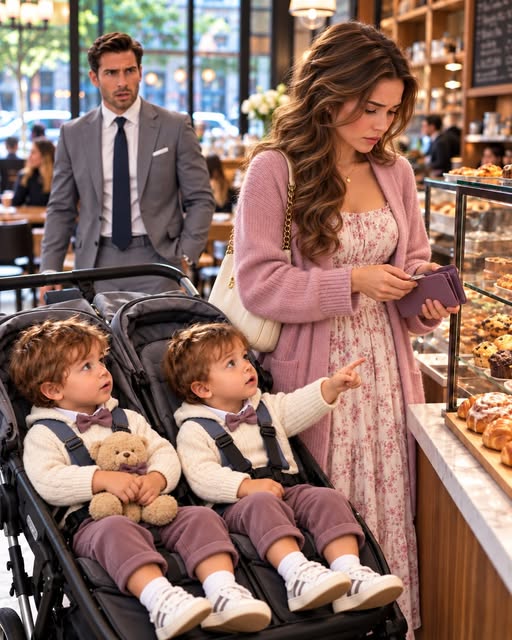
One evening, nearly a year after Nathan first saw Emma counting coins in the bakery, the four of them stopped at Mr. Russo’s shop.
The boys pressed their faces to the display case.
“Two cinnamon rolls,” Emma said.
Nathan reached for his wallet.
Emma gave him a warning look.
He stopped.
She counted out the money, then glanced at Mr. Russo.
“Four,” he said, placing two extra pastries in the bag.
Emma began to protest.
He waved her off.
“Friday special.”
Outside, the boys ran ahead with their treats.
Nathan stood beside Emma beneath the bakery’s striped awning.
“I remember watching you count those coins,” he said.
“I remember you pretending not to.”
“I was afraid.”
“Of me?”
“Of what I had lost.”
Emma looked through the window at the empty table where she had once sat with the boys.
“You didn’t lose everything.”
“No,” he said. “I lost time.”
She nodded.
“That can’t be replaced.”
“I know.”
“But it can be honored.”
He turned toward her.
“How?”
“By not wasting what comes next.”
The boys called for them from the sidewalk.
Nathan offered his hand—not assuming, only offering.
Emma looked at it.
Then she took it.
Together, they walked toward their sons.
Above them, the evening sky deepened into blue. Somewhere beyond the first stars, Saturn was rising, ringed and distant, steady in its orbit.
Ethan pointed upward.
“There!”
Noah looked too.
Nathan bent beside them, and Emma stood close enough that their shoulders touched.
For the first time, the future did not feel like something any of them had to force into existence.
It was simply there, waiting to be built carefully, honestly, one day at a time.
– END OF PART 4 - LET SAY YES AND LIKE, SHARE THIS POST IN FACEBOOK SO THAT WE HAVE THE MOTIVATION TO SHARE MORE STORIES