Chapter 1: The Phantom Ringtone
The absolute worst thing I have ever witnessed in my thirty-nine years of life was not on a classified field mission, nor was it in the aftermath of a federal raid. The worst thing I have ever seen was my seven-year-old daughter, Sophie, desperately trying not to cry, because crying had already cost her far too much.
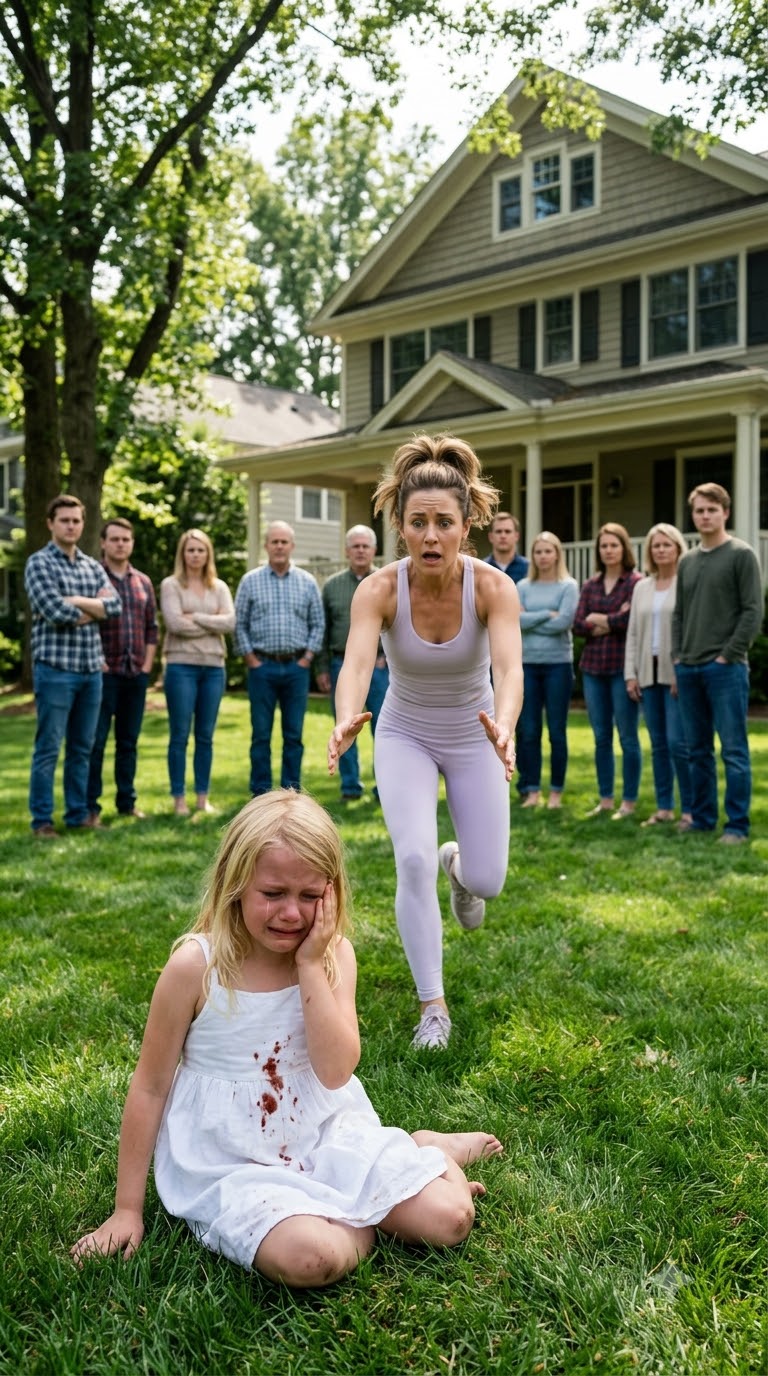
To understand the anatomy of that afternoon, and why eleven members of my ex-husband’s family eventually formed a human barricade around my SUV, I have to rewind the tape. I have to go back to the exact moment the phone rang.
It was a Tuesday afternoon. The air in my kitchen smelled of roasted coffee beans and lemon soap. I had just finished rinsing a ceramic mug, the water running hot over my knuckles, when my phone vibrated, sliding half an inch across the granite counter. I glanced at the screen. The caller ID read Owen Ellison, my ex-husband’s younger brother.
That detail alone dictated my immediate response. I swiped the screen and brought the phone to my ear before it could ring a third time. Owen never called me. In the two years since my divorce from Grant Ellison, Owen and I had exchanged perhaps three polite nods at neutral drop-off locations. We did not chat. We did not text.
“Mara,” he murmured. His voice was pitched so low, so reedy and compressed, that for a split second, I thought the cellular connection was failing.
“Owen?” I asked, turning off the faucet. The sudden silence in the kitchen felt heavy. “What is it?”
“You need to come get Sophie.”
I set the wet mug down on the drying rack. A cold, metallic dread began to pool at the base of my spine. “What happened?”
A suffocating pause stretched across the line. I could hear the faint, muffled sounds of a chaotic environment bleeding through the receiver—the sharp cadence of overlapping voices, a door slamming, someone cursing.
“Then?” I pressed, my voice hardening.
“She got hurt.”
“Define ‘hurt’, Owen. What does that mean?”
Another agonizing hesitation. In the background, a sharp, authoritative voice—a voice I recognized instantly as Grant’s older brother, Caleb Ellison—barked Owen’s name.
“Owen?” I demanded, abandoning any pretense of politeness.
“She hit her face.”
“How?”
“I just… I think you should just come here right now.”
My fingers clamped around the phone casing, turning my knuckles white. “Put Grant on the phone. Now.”
“He’s busy.”
“Busy with what?”
Owen swallowed audibly. He didn’t answer.
That was the precise fraction of a second where I stopped hearing a disorganized family disagreement and started hearing a controlled, active scene. For sixteen years, I had worked inside a specialized federal recovery unit—a ghost division that never appeared on any public government roster. I had spent my entire adult life training myself to ignore the surface noise of a crisis and listen strictly to the underlying frequency. People panic. People exaggerate. People obscure facts for a myriad of reasons that have absolutely nothing to do with physical danger.
But they also withhold information when they are actively trying to buy time.
I snatched my car keys from the ceramic bowl by the door. “Is Sophie conscious?”
“Yes.”
“Is she bleeding?”
“A little.”
“Can she speak normally?”
Dead silence on the line.
“Owen!”
“Not… not really.”
I was already out the door, the deadbolt clicking shut behind me. The drive from my driveway to Grant’s sprawling suburban house usually took seventeen minutes. For the average person running an errand, seventeen minutes is a blip, a forgotten fraction of a day. But when your child has suffered an undisclosed facial trauma, and a house full of adults is collectively refusing to tell you the narrative of that trauma, seventeen minutes expands into a torturous eternity.
I merged onto the highway, my pulse hammering a frantic rhythm against my collarbone. I dialed Grant’s number. It rang to voicemail. I dialed again. Voicemail. On the third attempt, the call was actively rejected after a single ring.
That was the exact moment the icy dread in my stomach crystallized into something entirely different. It turned into a ruthless, surgical focus. Training can do that. It compartmentalizes the mother and awakens the operative.
Grant and I had shared custody for twenty-four months. I had agreed to it because I fundamentally believed Sophie deserved an unhindered relationship with both of her parents, even if my marriage to her father had collapsed into ash. I had spent those two years swallowing my pride, biting my tongue, and refusing to turn every minor parenting discrepancy into a scorched-earth legal battle. The Ellisons called my behavior “cooperation” whenever it served their agenda.
As the manicured lawns of Grant’s subdivision came into view, I was finally beginning to understand that they had profoundly mistaken my diplomacy for weakness.
I’m coming, Sophie, I thought, my foot pressing harder on the accelerator. I’m coming.
I whipped around the final corner, the tires of my SUV screeching faintly against the asphalt. What I saw waiting for me in the driveway made my blood run instantly cold.