Chapter 2: The Hearth and the Hound
There were far too many vehicles. Grant’s silver truck was parked at an aggressive angle. Caleb’s lifted black pickup sat menacingly near the garage. I spotted the beige sedan belonging to their mother, Diane Ellison, along with two other SUVs I recognized from suffocating Thanksgiving dinners, and several more cars choked the curb. The entire clan had been summoned.
I shoved the transmission into park and threw my door open before the engine had even fully settled. The heavy, humid afternoon air hit me like a physical blow.
The front door of the house cracked open before my boots hit the porch steps. Owen stood in the threshold. He looked pale, his eyes darting nervously toward the interior of the house, then back to me. His face, etched with a coward’s regret, told me the catastrophic truth before a single syllable was spoken.
“Mara,” he whispered.
“Where is she?” I didn’t yell. I didn’t have to. The tenor of my voice made him flinch.
He stepped aside. I crossed the threshold into the suffocating heat of the Ellison family room.
I found my daughter exactly where she had fallen. Sophie was crumpled on the hardwood floor beside the jagged, exposed stone hearth of the fireplace. Her knees were pulled into her chest, and one tiny, trembling hand was cupped defensively beneath her chin.
A smear of dark, crimson blood painted the left corner of her mouth, trailing down to her chin. The entire left side of her face was already ballooning, the skin stretched tight and turning a violent, mottled purple. When she heard my footsteps, her glazed eyes shifted to me. She opened her mouth, trying to form the word “Mom.”
The word didn’t make it out. It emerged as a wet, broken gurgle.
And the most horrifying detail? Not a single person in that crowded room was kneeling beside her. Nobody was holding a cold compress to her swelling jaw. Nobody was stroking her hair.
Grant stood a cowardly six feet away, his smartphone clutched tightly in his right hand. Caleb paced near the mantle, his chest heaving, breathing hard and heavy through his nose as if he were the victim who had just been grievously wronged. Around them, an orbit of aunts, uncles, and cousins buzzed, their voices overlapping in a frantic, self-serving chorus.
“She just fell—”
“It happened so damn fast—”
“She was being completely hysterical—”
“Don’t make this a bigger deal than it is, Mara—”
I tuned them out. It was a skill I had perfected in war zones and hostage negotiations. I dropped to my knees beside my little girl, ignoring the chorus of excuses entirely.
Her jaw was visibly, sickeningly out of alignment. The structural geometry of her delicate face was ruined. She could not close her mouth properly; her teeth were hovering at an unnatural, skewed angle. When I gently extended my fingertips to graze the uninjured right side of her face, Sophie flinched. She recoiled so violently that a spike of pure, unadulterated ice drove itself straight through my chest.
Sixteen years of federal tactical training had taught me how to instantly recognize when a volatile situation had crossed the invisible perimeter from ‘bad’ into ‘irreversible.’
This had crossed the line.
Then, Sophie did something that broke my heart into a thousand jagged pieces. She reached out with her uninjured arm and grabbed my sleeve. Not my hand. She grabbed the fabric of my jacket sleeve. She held it with a terrified, white-knuckled grip, looking up at me with wide, frantic eyes, as if she believed that clinging to me too directly, too affectionately, might earn her another punishment.
That profound, conditioned terror frightened me infinitely more than the blood pooling on the floorboards. I still possessed no factual data regarding the timeline of events prior to my arrival. I only possessed the immediate evidence: Caleb had struck my child. Grant had stood by and watched. And somehow, every single adult occupying this suffocating room was entirely focused on managing my perception of the narrative rather than calling for a goddamn ambulance.
Grant finally found the nerve to meet my gaze. “Mara. You need to just calm down. We can talk about this.”
I stared at him. The sheer audacity of that sentence—you need to calm down—told me everything I needed to know about his priorities. He was managing a PR crisis; I was managing a medical emergency.
I leaned down, sliding my left arm firmly behind Sophie’s trembling back and scooping my right arm beneath her knees. She whimpered a high, thin sound of agony when I lifted her weight against my chest.
Grant stepped forward, raising a hand. “Wait. Put her down. We need to talk about this first as a family.”
“No,” I said, my voice eerily flat. “She needs a trauma center.”
From behind Grant, Caleb let out a short, derisive bark of laughter. It was a cruel, ugly sound. “What she needs is some actual discipline. She’s spoiled rotten.”
I stopped walking.
I paused for precisely half a second. My muscles locked. Every lethal instinct I had ever buried deep beneath suburban PTA meetings and cooperative co-parenting schedules screamed to drop my child safely on the sofa and shatter Caleb’s jaw with my heel.
But then I looked down. Sophie’s tear-filled, terrified eyes were locked onto my face. She wasn’t looking at the monster who hit her, nor the father who allowed it. She was looking at me. Her anchor. Her escape.
So, I swallowed the violence. I adjusted her weight in my arms, and I kept walking.
I pushed through the front door, the oppressive heat of the afternoon washing over us again. But I wasn’t alone. Footsteps echoed heavily on the wooden porch behind me. First Grant, then Caleb, then Diane, and finally the echoing shuffle of the extended family.
By the time I carried Sophie down the driveway and reached the side of my SUV, the footsteps had spread out like a deployed tactical unit, fanning across the concrete. I pulled the passenger door open, moving with deliberate, agonizing care as I eased my daughter into the leather seat.
“Stay right here with me, sweetheart,” I whispered, buckling the belt across her chest.
She offered one tiny, trembling nod.
I closed her door and turned around. The breath hitched in my throat.
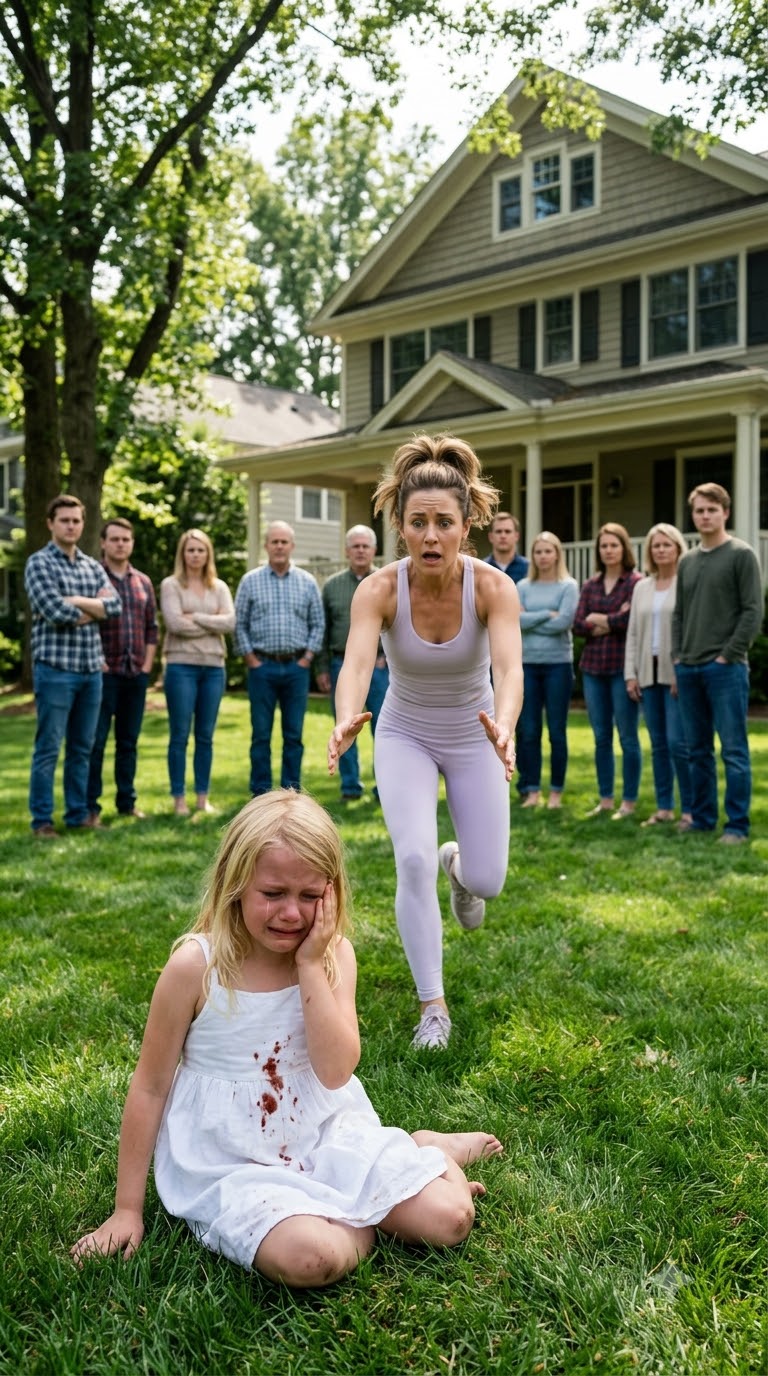
Eleven people. Eleven grown adults had quietly, seamlessly arranged themselves around the perimeter of my vehicle. It wasn’t a perfect, cinematic circle. A perfect circle would have implied a rehearsed choreography. This was organic. This was infinitely worse.
Two burly cousins stood aggressively near the front bumper. Three aunts formed a wall along the passenger side, blocking Sophie’s door. Caleb leaned casually against the hood, his arms crossed over his chest, his eyes mocking me. Diane stood directly behind him, her face a mask of faux-maternal concern. And Grant? Grant stood dead center, wedging his body firmly between me and the driver’s side door.
The remaining relatives plugged the gaps. It was a tapestry of different faces, all radiating the exact same silent, unified message.
Grant lifted his chin, puffing out his chest. “You’re not leaving with the girl, Mara.”
For the first time since I had crossed the threshold of that house, the frantic overlapping shouting had ceased. The silence in the driveway was deafening. Eleven sets of eyes were locked onto me.
They were waiting to see what the frantic, outnumbered mother would do next.