Chapter Five: The Siege of Maplewood Terrace
By Sunday afternoon, the telephone had ceased to be an instrument of communication; it had become a siege engine.
The news that an official investigation had been opened had rippled through the Mercer family grapevine with the speed of an oil fire. In the warped mythology of my extended relatives, the crime wasn’t that a grandmother had brutalized a six-year-old until her skull parted; the crime was that I had reported it.
At 10:15 AM, my Aunt Beatrice, my mother’s older sister, called from Florida.
“Natalie,” she began, not bothering with a greeting, her drawl thick with righteous condescension. “Your mother called me in tears. She is hyperventilating so hard she can barely speak. Have you lost your absolute mind?”
“Good morning, Aunt Beatrice,” I said, setting my coffee cup down on the kitchen counter next to my legal pad. “Did Mom tell you that Ava needed seven surgical staples in her head?”
“Children fall, Natalie! When you were four, you fell off the porch swing and split your chin wide open! Did I call the sheriff on your mother? No! We put butterfly bandages on it and prayed over you! You don’t drag a sixty-two-year-old church-going woman into a criminal database over a domestic accident! It’s ungodly!”
“She didn’t fall from a swing, Beatrice. Mom threw her against an oak sideboard because Ava asked to call me.”
“That is a lie!” Beatrice hissed. “Your mother would never do such a thing! Ava is confused! Children that age will say whatever the doctors want them to say to get attention! You are letting some socialist state agency destroy your family’s good name!”
“My family’s good name,” I replied, feeling a cold smile touch my lips, “is sitting in my living room with seven metal clips in her skull. Don’t call this house again.”
I hung up and blocked the number.
Ten minutes later, my cousin Greg texted: Nat, you need to pull this report back. Mom’s church group is already talking. If Linda gets arrested, it’s going to affect all of us in town. Think about the family.
I didn’t reply. I took a screenshot, saved it to a cloud drive labeled EVIDENCE, and blocked him too.
Then came the voicemail from Linda herself.
Her voice wasn’t tearful anymore. The performance of the grieving, misunderstood elder had dropped away, replaced by the guttural, tyrannical fury that had ruled my childhood.
“You listen to me, you ungrateful, malicious little bitch,” the recording spat through the speaker, so loud Daniel could hear it from the kitchen sink. “You think you’re so smart with your corporate spreadsheets and your high-and-mighty parenting rules. I gave you life! I put clothes on your back when your father left us with nothing! I disciplined that child because you and that grease-monkey husband of yours are raising a disrespectful, insolent brat! I had every right to correct her! If she hit her head, it was because she fought back against my hand! Her blood is on her own head, and if you let those people come into my home, I swear to God, Natalie, I will drag you through every court in this state until you don’t have a penny left to your name! You will rot in hell before I apologize to you!”
Click.
Daniel dried his hands on a kitchen towel. He walked over to the table, took my phone, and plugged it into his laptop, immediately transferring the audio file to an external hard drive.
“That’s evidence of intent, intimidation, and an admission of physical battery,” Daniel said quietly. His calm was absolute, terrifying in its stillness. “The prosecutor is going to love this.”
“She thinks she’s untouchable,” I whispered, staring down at my hands. They were steady now. The trembling had stopped somewhere around midnight. “She has lived her entire life believing that family loyalty is a legal immunity agreement.”
“It isn’t,” Daniel said.
At 2:00 PM, there was a knock at the door. Not the frantic, pounding assault of my mother, but a firm, measured three-beat rap.
I walked to the entryway and looked through the peep-sight.
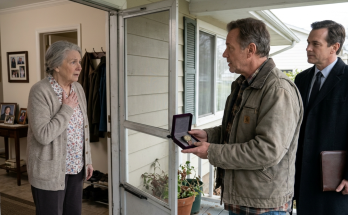
Standing on the porch was Detective Miller from the county sheriff’s department, accompanied by Marcus Vance, the child safety investigator from the hospital. Behind them, idling at the curb, was a marked patrol car.
I took a deep breath, smoothed down my sweater, and opened the door.
“Mrs. Mercer?” Detective Miller asked, tipping his hat. He was a broad-shouldered man with weary eyes and a leather notebook tucked into his belt. “We’re here about the incident on Saturday afternoon.”
“Please come in, gentlemen,” I said, stepping aside. “I have the clothing, the medical logs, the recorded voicemails, and the names of every individual who has attempted to tamper with my daughter’s testimony ready for you.”
Marcus Vance looked at me, a subtle, approving nod passing between us. “You’re organized, Mrs. Mercer.”
“I’m an accountant, Mr. Vance,” I said, leading them into the dining room where my files were arrayed in chronological order. “I don’t leave room for discrepancies.”