The Architecture of Silence
Chapter 1: The Zero-Balance Dawn
The digital payment console emitted two shrill, rhythmic chirps that sounded absurdly festive against the sterilized hush of the corridor.
Behind the laminate partition, the billing coordinator didn’t look angry; she looked practiced. Hers was the specific, rehearsed sympathy reserved for individuals encountering catastrophe under harsh overhead neon. It was the face people put on when they are about to explain that an institutional barrier stands directly between you and your dignity.
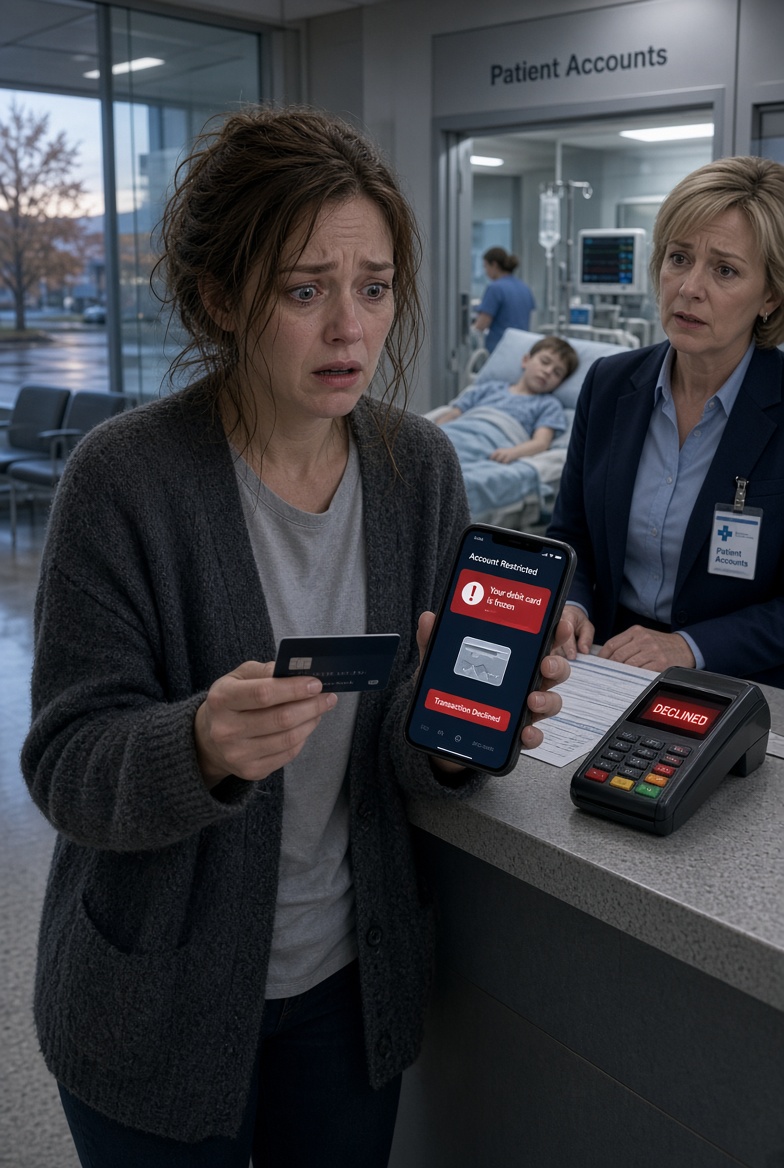
“I am so sorry, Mrs. Whitmore,” she said, her voice dropping into a calibrated register of clerical condolence. “The terminal indicates that the transaction cannot proceed. It specifies an administrative restriction. The primary account holder placed an explicit lock on all outbound debits approximately twenty minutes ago.”
I stood anchored to the speckled linoleum at the patient accounts desk of St. Michael’s Hospital in Ottawa. I was thirty-four years old, and my clothes smelled of scorched vegetable oil and panic. I was wearing an oversized wool cardigan I had dragged off the peg by the garage entryway at a quarter past two in the morning, when the small, agonizing sound of my nine-year-old son hitting our slate kitchen floor had jolted me out of shallow sleep.
My hands, rested flat upon the formica counter, were remarkably still. That calmness did not stem from poise; it was the eerie, suspended balance that occurs inside a vacuum before glass gives way to pressure.
“Could you run it once more, please?” I asked. My tone sounded detached, almost polite. “There might have been a routing delay. My son was wheeled out of the operating room less than forty minutes ago.”
She nodded without arguing, her fingers clacking across the rubberized keys with swift efficiency. She swiped the plastic again. The machine paused, digested the magnetic strip, and emitted the exact same double-tone refusal.
“The block is active at the source,” she murmured, turning the screen slightly away so I wouldn’t have to endure looking at the red alphanumeric error code. “Do you have an alternate card? A secondary checking line, or perhaps you could execute an instant transfer through your mobile banking portal?”
A secondary checking line.
The phrase fluttered in the air between us like dry parchment. My legal name was Vivian Beauchamp. I held a master’s degree in strategic communications from McGill University—an asset that had remained neatly folded inside a cedar trunk for six years while I managed parent-teacher rosters, kept inventory of furnace filters, and made sure my husband’s bespoke shirts were returned from the cleaners without starch.
And at that exact second, the sum total of my personal wealth in the world was forty-three dollars and twelve cents.
It was stored inside an obscure credit union account I had opened eighteen months earlier during a sudden, unprompted surge of nausea while standing in line at a grocery store. Over seventy-four weeks, I had deposited five dollars here, eight dollars there, taking cash back from purchases of laundry detergent and rotisserie chicken. I had squirreled that pocket money away without ever admitting to myself why I was doing it. I had called it an emergency cushion, but in the dark corridors of my mind, where I refused to let my thoughts linger, I knew it was something else: escape money.
Forty-three dollars.
The surgical balance, mandatory deposit, and specialized pediatric post-operative care fee required by the facility totaled four thousand two hundred dollars.
“Give me just five minutes, please,” I said. “I need to step outside to make a call.”
“Take your time, Mrs. Whitmore,” she replied softly. “We won’t move him from the post-anesthesia bay until the paperwork is cleared, but take your time.”
I walked toward the sliding automatic doors that opened into the damp October dawn. The chill outside was sharp, carrying the scent of rotting maples, wet pavement, and the metallic breath of early morning commuter traffic crawling toward the Queensway.
Six hours earlier, at 1:47 a.m., Eli had materialized at the foot of my mattress like an apparition. He was bent nearly double, his small hands clutching his lower right abdomen as if trying to keep his insides from tearing apart. His skin had the sickly gray pallor of damp sidewalk chalk. Eli was a boy who took an absurd, heartbreaking pride in stoicism; when he had fractured his collarbone falling from the neighbor’s cedar swing two summers ago, he hadn’t shed a tear until the paramedic touched the bone. But last night, he was shuddering, tears tracing clear lines through the cold perspiration on his cheeks.
“Mom,” he had whispered, his teeth chattering against each other. “My stomach is on fire. It hurts so bad.”
I had not bothered with shoes. I had shoved his legs into sweatpants, carried his forty-eight-pound frame to our crossover wagon, and covered the eleven kilometers to the trauma center in twenty-two minutes, running two stale yellow lights on Carling Avenue with my hazard flashers pulsing.
By three-fifteen, the pediatric surgical fellow had pressed two fingers into Eli’s lower quadrant, pulled back, watched my child seize with rebound tenderness, and immediately paged the OR team. Acute appendicitis. Perforated. We were already dancing along the edge of systemic infection.
Between three-twenty and five in the morning, while my son lay cut open under halogen luminaires with stainless steel clamps holding his abdominal wall apart, I sat beneath the fluorescent glare of the family waiting alcove and dialed my husband’s phone eleven times.
Eleven.
Not once did the line roll through the normal four rings that signify a caller out of range or a dead battery. Every single call terminated abruptly after precisely two buzzes—a click, followed by the synthetic lilt of the carrier’s automated message.
It meant his thumb was resting on the screen. He was watching my name illuminate the display in the dark, and he was deliberately flicking the red button to divert me to voicemail.
He knew our son was ill. He knew I had dragged the child into the night.
After the fourth attempt, I had sent a text: Eli collapsed. Suspected rupture. We are at St. Michael’s ER. He is going into surgery right now. Answer me.
At four o’clock: They are operating. Craig, please pick up.
At four-thirty: He is in theater. Where are you?
Each message was promptly stamped with two subtle, slate-colored check marks that transitioned into glowing, merciless blue within seconds of delivery. Read. Acknowledged. Dismissed.
I had not broken down in that waiting area. I had leaned my skull back against the vinyl wall covering and stared at the wall clock, listening to the tiny mechanical shudder of the second hand as it crept from 3:10 to 5:48. During those two hours and thirty-eight minutes, something fundamental within my chest did not break—it hardened. It calcified into an unyielding, crystalline structure.
When the chief surgeon finally emerged through the double swinging doors, his surgical scrubs spattered with saline, his face lined with fatigue, he had pulled down his mask and delivered the miraculous words: “We retrieved it before the peritoneal contamination spread. He’s tough, Mrs. Whitmore. He’s going to be completely fine.”
The relief had hit me with such violent physical force that my knees buckled. I had caught myself on the frame of an emergency cart, my forehead pressed against cold steel, drawing in great, shuddering mouthfuls of hospital air.
And then, precisely four minutes later, at 6:04 a.m., my smartphone had vibrated in my palm.
It wasn’t an inquiry about our son’s survival. It wasn’t an apology.
It was an automated push notification from the centralized banking dashboard of the account that governed our entire domestic existence:
ALERT: Account holder C. Whitmore has initiated a temporary administrative freeze on debit card ending in -4471. Outbound activity suspended effective 06:04 EDT.
I stood outside the hospital entrance in the gray light, reading the notification until the screen dimmed to charcoal. Craig had deliberately sat in the quiet of his morning, monitored his phone just long enough to ensure the surgery was over, and then pulled the financial rug straight out from beneath my feet.
The timing wasn’t an oversight. It was an execution.