Chapter 4: Elgin Street Revelations
Friday morning broke cold, damp, and mercilessly gray over the capital.
I left Eli under the watchful eye of a senior nurse named Miriam, whom I had known since my father’s illness. I had tipped the hospital orderly twenty dollars to ensure fresh ginger ale was brought to his room every two hours, kissed my son’s warm forehead, and taken the bus down Bank Street to the heritage commercial district.
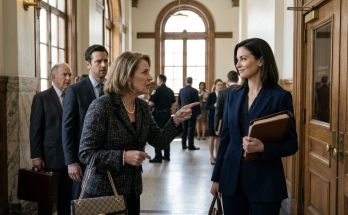
Maureen Okafor’s legal chambers occupied the second floor of a restored Victorian stone building on Elgin Street. The reception area did not boast glass installations or trendy Scandinavian furnishings; it smelled of beeswax, calfskin bindings, old wool, and institutional authority. Floor-to-ceiling mahogany shelves held leather-bound editions of the Ontario Law Reports dating back to the late nineteenth century.
Maureen sat behind an immense, unvarnished oak partner’s desk that had once belonged to her grandfather. At sixty-six, she was striking—iron-gray hair woven into a tight crown braid, skin the color of dark roast coffee, and slate-colored eyes that seemed capable of detecting a misplaced comma through a lead vault.
She didn’t offer empty condolences. She pushed a steaming porcelain mug of black Earl Grey tea toward me, accompanied by a small plate of butter biscuits, and gestured to the leather chair across from her.
“Drink,” she commanded. “You look like you’ve spent forty-eight hours breathing industrial disinfectant.”
I took three sips of the tea, feeling the warmth cut through the persistent chill that had lodged behind my breastbone. “Tell me what my father did, Maureen.”
Maureen opened a forest-green dossier bound with red cotton tape. She adjusted her silver-framed reading glasses and laid out three separate legal instruments upon the green desk blotter.
“When your husband approached your father seven years ago requesting expansion capital to absorb his boutique property agency into the Beauchamp commercial umbrella, Gordon agreed on one condition,” Maureen began, her manicured finger tapping the first document. “Craig believed he was dealing with an aging timber merchant who had made lucky investments in suburban strip malls. Craig was, to put it charitably, an arrogant young man blinded by modern private-equity jargon.”
She slid the first document toward me. It was titled: Amended Articles of Incorporation: Beauchamp-Whitmore Holdings Ltd.
“Your father did not provide Craig with a direct capital infusion,” Maureen explained, her voice steady and clinical. “He established a two-tiered corporate architecture. The operational entity—the company that manages the commercial leases, collects tenant fees, and signs vendor contracts—is Whitmore Operations Group Inc. Craig is the Managing Director. He draws a generous salary, has a discretionary vehicle allowance, and exercises day-to-day administrative authority.”
“And the parent company?” I asked.
“The parent entity is Beauchamp-Whitmore Holdings,” Maureen replied, turning the page. “The parent entity owns one hundred percent of the voting preferred shares of the operational subsidiary. It holds the title to every single physical property in the portfolio—the medical plaza in Kanata, the industrial park in Nepean, and the three residential towers on Baseline Road. Craig owns zero percent of the holding company. When your father passed away last year, his sixty percent majority holding did not pass through probate into joint marital property. It passed directly into an irrevocable testamentary trust.”
She tapped a red wax seal at the bottom of the page.
“The sole beneficiary and executor of that trust is you, Vivian. Not you and your spouse. You alone, under your legal maiden name, Beauchamp.”
I stared at the black ink. The signature at the bottom was unmistakably my father’s—broad, heavy, penned with the fountain pen he had carried in his breast pocket for forty years.
“Why didn’t he tell me?” I whispered, my vision blurring slightly. “Why did he let me sit there for years while Craig made me feel like an indigent guest in my own home?”
“Because your father knew men like Craig,” Maureen said, her eyes softening with rare, fierce tenderness. “Gordon knew that if you were handed this power while your heart was still invested in being Craig’s wife, you would have signed it away to keep the peace. You would have surrendered the shares to make him feel important, to stop his sulking, to preserve the illusion of a happy suburban home for Eli.”
She leaned forward, resting her forearms on the desk.
“Your father told me: ‘Maureen, my Vivian is patient, and she is loyal to a fault. She will endure a great deal of coldness because she thinks love requires enduring the winter. But a day will come when Craig touches something she loves more than peace. When that day comes, she will need an armory, not an apology. Keep the doors locked until she asks for the key.’“
A tear broke over my lashes, tracing a hot, silver path down my cheek. I brushed it away with the back of my hand.
“He froze the card while Eli was under the knife,” I said, my voice dropping an octave.
“I know,” Maureen said. “And in doing so, he made his critical error. Because Craig’s employment contract as Managing Director contains three specific clauses that your father personally insisted upon.”
She turned to the second document.
“Clause 14-B: The Fiduciary Standard. Clause 18: Discretionary Expenditure Audits. And Clause 22: The Moral Turpitude and Ethical Compliance Covenant.”
Maureen smiled—a cold, razor-edged expression that held zero humor.
“As the sole trustee of the parent holding company, you hold the legal authority to order an unannounced, forensic audit of the operational subsidiary’s accounts at any moment, without notice, and without board consent. Furthermore, if that audit reveals material diversion of corporate resources for non-business, personal gratification exceeding twenty-five thousand dollars, the holding board—which consists of myself, retired Justice Thomas Sterling, and you—has the power to summarily suspend Craig Whitmore’s managing directorship with immediate forfeiture of all unvested options.”
“He used the corporate card for Château Montebello,” I said. “Patricia confirmed he pre-authorized the entire suite stay, including fine dining and private resort services, through the strategic development expenditure line.”
“Montebello is the tip of an iceberg that has been drifting through the accounts for over a year,” Maureen murmured, opening a manila folder filled with preliminary spreadsheet analyses. “I’ve been monitoring the quarterly corporate tax filings. The operational subsidiary’s miscellaneous travel and entertainment ledger has swelled by four hundred percent since last November. That coincides precisely with the arrival of Ms. Renée Fontaine.”
“Can we freeze him out?”
“We can do far more than freeze him out, Vivian,” Maureen said, pulling a heavy brass desk pen from its holder and offering it to me. “We can strip him of his administrative authority, seize his company-issued vehicle, repossess the master keys to the Elgin Street offices, and refer any fraudulent invoices to the commercial crimes section of the police.”
I took the pen. The polished brass felt heavy, cold, and perfectly balanced in my hand.
“If I sign this,” I said, looking out the window toward the gray spires of the Parliament Buildings in the distance, “he will burn down everything he can reach. He will try to poison Eli against me. He will tell everyone in this city that I am an unstable, vindictive housewife attempting to ruin a successful businessman.”
“Let him try,” Maureen said quietly. “A man who fights with lies always makes the mistake of assuming the other person will play by the rules of polite conversation. Gordon Beauchamp did not build an empire by being polite to thieves. Sign the instruction, Vivian. Let us take back your father’s house.”
I pressed the nib to the thick paper and signed my name: Vivian Beauchamp.
Not Whitmore.
Beauchamp.