The Price of Admission
Chapter 1: The Seventh Shirt
The chronicle of my own marital coup d’état began, as these domestic tragedies often do, in the blindingly fluorescent aisles of a suburban department store.
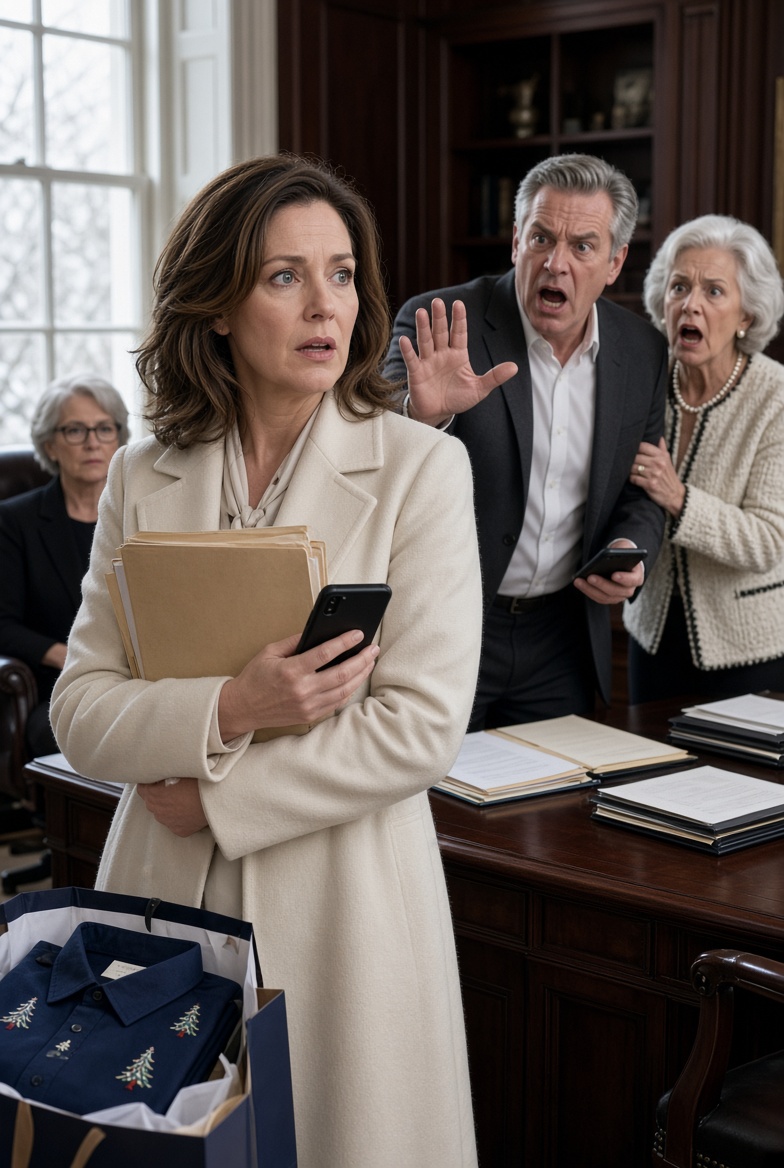
“What size shirt does your mother actually wear?” I asked, my cell phone wedged precariously between my ear and my shoulder. I was standing dead center in the women’s apparel section of Kohl’s, my arms heavy as I draped seven identical, freshly pressed Christmas shirts over the metal rim of my red plastic shopping cart.
“I found these matching ones,” I continued, speaking to my husband, Mark, who was supposedly at his office. “Nothing too obnoxious or cheesy. Just a tasteful navy blue with little embroidered Christmas trees across the chest. I grabbed one for everybody in the family, but for the life of me, I can’t remember if your mom wears a medium or a large these days.”
There was a pause on the line.
It wasn’t a normal, conversational pause where someone is simply retrieving a piece of information from their memory. It was a heavy, suffocating silence. The kind of silence that has a distinct texture.
“Mark? I’m standing right here in the aisle. Medium or large?”
I heard voices murmuring in the background on his end. The distinct, porcelain clatter of dinner plates being stacked. Someone, a woman, let out a sharp, genuine laugh. Then, cutting through the ambient noise, I heard the unmistakable voice of my mother-in-law, Diane.
“Don’t even bother,” she said.
I straightened my spine, my grip tightening on the plastic handle of the cart. “What was that?”
His mother’s voice filtered through the receiver again, much clearer this time, lacking any attempt at discretion. “Tell her we already did Christmas yesterday.”
For a fleeting, disorienting second, my brain scrambled for a logical explanation. I genuinely thought she was referring to some senior citizen church function. Diane belonged to three separate community committees and attended enough festive holiday luncheons to legally qualify as a seasonal employee.
“What does she mean, you ‘did Christmas’?” I asked, my voice dropping an octave.
Mark expelled a long, heavy sigh. That specific sigh bothered me almost as much as the words themselves. It was the exasperated exhalation of a man who felt he was being forced to explain something incredibly tedious to a slow child.
“Lisa needed to move some things around,” he said, invoking his younger sister’s name as a shield. “Her family had a massive scheduling conflict with the kids’ winter recitals. So, everybody just got together yesterday instead.”
Everybody.
Another hollow pause stretched across the cellular towers.
I looked down at the pile of navy blue cotton sitting in my cart. One for Mark. One for Diane. One for Lisa. Three for Lisa’s husband and teenagers. And one for me.
“Mark,” I said, the blood slowly draining from my face, pooling somewhere in my boots. “Was your mother there yesterday?”
“Well, obviously, Claire. Yes.”
“And Lisa?”
“Yes.”
“And you.”
It wasn’t phrased as a question because it didn’t require an answer. The reality of the situation locked into place with an audible, sickening click.
“You had the family Christmas dinner without me,” I stated, the sheer absurdity of the sentence hanging in the artificially pine-scented air of the department store.
Diane’s voice chimed in again from somewhere near his shoulder. “It was just significantly easier this way.”
I almost let out a bark of manic laughter. Easier.
“You’ve been so terribly busy at work,” Diane justified loudly, ensuring I could hear her self-righteous tone. “And quite honestly, Claire, you never truly enjoy these holiday gatherings the way the rest of us do.”
That was certainly breaking news to me.
I had spent twenty-two years of my life meticulously purchasing their holiday gifts. I was the one who remembered that Lisa’s husband preferred dark chocolate over milk, and that Diane possessed a violent allergy to heavily scented candles. I was the one who stood in line at the post office every January to ensure Diane’s forgotten packages were safely mailed to her winter rental in Florida when she escaped the bitter Ohio snow. Apparently, I had been radiating pure misery for over two decades without my own knowledge.
Mark lowered his voice to a harsh, conspiratorial whisper. “Can we please not turn this into a whole dramatic thing?”
“I am currently standing in a department store, Mark, spending my hard-earned money buying matching Christmas shirts for your entire family.”
“I know that, Claire. But—”
“No,” I interrupted, the tremor finally reaching my vocal cords. “I truly do not think you do.”
He was quiet for a long, agonizing moment. Then, he delivered the fatal blow. He said the quiet part out loud.
“Honestly, Claire? It was just better without you there.”
I didn’t say a single word. There are certain sentences in life that ignite an immediate, fiery rage. And then there are sentences that are so surgically clean, so fundamentally simple in their cruelty, that your mind simply does not know where to file them.
I stood paralyzed, staring blankly at the tiny, embroidered evergreen trees printed across the fabric in my hand.
Finally, I managed to force air through my constricted throat. “Good to know.”
Then, I disconnected the call.
I wish I could write that I experienced some magnificent, cinematic moment of absolute clarity right there, standing between women’s petite and men’s casual wear. I didn’t. I just stood completely still, clutching a large-sized shirt I had thoughtfully selected to accommodate my mother-in-law’s changing figure.
Slowly, methodically, I turned the red plastic cart around and pushed it back toward the customer service desk.
The woman working the register was perhaps twenty-two years old. She wore flashing, plastic reindeer earrings and possessed the hollow, exhausted expression of a retail worker who had been subjected to a looping playlist of Mariah Carey since the week of Halloween.
“Returning all of these?” she asked, eyeing the pile.
“Yes.”
She grabbed her scanner gun. “Was there anything wrong with them?”
I looked at the neat stack of navy blue cotton. “No. Just the wrong family.”
She glanced up at me, her hand pausing over the keyboard. I don’t know whether she truly understood the gravity of my statement, but she possessed the profound wisdom not to pry. Retail workers have witnessed enough of humanity’s dark underbelly; they don’t go digging for more. She swiftly finished the transaction, printed the long thermal receipt, and handed it to me across the counter.
“Merry Christmas to you,” she said softly.
“You too.”
I maintained my composure all the way through the sliding glass doors, across the slush-covered asphalt, and into the driver’s seat of my sedan. Not dramatically. No random holiday shopper passing through the parking lot would have noticed a thing.
I dropped my heavy leather purse onto the passenger seat. I reached forward, attempting to slide my key into the ignition.
I missed the slot.
I pulled my hand back, took a breath, and tried again. I missed a second time. My hand was shaking so violently I couldn’t operate a basic machine.
That was the exact moment the tears finally breached the dam.
I sat there in the freezing car, the engine dead, weeping into my hands as I replayed Mark’s voice in my head. It was better without you. Not Diane’s words. Mark’s. After twenty-two years of marriage, my husband had deliberately attended a secret holiday celebration with his family, intentionally excluded his wife, and his primary grievance was that I possessed the unmitigated gall to notice my own absence.
I have no concept of how long I sat there deteriorating in the cold. Five minutes. Perhaps ten. Eventually, the chill in the cabin forced me to move. I reached blindly into my open purse, searching for a crumpled tissue.
Instead, my fingers brushed against soft cotton.
I pulled it out. It was a seventh Christmas shirt. A size small. The exhausted cashier had completely missed scanning it, and it had somehow been shoved beneath my wallet.
I stared at that stupid, navy blue shirt with its mocking little trees, and a bizarre sound erupted from my chest. I started laughing. I was still sobbing, my face slick with mascara and tears, but I was laughing, too. The sheer, cosmic absurdity of it all was overwhelming.
“You have got to be kidding me,” I gasped to the empty car.
I wiped my face with the back of my sleeve, threw the car door open, and marched right back across the slushy parking lot, back into Kohl’s, with the final matching Christmas shirt tucked firmly under my arm.
The exact same clerk saw me approaching the counter. She looked at the shirt, then looked up at my red, swollen eyes.
“I found another one,” I said, my voice thick. “Apparently, they multiply in captivity.”
That actually elicited a genuine, sympathetic smile from her. She scanned the barcode without a word and handed me a crisp five-dollar bill from the drawer.
This time, when I returned to the sanctuary of my car, I didn’t even attempt to drive home. I picked up my phone and scrolled through my contacts until I found the name Susan Kaplan.
Susan had meticulously handled my late father’s complex estate four years earlier. She was a powerhouse attorney somewhere in her late sixties—practical, brutally calm, and constitutionally incapable of making anything sound more dramatic than it actually was. At that precise moment, tethered to reality by a thread, she was exactly the kind of unshakeable force I required.
Her legal assistant answered the line. Panic seized me, and I almost hung up. Instead, I forced myself to speak.
“This is Claire Bennett. I urgently need to speak with Susan regarding a highly personal matter.”
Susan returned my call exactly ten minutes later. “Claire. I hear it in your voice. What exactly is going on?”
I stared down at the crumpled return receipt resting in my palm. “Susan, I need to know exactly what steps I should take before I leave a marriage.”
She didn’t gasp theatrically. She didn’t press for salacious details about what Mark had done to provoke this. She simply shifted into operational mode.
“Can you be at my office by three o’clock?”
I was sitting in her leather guest chair by 2:45.
I recounted the phone call in the department store. I didn’t include every humiliating detail; I couldn’t bring myself to explain the sheer pathetic nature of the seven matching shirts just yet.
Susan listened intently, her pen hovering over a yellow legal pad. When I finished, she began firing questions with surgical precision. Joint checking accounts, retirement funds, outstanding debts, life insurance policies.
Finally, she arrived at the largest asset. “The house.”
My father had formally transferred the deed of the house directly into my name several months before Mark and I were even engaged. It had remained solely my property, my sanctuary.
Susan folded her hands on her mahogany desk. “Claire, did you ever, at any point in the last two decades, add Mark’s name to the deed, or attempt to refinance the property using his credit?”
“No.”
“Did he ever pressure you to do so?”
That question gave me pause. I searched my memory. “Twice,” I confirmed softly. “He asked twice over the years. And I told him no, twice.”
She nodded approvingly, jotting down a coded note. Then, she removed her reading glasses and locked her eyes onto mine.
“Do absolutely nothing foolish,” she instructed, her tone brokering no argument. “No emptying joint accounts. No hiding physical assets. No dramatically changing the locks on the doors. And absolutely no making massive financial decisions while you are operating under the influence of anger. Right now, your only job is to gather information. That is it. If you decide to move forward, I will personally put you in touch with a vicious family law attorney.”
I nodded, swallowing hard. Suddenly, a wave of profound embarrassment washed over me. I felt like a hysterical fraud.
“Susan,” I stammered, looking at the floor. “Maybe I am completely overreacting to all of this. It’s just… it was just a Christmas dinner.”
She slowly leaned back in her high-backed leather chair, the leather creaking in the quiet room.
“Claire, look at me,” she said gently. “Is this truly just about a Christmas dinner?”
I didn’t answer. I couldn’t, because we both knew the truth.
Susan let the silence stretch before asking the question that would haunt my drive home. “Are you sitting in my office asking me how to legally protect yourself, Claire? Or have you already made the silent decision to leave him?”
I opened my mouth to respond, but nothing came out. The air caught in my throat. Until she phrased it exactly like that, laying the reality bare on the table, I honestly didn’t know the answer.
But as I walked back to my car, clutching a legal pad full of demands, my phone vibrated in my pocket. It was a text from Mark. I read it, and the answer to Susan’s question suddenly became terrifyingly clear.