The Ledger of Lies
Chapter 1: The Cost of a Seat
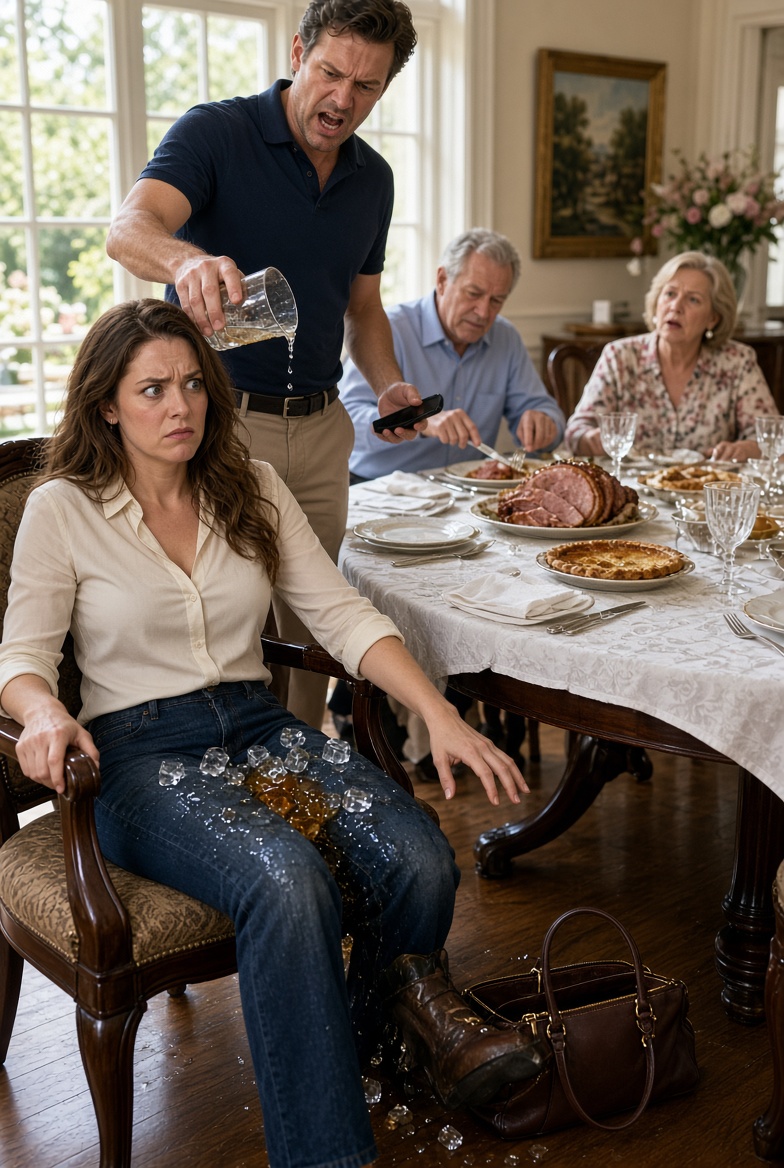
The freezing cascade of sweetened tea soaked through my denim, a deliberate punishment from my older brother just for occupying his preferred seat. A seat located inside the four walls of the property I legally owned.
I am Elara Vance, thirty-six years old, and a professional medical billing auditor. I spend my days finding discrepancies in strangers’ tragedies. I should have known better than to ignore the discrepancies in my own.
The half-melted ice cubes were still cascading off my kneecaps, clattering against the polished hardwood floor, when my father, Arthur Vance, casually extended his heavy boot. With a dull thud, he kicked my leather purse all the way across the dining room.
“Always playing the victim,” he muttered, returning his attention to his plate.
Across the table, my mother, Evelyn, let out a long, theatrical exhalation. “Oh, honey. Stop being so intensely sensitive.”
I didn’t scream. I didn’t cry. I simply folded my linen napkin, smoothing the edges with damp, trembling fingers, and thanked them for the meal. Old habits die screaming. I had spent the entirety of my conscious life apologizing for the absolute audacity of remaining alive.
By the time the sun bled over the horizon the following morning, a crisp, wooden ‘For Sale’ sign was driven deep into the front yard, piercing the heart of my mother’s prized crimson tulips. The physical house, however, was only the first domino to fall.
If anyone you deeply love has ever rolled their eyes and told you to stop being sensitive while you were the one shivering and dripping wet, you know exactly the sigh I’m talking about.
That wooden sign was the very first piece of myself I reclaimed. Tulip season was practically over anyway, but the manicured flower beds lining our idyllic suburban street in Oakhaven were still standing at rigid attention. In a town like ours, a front lawn is never merely grass and soil. It is the community billboard; the page the entire neighborhood reads to decipher your family’s internal temperature.
Earlier that same Mother’s Day, just hours before the tea incident, congregations had spilled out onto the stone steps of the local church. Men in pressed suits stopped my father to read our lawn’s metaphorical status out loud.
“Arthur, you’ve got the old place looking like it never slipped through your fingers,” a deacon had praised.
Arthur had pumped the man’s hand using the two-handed grip reserved for church elders. “The Almighty has been exceedingly merciful to us.”
I had stood slightly behind him, offering a hollow smile, swallowing the truth. My name was etched on the county deed. His name was merely painted on the aluminum mailbox. I had dutifully paid the suffocating mortgage on that structure every single month for five agonizing years. Monday through Friday, I sat in a sterile corporate office in the city, auditing hospital invoices line by excruciating line. But on Sundays, I stepped aside and allowed my father to harvest the public adoration.
Back at the house, Evelyn had the kitchen radiating heat. A glazed ham rested in the oven, yeasty rolls breathed under a checkered dish towel, and a lattice-crust cherry pie was cooling on the sill.
“Happy Mother’s Day, Mom,” I had offered softly.
“Honey, fetch the salted butter,” she had replied without looking up. “After the pie, we’re all going to sit down and have a little family chat.”
“About what?” I asked, a cold knot tightening in my stomach.
“Oh, it’s nothing heavy. We’ll talk after pie.”
That was the precise moment I spotted it. Resting ominously on the mahogany dining room sideboard, squared perfectly against the polished edge, was a thick manila envelope. It was bristling with bright, neon-yellow sticky tabs. Sign here. Sign here.
I possessed the exact same oak table. I had purchased it the very week I bought back the house. The imposing armchair at the head of it had been surrendered to my older brother, Julian Vance, ever since his messy divorce finalized in the autumn and he slinked back to our childhood home. Arthur had proudly surrendered the seat to him.
“A man requires his rightful place,” my father had declared, moving himself to the subordinate corner chair.
Evelyn had waved her carving fork at me. “Sit down, Elara. The glaze is congealing.” She pointed the metallic prongs directly at the head armchair. “Julian won’t mind, sweetie.”
So, I sat.
The porch’s screen door slammed shut. Julian sauntered in, his smartphone illuminating his smug face in one hand, a sweating highball glass of iced tea in the other. He froze two steps into the dining room. The ambient chatter evaporated. Even the rhythmic slicing of the carving knife ceased.
Julian looked at my face, then glared at the chair. He took a slow, predatory walk around the perimeter of the table, moving like a feudal lord inspecting his domain.
“That is my chair,” he stated. “Are you aware of that?”
He didn’t hurl the glass. He didn’t shout. He simply tilted his wrist and emptied the freezing, sugary liquid directly into my lap. It was so shockingly cold it felt like a thermal burn. The liquid saturated my jeans in an instant, pooling into the creases of my hips. My thighs spasmed. My breath hitched in my throat and refused to release.
I didn’t flinch. Decades of conditioning had taught me that reacting only provided them with the dramatic entertainment they craved.
Beside me, Arthur calmly resumed slicing the ham into perfectly even, geometric portions. Across the mahogany, my mother’s fork hovered in mid-air. Two minutes prior, she had specifically directed me to that seat. She conveniently suffered amnesia now.
“Oh, for heaven’s sake,” Evelyn muttered, leaning across the spread to dab at the pristine white tablecloth. The tea had cascaded off my legs, threatening her heirloom gravy boat.
“Julian,” Arthur reprimanded softly, his eyes fixed on the linen. “Mind the tablecloth.”
He looked at the stain. He did not look at his daughter.
When I finally stood up, the ice cubes cascaded onto the floor in a symphony of pathetic, hollow clicks. My purse rested near the chair leg. As I leaned down to retrieve my car keys, Arthur’s leather boot shot out from under the table.
One flat, calculated kick.
My bag skidded across the wax, spun wildly, and vanished beneath the sideboard—coming to rest directly beneath the manila envelope with the neon tabs.
“Always playing the victim,” Arthur whispered. He glanced around the room, waiting for the silent nods of agreement he was so accustomed to receiving at consistory meetings. He had been lobbing that exact phrase at me since I was sixteen years old, bald from chemotherapy, and vomiting in a plastic bucket.
I retrieved my purse, dripping sticky tea onto my own socks. I delivered my rehearsed gratitude for the meal, walked out the front door, and left my family to their pie.
My jeans were still draped over the edge of my apartment bathtub later that night, dripping brown water onto the porcelain. I sat on the closed toilet lid, shivering despite the heat, and texted Martha Hayes, the aggressive, no-nonsense real estate agent who had sold me the property five years prior.
I typed a single word: Tomorrow.
Her reply materialized in forty seconds: Six AM.
The sun was still hiding behind the tree line when I pulled onto my parents’ street. Martha’s SUV was already idling at the curb, her trunk yawning open to reveal a stark, white ‘For Sale’ sign resting atop her spare tire. She was sixty-two, clad in a quilted vest and heavy leather work gloves, wielding a heavy rubber mallet.
“Martha, I apologize for the ungodly hour,” I stammered, stepping onto the dewy grass. “I just need you to understand… I know how terrible this looks. They are my parents. I’m not trying to be cruel—”
She didn’t let me finish. She simply extended the handle of the mallet toward me. “Your yard. The last swing belongs to you.”
I took the rubber grip. I never finished my justification. With one violent, cathartic swing, the wooden stake plunged flush into the dark soil of Evelyn’s beloved tulip bed. A vibrant red bloom was crushed against the post.
It felt like narcotic relief. A profound, physical unburdening, akin to dropping a crate of lead I had been hauling up an endless staircase.
By the time the warm glow of the kitchen light clicked on behind the floral curtains, I was already reversing my car. Martha had been carrying that sign in her trunk for thirteen agonizing days. And those thirteen days of anticipation had all begun with a knock on my apartment door.