Chapter Three: The Triage of Truth
The pediatric emergency department at St. Jude’s Memorial was an assault on the senses—a sterile theater of screeching monitors, harsh antiseptic fumes, and the low, collective groan of human misery beneath cold fluorescent lighting.
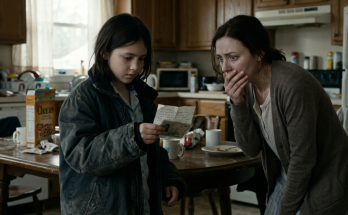
I didn’t take off Ava’s coat in the waiting room. I kept her folded in my lap, feeling the rapid, rabbit-like thump of her heartbeat against my ribs.
When the triage nurse, a middle-aged woman named Elena with tired eyes and graying curls, called our name, she brought us into a small exam booth. I untied the makeshift bandana I had fashioned from a clean dishcloth.
Elena’s demeanor transformed instantly. The bored exhaustion vanished, replaced by an alert, razor-sharp focus.
“What happened here, mom?” she asked, pulling on blue nitrile gloves and gently parting Ava’s blood-soaked hair with wooden tongue depressors.
“I was told she fell,” I said, choosing my words with the precision of an explosive ordnance disposal technician. “At her grandmother’s house. About an hour and a half ago.”
“Did she lose consciousness?”
“They told me no. But I wasn’t there.”
Elena’s eyes flicked to mine for a second. “Did she vomit?”
“No.”
Elena leaned down to Ava’s eye level. “Hi there, Ava. My name is Elena. Can you tell me what game you were playing when you had your big bump?”
Ava looked down at her lap. Her thumbs were working frantically against the seams of her jeans. “I don’t remember.”
“You don’t remember?”
“Grandma said it happened too fast to remember.”
Elena didn’t say another word. She took Ava’s vitals, checked her pupillary response with a penlight, and stepped out of the room. Two minutes later, we were bypassed around seven waiting families directly into an acute trauma examination room.
That was when the heavy double doors at the end of the corridor swung open, and Daniel appeared.
He was still wearing his heavy canvas work boots and his navy technician uniform, grayed at the cuffs with motor oil and drywall dust. His eyes found mine across the room. He didn’t ask silly questions. He didn’t tell me to calm down. He walked straight to the gurney, pressed his rough, calloused palm against Ava’s cheek, kissed her temple right below the bloody matting, and then looked at me.
“Talk to me,” he said.
“Scalp laceration,” I said, my voice finally cracking at the edges. “And this.”
I reached out and lifted the sleeve of the oversized navy sweater, exposing the bruising.
Daniel went utterly still. To someone who didn’t know him, he might have looked impassive. But I knew the tell: a small muscle right along his jawline began to rhythmically pulse like an engine idling under pressure. His eyes darkened into flint.
“Who was there?” he asked, his voice a low, gravelly rasp.
“Mom. And Kelly.”
“Which one?”
“I don’t know yet,” I answered. “Mom claims she grabbed her to keep her from hitting a coffee table.”
Before Daniel could respond, the curtain was pulled back, and Dr. Priya Shah stepped in. She was a slender, sharp-featured woman in her early forties, wearing dark green scrubs and an air of quiet, authoritative composure.
“Hello, Ava,” Dr. Shah said warmly, introducing herself with a quick fist-bump that momentarily broke through Ava’s shell.
For the next ten minutes, Dr. Shah performed an exhaustive physical inventory. She checked the range of motion in Ava’s neck. She felt every vertebrae along her spine. But her examination slowed down when she reached the right arm.
With practiced gentleness, Dr. Shah documented the bruising with a small digital camera. Four circular, distinct contusions on the inside bicep; one wide, deep bruise on the lateral tricep.
“Ava,” Dr. Shah said softly, “did these marks happen when you fell toward the table?”
Ava’s lower lip began to quiver. She didn’t look at Daniel, and she didn’t look at me. She stared down at the paper sanitary runner covering the gurney. “I was bad.”
The room seemed to drop ten degrees.
“What did you say, sweetheart?” I asked, my heart breaking into fragments.
“I didn’t listen,” Ava whispered, tears finally leaking from her lashes, cutting clean tracks through the dried, dusty blood on her cheek. “I wanted to call you, Mommy. Grandma was cooking lunch, and I kept asking for my tablet so I could video-call you. And she told me to shut my mouth and eat my soup. And I said no. I told her that Daddy said nobody gets to tell me to shut up.”
Daniel’s breath caught in his throat.
Dr. Shah gently placed her hand over Ava’s small fingers. “And what happened then, sweet girl?”
Ava pulled her hand back, tucking it tightly under her armpit, curling into a defensive ball on the gurney. “I don’t want Grandma to lose her house.”
The sentence was an absurdity, a non-sequitur ripped from an adult’s nightmare and planted into the brain of a first-grader.
Dr. Shah looked up, meeting my eyes, then Daniel’s. Her expression was completely devoid of professional detachment; it was filled with grim certainty.
“Mrs. Mercer, Mr. Mercer,” Dr. Shah said, standing up. “Could you step with me into the consultation alcove for just a moment? Nurse Higgins will stay right here with Ava and put on the Disney channel.”
We stepped out into the hallway. The fluorescent light seemed violently bright.
Dr. Shah pulled the door closed until only a two-inch gap remained.
“I’m going to speak plainly,” Dr. Shah began, her voice lowered to a confidential murmur. “The wound on her scalp is a blunt-force laceration caused by high-impact contact with a sharp, rigid corner. It will require seven or eight surgical staples. It is not consistent with a simple slip on a rug. The velocity required to produce this depth of tissue separation in a child of her mass suggests either a violent shove or an intentional strike.”
My knees buckled slightly. Daniel’s arm wrapped around my waist like an iron beam, holding me upright.
“And the arm?” Daniel asked, his voice dangerously level.
“Compression contusions from adult hands,” Dr. Shah stated definitively. “Someone grabbed her with tremendous force, hard enough to rupture the subcutaneous capillaries. The child’s statement, combined with the presentation of these injuries, triggers our mandatory reporting protocol under state law. I have already contacted the Department of Children and Family Services and the on-call hospital social worker.”
She paused, looking at me with intense, piercing empathy.
“I know this is your family, Mrs. Mercer. But I have to be unambiguous with you: this was no accident. Someone assaulted your child, and then they attempted to coerce her into silence.”
Before I could breathe, my phone shivered violently in my back pocket. I pulled it out.
It was a text from Kelly.
Mom is in her car heading toward your house right now. Nat, please don’t let them file anything. If the state opens a file on Mom, they’ll pull my provisional daycare certification. My whole career is gone. Tell them she fell at the park. Please, Natalie. Family protects family.
I stared at the glowing glass screen, feeling the last remaining threads of my childhood dissolve into ash.