Title: The Green Light of Betrayal
Chapter 1: The Illusion of Sanctuary
My name is Claire Bennett. I am thirty-four years old, and the moment my entire understanding of reality shattered, I was staring at a tiny, blinking green light.
But to make you understand the gravity of that green light, I have to take you back to the hours before my family fractured. Back to a time when I still foolishly believed that the people who shared my blood were the ultimate safe harbor for my eight-year-old son, Eli.
Rain had just begun to speckle the windshield as I pulled my sedan into the familiar, tree-lined driveway of my childhood home. The wipers hummed a steady rhythm, matching the low, comforting cadence of Eli’s voice from the passenger seat. He was animating a grand vision for a school science project—a chaotic contraption involving cardboard, electrical tape, and a tiny motor he was absolutely certain lived inside my kitchen junk drawer.
“You don’t just have a junk drawer, Mom,” he noted, his tone deadpan as I shifted the car into park. “You have three. That’s practically a junk cabinet.”
“That is a vicious, unfounded accusation,” I replied, feigning deep offense.
It was entirely true, of course. I turned to look at him, and his face broke into a brilliant, gap-toothed smile. That was the essence of Eli. He was literal enough to correct you on a technicality, yet gentle enough to grin while doing it. He was a soft-hearted boy in a world that often demanded hard edges.
Through the rain-streaked glass, my parents’ house loomed exactly as it had for three decades. It was a picturesque suburban fortress. The same wraparound porch. The same pristine front windows. The same heavy, cream-colored dining room curtains that my mother, Diane Bennett, fiercely defended as being “perfectly good” despite being severely out of style.
I sat there with my fingers looped through the keychain, lingering for a second longer than was strictly necessary. A strange, unnamable static hummed in the back of my mind.
Eli noticed the hesitation. “Are we going in?”
“Of course, sweetheart.” I forced a bright smile, though my hand remained stubbornly gripping the keys.
There was no immediate, dramatic reason to dread our weekly Sunday dinner. That was the most insidious part of my family dynamic; it was maddeningly difficult to explain to outsiders. Most of our gatherings were entirely ordinary, mundane even. Mom would cook enough food to feed a small militia. My father, Richard, would grumble that nobody allowed him to carve the roast. My older brother, Mark, would inevitably arrive twenty minutes late, acting as though chronic tardiness was a charming personality trait rather than a lack of respect.
And they loved Eli. Mom doted on him. Dad slipped him extra dessert. I had never once doubted the presence of love in that house. Back then, I operated under the naive assumption that love was the only metric that truly mattered.
Stepping onto the porch, the scent of roasting garlic and damp earth greeted us. We pushed through the heavy oak door. Inside, Diane was already bustling out of the kitchen, a massive ceramic serving bowl clutched in her manicured hands.
“There are my absolute favorites,” she announced, setting the bowl down to press a swift, perfume-heavy kiss to my cheek. She immediately pivoted, swooping down toward my son. “My handsome boy.”
Eli accepted the embrace with a polite nod, though his focus immediately drifted toward the dining room. My father was already stationed at the head of the long mahogany table. Ever since his terrifying fall in the hallway a few months prior, his movements had become slow, calculated, and cautious.
“Come here, kiddo,” Dad called out, his voice a warm, gravelly rumble.
Eli trotted over, leaning into my father’s side. I watched Dad wrap a thick arm around my son’s shoulders, and I felt the familiar, comforting loosening of tension in my own chest. This, I told myself. This is why I keep coming back.
After Dad’s fall, a cold dread had taken up permanent residence in my mind. I lived a town over, worked full-time, and raised Eli single-handedly. Yet, I found myself obsessively calculating traffic patterns, wondering how fast I could break the speed limit to reach their house if he collapsed again. Mom had violently rejected the idea of hiring a part-time nurse, viewing it as an insult to her capability as a wife. Dad had simply laughed off my anxiety.
I had eventually forced a compromise upon them—a small piece of technology that was meant to be my peace of mind. But the true purpose of that device was a secret the house was keeping from all of us.
Just as Mom began her predictable monologue about the potatoes losing their heat, the front door swung open. Mark strolled in, shaking the rain from his jacket.
“Perfect timing as always, Mark,” I remarked dryly, pulling out my chair.
“Thank you,” he replied smoothly, choosing, as he always did, to interpret my sarcasm as genuine praise.
For the first thirty minutes, the evening flowed perfectly. We were the portrait of a functional, happy family. Eli chatted enthusiastically about his cardboard motor. Dad asked probing, genuinely interested questions about the mechanics of it. Mark teased Eli about inevitably becoming a wealthy engineer and financing all of our retirements.
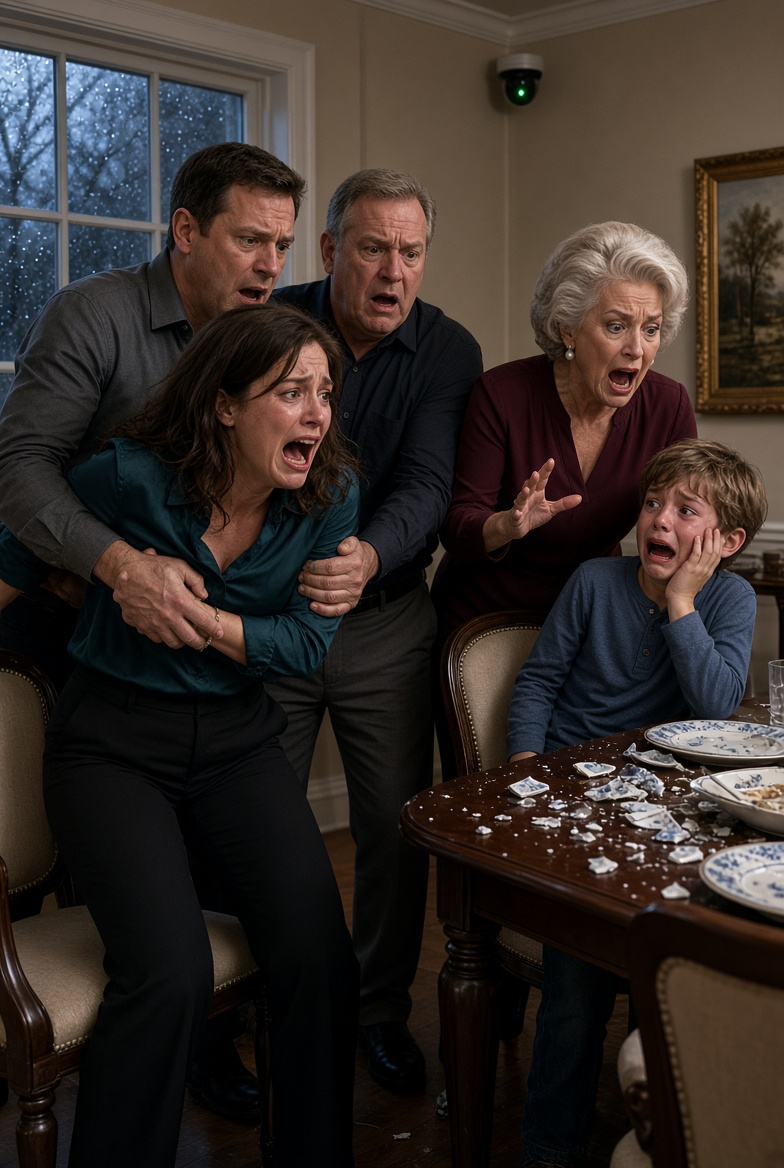
But underneath the laughter, the atmosphere in the dining room was a delicate ecosystem, balanced on the edge of a knife. And it only took a single drop of water to shatter it completely.
Cliffhanger: As Eli reached across the table, his sleeve snagged on something delicate, and the sound that followed would echo in my nightmares for years to come.