Chapter 7: The Unbroken Glass
The institutional consequences of that night moved at a glacial pace compared to the immediate, frantic panic of my family. There were interviews with social workers, tedious documentation of the bruise fading, and endless forms. I handed over the encrypted security footage to the appropriate authorities and strictly followed their psychological guidance regarding Eli.
There was no cinematic climax where a judge slammed a gavel and permanently solved the emotional wreckage of my life. Healing was entirely bureaucratic—waiting rooms, emails, and waking up every single morning having to consciously choose to maintain the boundary, long after the protective adrenaline had evaporated.
Leaving the dining room had taken three minutes. Defending the perimeter took months.
Mom attempted to circumvent the blockade by mailing extravagant gifts to Eli. I marked them “Return to Sender.” Dad sent melancholic letters begging me to reconsider as the holidays loomed closer. I replied with a single word: No.
Protecting Eli was non-negotiable, but what profoundly surprised me was the creeping, insidious nature of grief. I realized, with a heavy heart, that I genuinely missed my mother.
I didn’t miss the tyrant in the dining room, but I desperately missed the version of her who used to make me homemade chicken soup when I had the flu. I missed her chaotic, absurdly over-the-top Christmas decorations. I missed calling Dad for advice when my dashboard engine light flickered on. I even missed Mark’s groan-inducing dad jokes.
My brain constantly tried to present this grief as tangible evidence that I had made a catastrophic mistake. It took intense therapy to learn that holding a boundary and mourning a loss could coexist in the same heart.
Eventually, Dad agreed to meet me at a park, strictly without Mom.
Sitting on the cold green bench, he looked like he had aged ten years in a matter of months. He wore a rumpled coat, his posture defeated.
“I listened to the audio on that recording,” he rasped, watching a group of pigeons fight over a scrap of bread.
I just nodded, waiting.
He rubbed a trembling hand over his face, hiding his eyes. “I sound like a monster, Claire.”
“You told me to let her finish hitting my son.”
“I know.” He swallowed hard, his Adam’s apple bobbing. “You could see him crying. You knew she had struck him. And you physically held me down.”
“Yes.”
For the first time in his life, my father did not follow his admission with the word ‘but’. It was a microscopic victory, but it didn’t repair the shattered glass.
“Claire, I spent your entire childhood, my entire marriage, just trying to keep this family from tearing itself apart,” he pleaded, his voice breaking. “I honestly thought that was my job as a husband and a father.”
“No, Dad,” I corrected him, my voice steady and resolute. “You kept us together around the epicenter of Mom’s anger. You made sure we orbited her without blowing up.”
He looked at me, a profound sadness in his eyes.
“That isn’t the same thing as keeping us safe,” I finished.
He physically flinched as if I had struck him. The heavily conditioned part of my brain screamed at me to rescue him, to hug him and say it was okay. I anchored myself to the bench. I let the truth burn.
“What do I do now, Claire?” he whispered, looking utterly lost.
“I don’t know, Dad. I am busy protecting Eli. What you choose to do with the rest of your life is entirely yours.”
Mom’s confrontation occurred weeks later, entirely over the phone, as she flatly refused to meet in a neutral public space.
“Are you finally satisfied?” was her venomous opening line.
“Satisfied with what, Mom?”
“With orchestrating this entire circus. With having everyone look at me like I’m some sort of abusive monster.”
“I never asked a single person to call you a monster. You provided them with the video of your own actions.”
“You recorded me secretly in my own home!” she shrieked.
“I installed a safety camera that both of you explicitly consented to for Dad’s medical emergencies. It recorded an emergency.”
She breathed heavily into the receiver. “I shouldn’t have slapped him,” she muttered. It was the closest thing to an admission of guilt I had ever heard pass her lips. I held my breath, waiting for the true apology.
“But,” she continued, right on cue, “that child looked me dead in the eye and openly challenged my authority in my own house, Claire! He is eight! You have raised him to believe he can negotiate reality with adults.”
“I raised him to believe he is allowed to tell the truth about an accident.”
“You have turned everyone against me!”
“No, Mom,” I said, leaning back against my kitchen counter, realizing for the first time that my heart rate hadn’t spiked. “I am not the judge of your soul. I am not deciding if you are fundamentally good or evil. I am simply deciding that you are not safe for my son to be around.”
She began to sob. For thirty years, the sound of my mother’s tears was a trigger that commanded my immediate surrender. This time, the sound was just noise.
“What do you want from me?” she choked out. “Do you want me to crawl? Do you want me humiliated?”
I looked down the hallway. Eli’s bedroom door was cracked open, a warm sliver of golden light spilling out onto the hardwood floor. I could hear the faint, happy sounds of a video game.
“No,” I answered quietly. “I just want him safe.”
She had no rebuttal for that.
The first holiday season without them was an agonizing trial. There was no chaotic argument to distract me. No passive-aggressive comments about the turkey. Just an echoing, empty space where lifelong traditions used to reside.
I accidentally cooked enough potatoes to feed an army, purely out of muscle memory. Eli looked at the massive bowl, then at me. “Mom, are twenty people hiding in the closet?”
I barked out a laugh that quickly dissolved into tears. I had to turn my face toward the stove so he wouldn’t see me break.
But later, as we sat at our own small table, the magic of the boundary revealed itself. Eli talked excitedly through the entire meal. Nobody scolded him for how he held his fork. Nobody demanded performative gratitude. Nobody confused his absolute obedience with love.
Months blurred into a year. The apartment finally felt like our undisputed sanctuary. Eli stopped asking if Grandma was going to ambush him at school. The night terrors ceased.
Mark maintained sporadic, respectful contact. We met for coffee occasionally. He never pushed to see Eli, and I never offered. Trust was no longer a default setting in our relationship; it was a currency he had to slowly earn back.
One mundane Tuesday evening, Eli and I were eating dinner. We were having pasta, and he was dedicating a staggering amount of engineering genius to avoid eating his salad. A tall glass of ice water sat precariously near his elbow.
He was in the middle of a wildly exaggerated story about a classmate who claimed to have taught a golden retriever how to do long division.
As he reached across the table for a piece of garlic bread, his forearm caught the edge of the glass.
It tipped. Water cascaded across the table in a tidal wave, splashing violently onto the floorboards. The heavy glass bounced once against the leg of the chair and rolled away.
Eli froze instantly.
Before he could mask it, his face contorted. His shoulders hiked up to his ears. His eyes widened into saucers of pure terror. He was bracing for the explosion. He was an eight-year-old boy desperately calculating which form of groveling would pacify the inevitable rage.
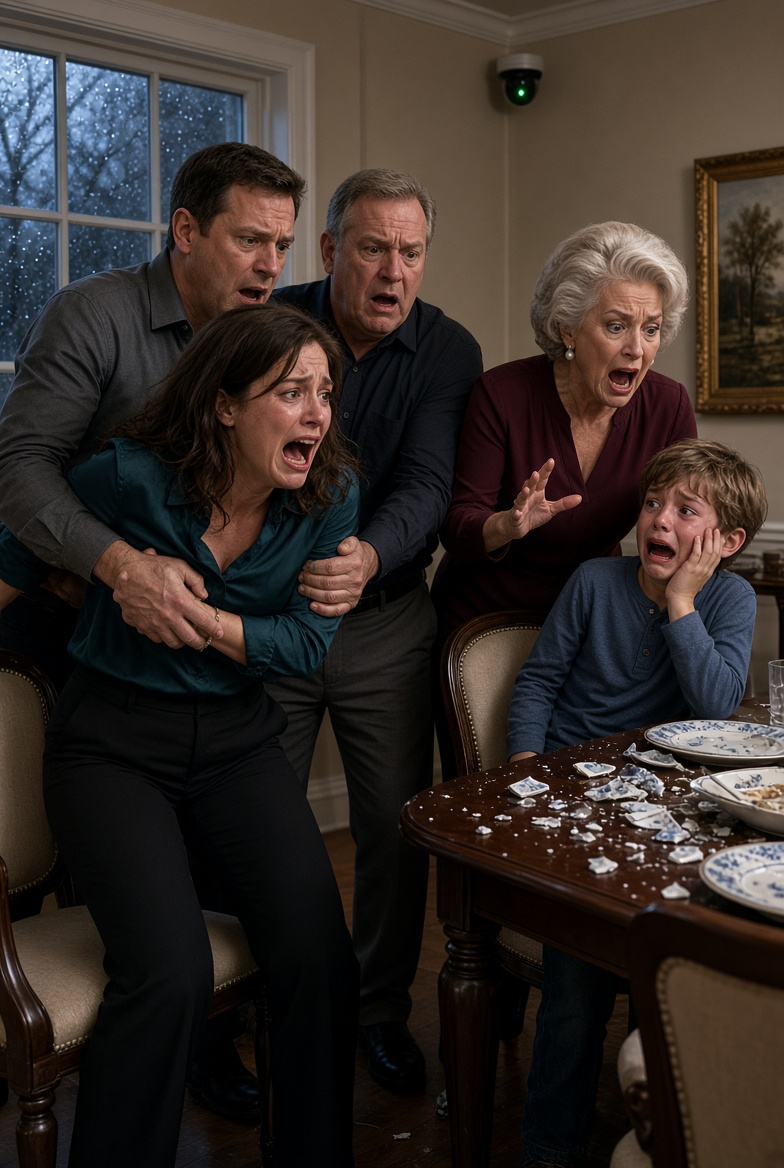
For a fraction of a second, the phantom overlay of my mother’s dining room superimposed itself over my kitchen. I saw the shattered porcelain. I felt my father’s iron grip on my wrists.
Then, I looked at my beautiful, terrified son.
“Hey,” I said gently. “Grab a towel.”
He blinked, his brain misfiring. “That’s it?”
I looked at the puddle steadily dripping onto the rug. “Well, unless you’ve figured out a magic spell to convince the water to climb back into the glass, yes. That’s it.”
The tension drained out of his posture like a deflating balloon. A tiny, incredulous laugh bubbled out of his chest. “I don’t know any spells.”
“Then towel it is.”
He scrambled to the kitchen, returning with two large dish towels. We got down on our hands and knees and wiped up the mess side-by-side.
“Mom… it was an accident,” he whispered, wiping the floor.
“I know it was, buddy.”
“I really should have watched where my elbow was.”
“Probably. We’ll put the glass further back next time.”
He stopped wiping and looked up at me, searching my eyes for any hidden resentment. I offered him a warm, uncomplicated smile.
“A spilled glass of water doesn’t make it a catastrophe, Eli,” I told him.
He smiled back, a genuine, relaxed grin. He tossed the wet towel into the sink, sat back down, and immediately resumed his story about the mathematical dog, completely unburdened.
I sat there, listening to the cadence of his voice, and a profound sense of peace washed over me. For years, I had believed that breaking a cycle of generational trauma would feel like a cinematic triumph. I thought it would be loud. I thought it would require forcing the people who hurt me to finally confess their sins.
But it didn’t.
Triumph wasn’t a confession. Triumph was just water on a table. It was a damp towel in my son’s hand. It was an honest mistake remaining nothing more than an honest mistake.
And most importantly, it was an eight-year-old boy who finally knew, with absolute certainty, that he never had to be terrified of the people who claimed to love him.
Like and share this post if you find it interesting.