Chapter 5: The Pacifier’s Guilt
The apartment was suffocatingly quiet. Eli was finally asleep, his breathing a steady rhythm against my pillows. I sat at the kitchen island in the dark, the blue glow of my phone illuminating the granite countertop.
The screen displayed a barrage of panic. Twenty-three missed calls. A string of text messages that read like a masterclass in manipulation.
Mom: Call me back the second you stop being hysterical.
Dad: Claire, please. We need to talk this out rationally before this gets blown completely out of proportion.
Mark: Pick up the phone. I’m sorry things got so out of control.
Things. As if the dining room furniture had spontaneously animated and orchestrated the violence. As if human hands had accidentally attached themselves to innocent people.
My thumb hovered over the smart-home application icon. My chest felt hollow. For several minutes, I was physically paralyzed, terrified of what confirming my reality would do to me.
Then, I pressed the icon. I accessed the cloud storage. I pressed play.
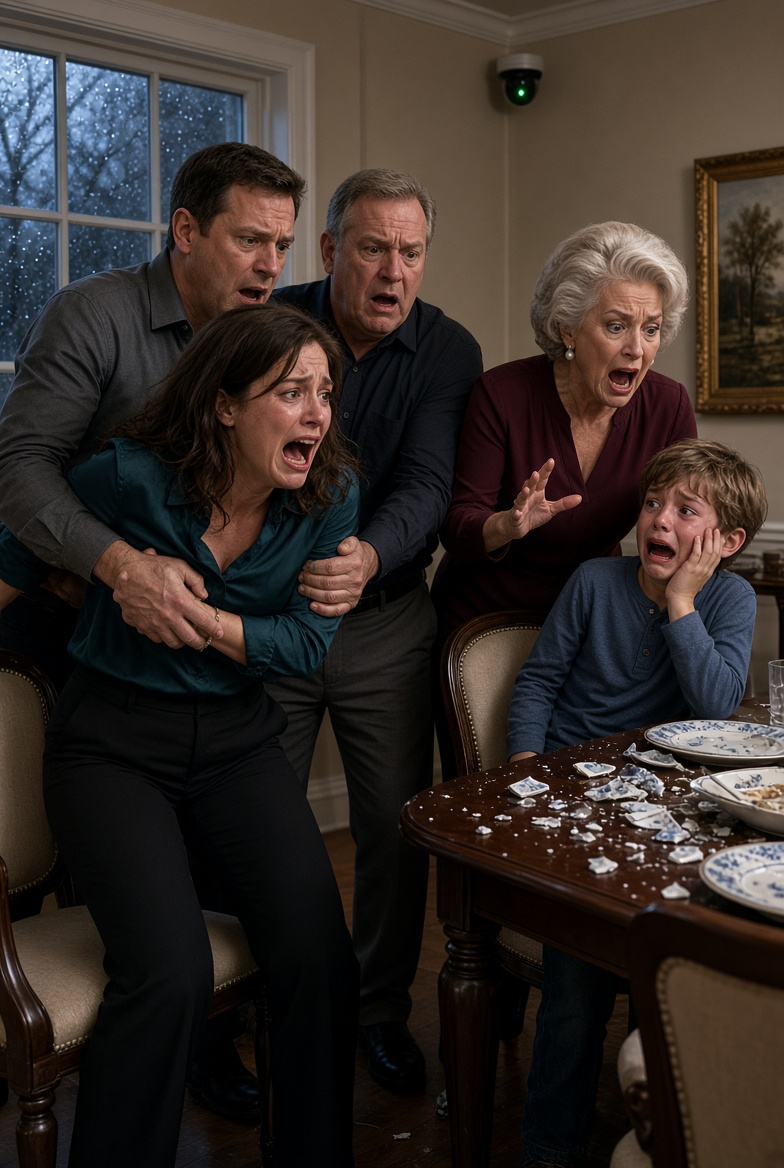
I only subjected myself to what was strictly necessary. I watched the dish shatter. I heard Eli’s panicked apologies. I watched Mom systematically reject his contrition, demanding a submission of his spirit rather than an apology for the accident. I heard my own desperate attempts to de-escalate.
Then came the strike. It was faster and more violent on screen than in my memory.
Then, I watched myself move. Dad intercepted me with practiced speed. Mark was right behind him. On the high-definition recording, there was no blur of panic, no distortion of adrenaline, no possibility that my traumatized mind had rearranged the timeline. It was empirical evidence.
I heard my recorded voice scream, “She hit him!”
I heard Mark grunt, “I’m trying to keep this from getting worse.”
And then, cutting through the chaos with chilling clarity, came my father’s voice, directly beneath the microphone: “Don’t move. Let her finish.”
I slammed my finger against the pause button.
For the entirety of my thirty-four years on this earth, if someone had asked me which parent I feared, I would have answered without hesitation: My mother. If they had asked which parent was my sanctuary, the one who made the world safe again, I would have smiled and said: My father.
Staring at the frozen frame of Dad’s hands locked around my wrists, the architectural foundation of my childhood collapsed. My answer had been tragically incomplete.
Dad had rarely been the storm. That was true. But he had been the man who meticulously boarded up the windows and ordered everyone to whisper so the storm wouldn’t get angrier. Sometimes, after Mom had screamed herself hoarse, he would quietly take me out for ice cream. Sometimes he would sigh and whisper, “You know how she gets, Claire.” Sometimes he would stand in the doorway of my bedroom while I cried and say, “Just go apologize to her. It doesn’t matter who started it. Just keep the peace.”
I had spent a lifetime mistaking comfort after the abuse for actual protection from the abuse. He wasn’t saving me from the fire; he was just handing me burn ointment while demanding I stay in the burning building.
I hit play again. I watched myself go perfectly still as I spotted the lens. I watched Mom lunge for Eli a second time. I heard my flat, dead voice say, “Take your hand off him.”
I downloaded the footage and saved copies to three separate encrypted cloud drives. I didn’t do it out of a thirst for vengeance. I did it because I knew the Bennett family playbook intimately, and I knew exactly what narrative was coming at dawn.
By sunrise, the revisionist history had been fully drafted and deployed.
Mom left a rambling, tearful voicemail claiming Eli had been “wildly and aggressively disrespectful,” that she had merely given him a “light, corrective tap,” and that I had “charged across the dining room like a deranged lunatic,” forcing the men to heroically restrain me for everyone’s safety.
Dad’s approach was far more insidious, wrapped in the guise of gentle reason. That tactic had almost always worked on me in the past.
“Your mother obviously shouldn’t have lost her temper like that,” he sighed heavily when I finally answered his seventh call. “And I have reprimanded her for it. But Claire, honey, you were completely out of control too. Mark and I were just trying to prevent a massive physical brawl in the dining room.”
“A bigger brawl than a grown woman striking an eight-year-old boy in the face?” I asked, my voice terrifyingly calm.
“That is not what I mean, and you know it.”
“You held my arms so she could continue hitting him, Dad.”
“No! Good lord, Claire, no. I held you back because you were violently lunging at your mother.”
“You explicitly told me to let her finish.”
The line went dead silent. Only the faint crackle of cellular static remained.
“You were highly upset,” he finally stammered, his voice losing its confident timbre. “Everybody says things poorly in the heat of a moment like that.”
“I have the security footage, Dad. The camera recorded the entire thing. Audio and video.”
Another silence stretched between us. This one was entirely different. It was the silence of a trapped animal.
When Dad spoke again, his voice dropped an octave, laced with a dark, commanding edge I rarely heard. “Claire. Do not start sending that video around to people.”
I stared blankly at the kitchen wall. He had been on the phone for five minutes. He had not once asked how Eli was feeling.
“Why shouldn’t I?” I asked softly.
“Because family business does not need to become public spectacle.”
“Eli being assaulted stopped being ‘family business’ the exact second you aided and abetted the person hurting him.”
“Claire, that is incredibly unfair to me!” he protested, playing the victim with practiced ease.
The sentence was so deeply familiar, so ingrained in my psychology, that an apology instinctively rose to the back of my throat. I swallowed it down like bile. “I have to hang up now, Dad.”
The invasion began by noon. Aunt Susan was the first flying monkey to breach the perimeter, followed swiftly by a cousin, and then Mom’s older sister. Each phone call was a differently wrapped package containing the exact same poison.
“Your mother sacrificed her entire youth for you.”
“Your father’s heart condition cannot handle this kind of dramatic stress, Claire.”
“Children need their grandparents. You are being selfish.”
“Diane is weeping inconsolably. Surely you don’t want one little bad night to destroy thirty-four years of family legacy?”
Initially, I fell into my old traps. I tried to defend reality. I argued back. No, he didn’t curse at her. Yes, she hit him hard enough to leave a mark. No, I did not attack her. I have literal video proof.
By the fourth interrogation, I caught myself doing something I had done since I was a teenager: I was building a desperate, logical court case to justify why I was allowed to feel pain.
I abruptly stopped.
When the fifth relative called, I didn’t argue. “Eli is safe,” I stated flatly. “I am not discussing the intimate details of my son’s trauma with the extended family. Goodbye.”
I hung up, and my hands shook violently. Establishing a firm boundary did not feel empowering or triumphant. It felt incredibly rude. It felt like a betrayal. That was how deeply the family’s toxic rulebook had been written into my DNA.
Cliffhanger: Two days later, my brother Mark requested a secret meeting, hinting that the dynamic I thought I understood was far more twisted than I ever realized.