
Chapter 6: The Anatomy of Justice
“Don’t move, Sam!” Abigail screamed, her voice cracking into a high, hysterical screech that bounced violently off the marble walls.
She stood in the vault threshold, swaying slightly on her feet. Her cream sundress was smeared with engine grease and blood, her hair wildly tangled. In her trembling left hand, she clutched a heavy industrial remote detonator, its LED pulsing a steady, rhythmic crimson.
“Lower the gun, or I blow the structural transformer in the sub-basement!” she shrieked. “The entire tower will pancake down into this vault!”
I didn’t lower the weapon. I kept the front sight post centered directly between her eyes, my breathing rhythmic, my finger taking up the first stage of slack on the trigger.
“You’re bluffing, Abigail,” I said, my voice dropping into that terrifying, cold register of battlefield certainty. “You’re a parasite. Parasites don’t commit suicide; they look for a new host. You came down here because your father abandoned you the second the accounts went to zero.”
Abigail’s eyes flared with a desperate, wild madness. “He didn’t abandon me! We have an extraction chopper at the helipad!”
“Check your phone, Abby,” Margaret spoke from behind me, her voice cutting through Abigail’s hysteria like an arctic gale. “Look at your offshore balance. Your father’s jet took off from the municipal airstrip six minutes ago. He left with one seat. And it wasn’t yours.”
Abigail’s gaze flickered downward for a fraction of a second toward the smartphone clutched in her palm. The screen was alive with cascading red alerts: Account Terminated. Balance: $0.00. Wire Routing Blocked.
That split-second drop of her eyes was the only tactical window I needed.
I lunged forward, closing the six-foot gap in a fraction of a second. My left hand clamped down over the detonator’s housing, driving my thumb beneath the firing toggle to prevent the contact switch from closing. With my right hand, I drove the butt of the SIG Sauer into the nerve cluster on her forearm.
Abigail screamed in pain as her fingers spasmed open. The detonator dropped harmlessly into my palm.
I spun her around, swept her legs out from beneath her, and drove her face-down onto the cold marble floor, planting my knee firmly between her shoulder blades while wrenching her wrists behind her back. With practiced, mechanical efficiency, I pulled a pair of heavy-duty zip-ties from my tactical bag and cinched them around her wrists until the nylon teeth locked tight.
“Get off me!” she spat, thrashing against the floor like a hooked viper. “You have nothing! My father will buy every judge in this district! He’ll wipe this clean by morning!”
“Your father doesn’t have enough money left to buy a bus ticket, Abigail,” I said, stepping off her and kicking the detonator across the room.
Footsteps—heavy, synchronized, tactical boots—thundered down the outer corridor.
A dozen state police officers in full tactical armor flooded the vault annex, led by a tall, sharp-eyed Hispanic man wearing a windbreaker with gold detective insignia. Detective Marcus Ramirez.
“Drop the weapon! Police!” Ramirez roared, his service weapon drawn, scanning the chamber.
I immediately placed the SIG Sauer on the oak table, raised both hands in the air, and stepped back toward my mother. “Captain Samuel Hayes, United States Army Intelligence. This is my mother, Margaret Hayes. The situation is secured, Detective.”
Ramirez lowered his weapon, his gaze taking in the shattered oak table, the zip-tied woman writhing on the floor, and the laptop glowing on the viewing desk.
“We received the data dump, Captain,” Ramirez said, his voice laced with awe and disbelief. “Every terminal at the state police headquarters just lit up with the encrypted ledgers. Internal Affairs kicked in Martin Cole’s office door ten minutes ago. They caught him running shredded files through an incinerator. He’s already in custody, singing like a canary to save himself from a federal conspiracy indictment.”
“And David Mercer?” Margaret asked, stepping forward, her voice trembling slightly.
Ramirez looked at my mother with deep, solemn respect. “State tactical units intercepted his armored sedan at the harbor checkpoint. When his accounts zeroed out, his private security detail abandoned him in the middle of the road. They left him sitting in the back seat with his hands on his head. He’s in federal lockup.”
The air in the vault suddenly felt light, breathable, clean.
I looked down at Abigail. The feral, venomous arrogance was gone, replaced by the hollow, broken vacancy of an operative who had lost everything. Two uniformed officers hauled her to her feet and dragged her toward the corridor, her heels dragging against the marble floor.
Paramedics entered the room, draping a warm wool blanket over my mother’s bruised shoulders. As the young medic checked her pulse, Margaret reached out, took my face in both of her hands, and pulled me down until our foreheads touched.
“Your father would be proud of you, Samuel,” she whispered, tears cutting clean lines through the dust on her face. “He can finally rest.”
“We both can, Mom,” I said, swallowing the lump in my throat. “We both can.”
Epilogue: The Architecture of Peace
Two months later, the early October air carried the crisp, smoky scent of autumn leaves across the front lawn.
The house had changed. The commercial mortise locks on the second floor had been removed, replaced with polished brass handles that turned freely. The heavy blackout curtains had been taken down, allowing the morning sunlight to flood every corner of the master bedroom.
Abigail was currently awaiting trial at the federal detention center in Philadelphia, facing twenty-four felony counts including attempted murder, elder abuse, wire fraud, and treasonous conspiracy. David Mercer had already suffered a massive stroke in his holding cell, stripped of every cent of his stolen fortune, abandoned by the corrupt network he had spent forty years constructing.
Dr. Julian Leonard had surrendered his medical license before the state board could revoke it, currently serving an eight-year sentence for clinical fraud and chemical endangerment.
The four hundred and eighteen million dollars my father’s algorithm liquidated had been distributed across twenty-six international foundations, funding veterans’ mental health initiatives, independent investigative journalism units, and memory-care research facilities that treated human beings with dignity instead of profit margins.
I stood on the front porch, wearing a comfortable flannel shirt, holding a steaming ceramic mug of black coffee.
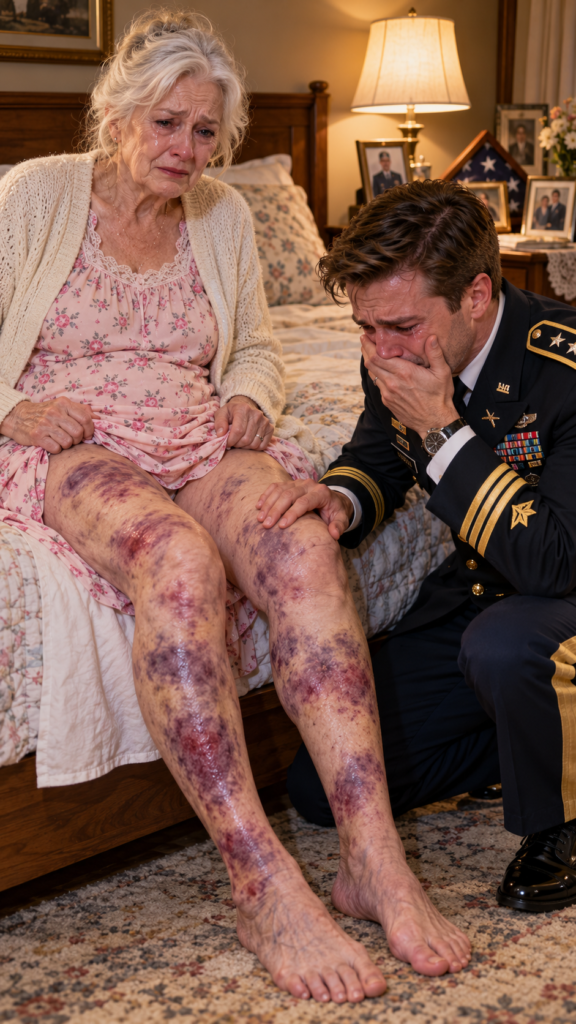
From the kitchen inside came the rich, sweet aroma of cinnamon, baked apples, and roasted pecans. Margaret was standing by the center island, humming a light, beautiful waltz as she rolled out fresh pastry dough. Her forearms were bare. The deep, violent bruises she had inflicted upon herself to maintain her sanity had faded completely, replaced by smooth, healthy skin.
She looked up through the bay window, caught my eye, and smiled—a genuine, radiant, unbreakable smile.
A war fought in the dark doesn’t leave medals on your chest. It leaves scars on your ribs, questions in your soul, and an unshakeable understanding of how fragile the surface of normalcy truly is. But as I watched my mother place the pie into the oven and wipe her hands on a clean white apron, I knew that justice isn’t an abstract legal concept drafted in granite courthouses.
Justice is the light that returns to an old woman’s eyes when she is no longer afraid of the dark.
I set my coffee mug down, stepped through the front door, and walked inside the home we had fought for, letting the heavy oak door close softly behind me.
And this time, the door was unlocked.
If you want more stories like this, or if you’d like to share your thoughts about what you would have done in my situation, I’d love to hear from you. Your perspective helps these stories reach more people, so don’t be shy about commenting or sharing.