
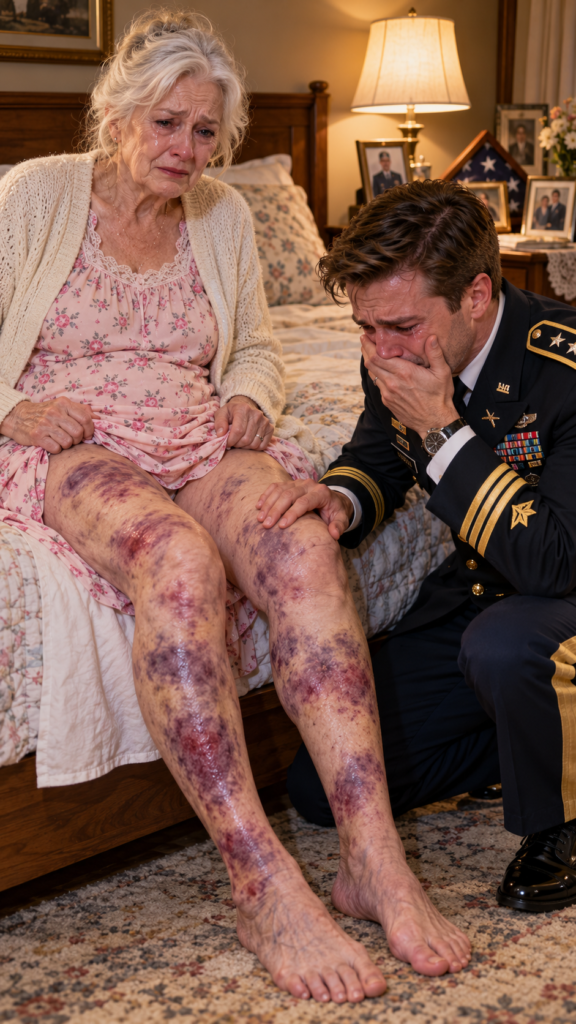
Chapter 3: The Deepfake Protocol
“My father died of pancreatic cancer eleven years ago, Abigail,” I said, keeping my voice deadpan, refusing to let my gaze drop toward the firearm concealed behind her silk robe. Every muscle in my body was primed for a violent disarm, but the distance between us was twelve feet—too far to close before a trigger pull.
Abigail stepped forward into the ambient moonlight of the landing, lowering the glass of bourbon to a side table. Her smile remained fixed, an eerie porcelain carving.
“Keep telling yourself that, darling,” she murmured, her left hand remaining casually hidden behind her hip. “Pancreatic cancer usually doesn’t leave heavy traces of synthetic polonium isotopes in bone marrow. But then again, your father always was a stubborn accountant. He thought he could audit the wrong people and walk away with a pension.”
The room seemed to tilt beneath my boots. Polonium. Eleven years ago, my father had deteriorated over five agonizing months. The doctors had called it an unusually aggressive adenocarcinoma. But my father had spent his final days writing furious, coded columns of numbers in small black leather ledgers—ledgers that vanished from his office the night after his funeral.
“Why are you awake, Abby?” I asked, maintaining my relaxed, subservient posture.
“I woke up and the bed was cold,” she replied smoothly. She brought her left hand forward. The gun wasn’t pointed at me; it was resting casually against her thigh, her finger resting along the frame outside the trigger guard. She was testing me. Provoking a reaction. “I thought I heard someone tampering with the network downstairs. But you were just checking on your mother, weren’t you?”
“I couldn’t sleep,” I said, exhaling a heavy sigh of exhaustion. “Jet lag. And the thought of putting her in a home tomorrow… it makes me sick to my stomach. I went down to the kitchen to grab a glass of water, but I ended up just staring at the darkness.”
Abigail watched me for five agonizing seconds. Then, she raised the revolver, turned it sideways, and slid the safety lever into the locked position before placing it atop the high corridor console.
“It’s a dangerous world, Sam. A woman alone for eight months learns to sleep with protection. Go to bed. Tomorrow is going to be an exhausting day.”
At 8:00 AM, the psychological theater resumed.
Abigail had dressed my mother in a soiled, mismatched floral blouse, deliberately leaving her silver hair unbrushed and her slippers on the wrong feet. Margaret played her part with terrifying perfection, mumbling nonsensical phrases about rainfall and yellow ribbons, allowing her jaw to hang slack whenever Abigail entered the room.
When we arrived at the Oakwood Psychiatric Pavilion, the air smelled of industrial floor wax and synthetic lavender. Dr. Julian Leonard’s private office was an opulent expanse of mahogany paneling, leather Chesterfield armchairs, and framed diplomas from prestigious medical academies.
Dr. Leonard was a man of fifty-five with silvering temples, rimless designer spectacles, and an expression of practiced, somber empathy that looked as if it had been calibrated in front of a dressing-room mirror.
“Captain Hayes,” Dr. Leonard said, rising to shake my hand with a firm, practiced grip. “I only wish our meeting were under happier circumstances. Your wife has been extraordinarily diligent during your absence. Caring for a relative suffering from advanced degenerative psychosis is a crushing weight.”
“She’s carried it well,” I said, taking a seat beside Abigail.
Margaret was seated in a high-backed leather chair in the corner. She was staring fixatedly at the brass pendulum of a grandfather clock, humming tunelessly, her hands trembling in her lap.
“Let’s get right to the clinical baseline,” Dr. Leonard said, opening a thick leather portfolio on his desk. “Abigail has provided comprehensive behavioral logs from the past ninety days. Wandering, extreme paranoia, loss of executive function. But most concerning are the episodic outbursts of severe domestic violence.”
“Violence?” I asked, tilting my head in apparent surprise.
“I didn’t want to show Samuel this earlier, Doctor,” Abigail interrupted, her voice instantly breaking into a delicate, sorrowful tremor. She reached into her leather tote bag and pulled out a high-resolution iPad. “I wanted to protect him until he was back on American soil. But two weeks ago, Margaret became completely unhinged. She believed our grocery delivery boy was an operative sent to liquidate her accounts. She took an eight-inch carving knife from the kitchen block.”
Dr. Leonard grimaced, adjusting his spectacles. “Good heavens. Did she cause injury?”
“I managed to disarm her,” Abigail whispered, dabbing the corner of her eye with a monogrammed handkerchief. “I had to lock her in the master suite for her own protection. The home security cameras captured the entire episode. Look for yourself, Doctor.”
Abigail tapped the screen and slid the tablet across the mahogany desk. Dr. Leonard leaned forward, and I leaned in beside him.
The video was black-and-white, carrying the timestamp 14:14:22 PM from the kitchen camera. In the footage, Margaret—wearing the exact same floral blouse she was currently wearing—stood by the kitchen island. Her face was twisted into a grotesque, snarling mask of rage. She seized a chef’s knife, turned toward the foyer, and lunged violently forward, screaming unintelligible threats while stabbing the air with frantic, feral energy.
Dr. Leonard shook his head in profound dismay. “This is severe, paranoid-schizoaffective manifestation. The frontal lobe inhibition is entirely degraded. Immediate clinical institutionalization under Title 14 is the only defensible medical course.”
He pulled a set of state commitment forms toward him and unscrewed the cap of a gold fountain pen. “I am prepared to execute the emergency psychiatric hold right now.”
“Doctor,” I said, my voice cutting through the room like a cold blade. “Before you sign that order, would you mind pausing the video at the fourteen-second mark?”
Dr. Leonard paused, his pen hovering an inch above the paper. Abigail stiffened beside me.
“Sam, please,” Abigail whispered, her voice tightening. “Don’t prolong this agony.”
“Fourteen seconds, Doctor. Humor a returning soldier,” I insisted.
Dr. Leonard tapped the screen, freezing the frame.
I leaned forward, placing my index finger directly on the glass. “I spent four years auditing forensic evidence for the Attorney General before I joined military intelligence. Doctor, look at the shadow cast by the kitchen island on the white tile floor.”
Dr. Leonard frowned, squinting through his rimless glasses. “The shadow?”
“The timestamp says 2:14 PM,” I said, my voice dropping into the precise, clinical cadence of a courtroom expert witness. “Our kitchen faces due south. At two o’clock in the afternoon in late July, the sun is at a sixty-two-degree elevation. The shadow should fall directly beneath the lip of the island counter. But look at this shadow: it is elongated, stretching forty-five degrees toward the eastern wall. That shadow was filmed at approximately 6:45 PM during the winter solstice.”
Abigail’s face drained of color. “That’s absurd! The security system clock simply reset during a power outage!”
“A power outage doesn’t alter solar geometry, Abigail,” I countered smoothly. “Now, Doctor, zoom in three hundred percent on my mother’s jawline and collarbone as she lunges.”
Dr. Leonard pinched the screen, enlarging the frozen image.
“Notice the micro-pixelation along the neck?” I pointed out. “Notice how the fabric of the collar doesn’t deform when the neck muscles flex? That is an adversarial generative artifact. Someone took a twelve-second clip of my mother chopping carrots six months ago, rendered her facial vectors onto an open-source deepfake motion rig, and mapped it onto a different actor’s body. It’s an amateur digital composite.”
“You’re insane!” Abigail hissed, slamming both hands on the desk as she stood up. “He’s suffering from acute combat stress! He’s hallucinating conspiracies to avoid the truth about his mother!”
“Am I?” I unzipped my military messenger bag and pulled out a three-inch-thick manila folder, slamming it onto Dr. Leonard’s desk with a resounding crash.
“Inside this file, Doctor, you will find the IP logs showing Abigail uploading that synthetic video to an offshore cloud server forty-eight hours ago. You will find the wire transfers draining two hundred and forty thousand dollars of my mother’s estate into four Delaware shell companies. And you will find the DNR you pre-signed last Tuesday, certifying a woman you hadn’t clinically examined in six months.”
Dr. Leonard’s face went pasty white. He dropped the gold fountain pen; it rolled off the desk and struck the Persian rug.
In the corner of the room, Margaret Hayes stopped humming.
She stood up with absolute, aristocratic grace. She smoothed the wrinkles from her floral blouse, threw her shoulders back, and walked directly to the desk. Her eyes were sharp as diamond shards.
“Good morning, Julian,” Margaret said, her voice clear, articulate, and completely devoid of tremors. “The square root of 1764 is 42. The current yield on the ten-year Treasury note is 4.28 percent. And the chemical compound your accomplice has been slipping into my tea for sixty days is scopolamine mixed with quetiapine. I may be bruised, gentlemen, but I am entirely sane. And you are both going to federal prison.”
Dr. Leonard looked as if he were having a massive coronary event. He sank back into his leather armchair, hyperventilating.
Abigail didn’t scream. She didn’t cry. The facade of the grieving daughter-in-law stripped away completely, revealing a creature of predatory, unyielding malice.
“You think you’re so brilliant, Samuel,” she whispered, her lips curling into a vicious sneer. “You think you solved a little domestic fraud case?”
She reached into her designer handbag. Before I could tackle her across the desk, she didn’t pull a weapon; she pulled a disposable burner phone. She pressed a single speed-dial digit and held the phone to her ear.
“It’s burned,” she said into the receiver. “Initiate the purge protocol.”
She hung up, looked me dead in the eyes, and laughed—a low, rhythmic, chilling sound that echoed through the clinical office.
Cliffhanger: “You think you’re saving your mother, Sam?” Abigail hissed, tossing the burner phone onto Dr. Leonard’s desk. “The bank vault downtown was breached twenty minutes ago. Everything your father died hiding… is already gone.”