
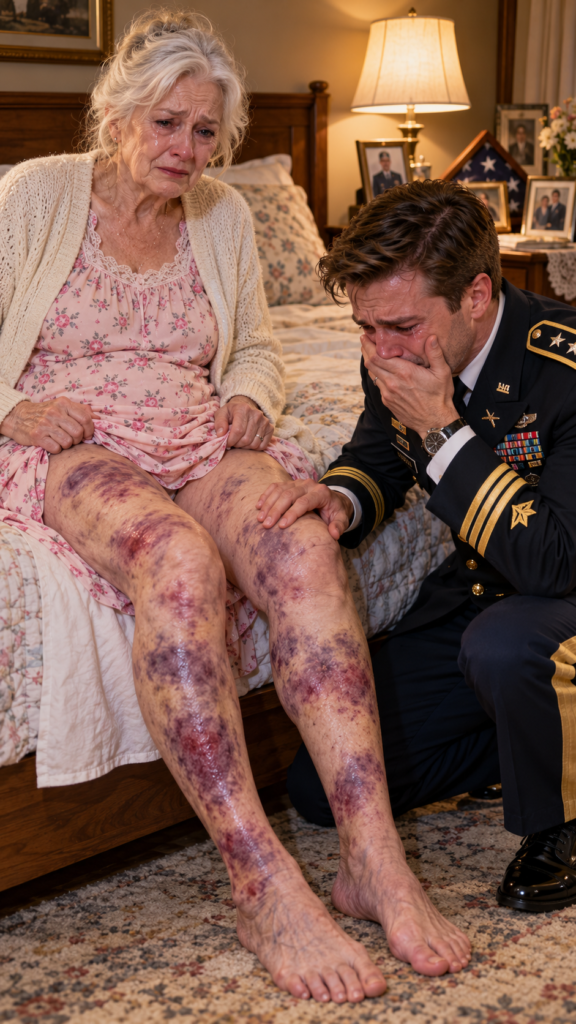
Chapter 2: The Architecture of Murder
“You shouldn’t have gone in there without me, Sam,” Abigail said softly, her voice smooth as oil on calm water. “She can become violent when her routine is disrupted.”
I kept my balance centered, feet shoulder-width apart, my posture projecting the relaxed authority of an officer inspecting quarters. I reached behind me, pulled the heavy oak door shut until the latch engaged, and slipped the brass key into my trouser pocket.
“She’s sleeping,” I lied without blinking, stepping toward her on the runner. “Or at least, she’s barely conscious. She didn’t even recognize my uniform, Abby. She looked right through me and asked if the milkman had delivered the morning cream.”
Abigail’s eyes searched mine, scanning for the micro-tremors of deception. I had passed polygraphs administered by counter-intelligence specialists in Baghdad; facing a sociopath in a suburban hallway required the exact same physiological control. I lowered my shoulders, exhaled a ragged breath, and allowed my face to crumble into an expression of hollow, defeated grief.
“You were right,” I whispered, leaning my forehead against her shoulder. “God… you were right. She’s completely gone.”
I felt the tension drain from Abigail’s frame. The rigid stance melted away, replaced by that sickening, patronizing warmth. She set the silver tray on a nearby console table and wrapped her arms around my neck, stroking the short hair at the base of my skull.
“Oh, my poor baby,” she cooed softly. “You’ve been through so much overseas, and now you come home to this tragedy. Come downstairs. Have some dinner. Let me take care of everything. Tomorrow, Dr. Leonard will handle the commitment paperwork, and the burden will be lifted from our shoulders.”
“Thank you,” I murmured into her neck, noting the faint scent of copper and printer ink lingering on her fingertips. “I don’t know what I would have done without you.”
Dinner was a masterclass in psychological warfare. Abigail poured two heavy glasses of vintage Cabernet, placed a rosemary-crusted salmon fillet before me, and spoke with exquisite, rehearsed tenderness about my mother’s alleged decline. She detailed fabricated incidents with staggering specificity: the afternoon Margaret purportedly tried to set fire to the garden shed, the evening she wandered toward the interstate in her nightgown, the morning she attacked a grocery courier with pruning shears.
“It’s rapid-onset vascular dementia,” Abigail explained, cutting her fish with surgical precision. “Dr. Leonard brought in a specialist from the state board. They both agreed that home care is no longer viable. In fact, keeping her here is practically negligence.”
“And the finances?” I asked, taking a measured sip of wine, ensuring the liquid barely touched the tip of my tongue before setting the glass down. “Memory care facilities of that caliber require substantial collateral.”
Abigail smiled reassuringly, reaching across the candlelit table to pat my hand. “Your mother’s savings and her estate trust will cover the monthly residency fees comfortably. She signed a durable Power of Attorney last month while she still had brief windows of lucidity. Everything is organized, Sam. You don’t have to look at a single spreadsheet. Just let me handle the administrative burden.”
“You’re an angel,” I said, looking her directly in the eyes. The words felt like drinking lye.
By midnight, the house was submerged in silence. Abigail slept beside me in the master bedroom, her breathing slow, rhythmic, and heavy. Beside her nightstand, her smartphone lay face-down on a wireless charging pad.
I slipped out from under the linen sheets without disturbing the mattress. Wearing soft wool socks and dark athletic gear, I bypassed the squeaking floorboards with instinctive ease and moved down to my home office in the basement.
Before I deployed, I had installed an isolated, hardware-level packet sniffer on our home’s fiber-optic router—a standard precaution for military intelligence personnel working with remote classified networks. Abigail had changed the administrative passwords, but she hadn’t touched the router’s physical firmware.
I booted up my personal, air-gapped laptop, plugged directly into the router via an Ethernet bridge, and began pulling the decrypted transaction logs for the past ninety days.
What unfolded across my screen over the next two hours wasn’t the sloppy opportunism of a greedy spouse; it was an intricate, highly sophisticated corporate extraction.
Abigail had systematically drained Margaret’s liquid assets through a labyrinth of four separate Delaware limited liability companies, each bearing innocuous names: Harborline Logistics, Bluecrest Consulting, Vanguard Heritage Holdings. Over two hundred and forty thousand dollars had been moved through these shells over an eleven-week period. The final transaction—an eighty-thousand-dollar wire transfer from Margaret’s primary mutual fund—was currently sitting in a pending escrow queue, awaiting final verification.
Attached to the transfer request was a PDF copy of the durable Power of Attorney.
I zoomed in on the signature page. My mother’s signature was there—shaky, jagged, completely atypical of her elegant cursive script. Beneath it was the signature of the legal witness and secondary executor: Samuel George Hayes.
My breath hitched. I stared at the screen, zooming in on my own signature.
The pressure of the pen stroke was too uniform. The baseline angle deviated by three degrees from my natural handwriting. Abigail hadn’t just forged it; she had used an automated autopen signature rig, tracing a signature pulled from our joint mortgage documents.
Then, I navigated to a hidden directory on Abigail’s cloud backup labeled Estate_Contingency.
Inside lay a single document drafted on standard legal parchment: an advance medical directive and a binding Do Not Resuscitate (DNR) order, already countersigned by Dr. Julian Leonard, MD.
The language was chillingly specific. In the event of respiratory distress, cardiac arrest, or chemical shock, medical responders were legally prohibited from administering advanced life support, epinephrine, or mechanical ventilation.
The entire endgame crystallized before me with horrific clarity.
Tomorrow morning, Dr. Leonard would certify Margaret as legally incompetent, granting Abigail full control under the forged Power of Attorney. The eighty thousand dollars would clear into the offshore escrow account. Within forty-eight hours of Margaret’s transfer to Whispering Pines, an “unfortunate incident” would occur—a lethal dose of sedatives disguised as a cardiac event. And when the paramedics arrived, Abigail would produce the DNR. The paramedics would stand down. My mother would die quietly in a locked room.
And because my forged signature was on both the Power of Attorney and the DNR, I would be legally implicated as an accomplice to her suspicious death. If I ever tried to expose the fraud later, Abigail could claim we had conspired together to liquidate my mother’s estate.
My hands trembled with a lethal mixture of rage and cold calculation. I extracted the digital logs, the routing ledgers, the autopen comparison files, and the forged DNR onto two encrypted flash drives. I tucked one into the sole of my combat boot and sent the second file to an encrypted dead-drop server belonging to my former commander at Fort Meade.
I closed the laptop, wiped the cache, and crept back up the stairs.
As I reached the top landing outside our bedroom, my foot paused mid-air.
The bedroom door was cracked open an inch. A faint sliver of amber light sliced across the hallway carpet.
Standing in the shadows at the end of the corridor, perfectly motionless, was Abigail. She was holding a heavy glass tumbler filled with amber liquid in her right hand, but it was her left hand that arrested my breath.
Tucked discreetly behind the folds of her silk dressing gown, the polished steel barrel of a small-caliber revolver glinted in the darkness.
Cliffhanger: Abigail smiled—a slow, terrifying, unblinking smile—and whispered into the dark: “Did you find everything you were looking for on the router, Sam? Or do you need me to explain why your father had to die, too?”