Chapter 5: The Mountain and the Crucible
The federal hammer did not fall with gentle bureaucratic restraint; it struck with the crushing velocity of an anvil.
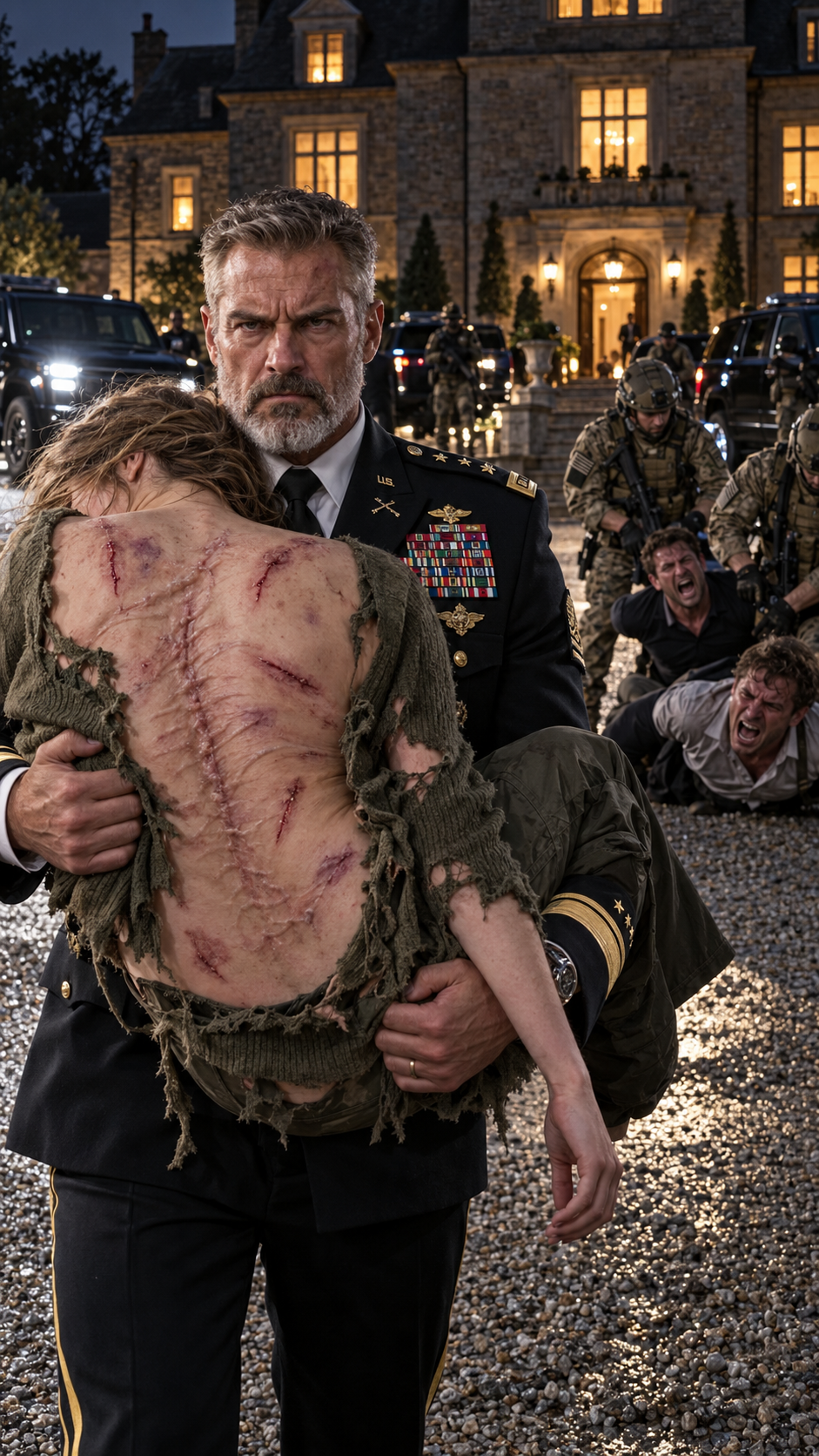
Within forty-eight hours of our extraction from The Sterling Manor, the story dominated every national news broadcast from coast to coast. The raid on an appellate judge’s estate by federal authorities—coordinated via joint jurisdiction between the FBI and the Department of Defense’s Inspector General—was unprecedented.
The encrypted files my father delivered were an open-and-shut evidentiary casket.
I watched from a hospital bed in a secure military medical facility at Walter Reed as the television screen broadcast live footage of Arthur Sterling. Gone was the bespoke three-piece suit. Gone was the booming, theatrical baritone of the bench. Stripped of his gavel, his accounts frozen under the federal RICO statute, Arthur was led down the courthouse steps in an orange jumpsuit, his wrists and ankles bound in heavy chains, his broken jaw wired shut with surgical steel.
The bail hearing lasted four minutes. The presiding federal magistrate—a woman whose nomination Arthur had spent years attempting to derail—denied bail immediately, declaring him an extreme flight risk and an active threat to public integrity.
Julian’s end was equally pathetic. When state and federal investigators examined the manor, they didn’t just find my torn clothing and the blood-stained floorboards of the pump house; they found Julian’s private electronic devices, which contained mountains of incriminating evidence detailing years of coerced silence from young women across three college campuses. Charged with felony assault, obstruction of justice, and perjury, Julian took a plea deal that offered no probation. He was sentenced to twelve years at a high-security state correctional facility—a place where the Sterling surname was merely an invitation for retribution.
Evelyn was left with nothing. Every piece of property, every offshore account, every vehicle and piece of fine art was seized under civil asset forfeiture. Ostracized by the high-society circles that had once courted her favor, she was forced to move into a tiny, subsidized efficiency apartment on the outskirts of Roanoke.
She sent me nine letters over the next four months.
I never opened a single one.
When my physical injuries healed—the deep contusions fading into faint, horizontal silver lines across my back—my father took me away from the East Coast entirely.
He brought me to Blackwood Ridge Ranch, a secluded, three-thousand-acre property tucked deep into the jagged pine-covered mountains of western Montana. The ranch sat ten miles past the nearest paved county road, protected by natural granite ridges, towering Douglas firs, and an unyielding perimeter of absolute peace.
It was there that the rebuilding began.
My father did not treat me like fragile porcelain. He understood that coddling trauma only reinforces the prison of the victim.
“The world does not run on fairness, Maya,” Victor told me six months after the raid, as we stood together on the wooden deck of the main lodge, watching the morning mist rise off the mountain river. “The world runs on strength. The monsters exist because good people convince themselves that the law is self-enforcing. It isn’t. The law is just ink on paper unless someone has the will to defend it.”
Every morning began at 0530. We ran the mountain trails until my lungs burned with clean, alpine air and the memory of the shed’s stagnant oil vanished from my sinuses.
In the afternoons, we worked in the timber-framed barn he had converted into a private training facility. He taught me the mechanics of physical leverage—how a woman of my size could dismantle a man twice her weight using joint manipulation, center-of-gravity displacement, and decisive, uncompromising aggression. He taught me how to breathe through adrenaline, how to keep my vision wide when panic threatened to narrow it into a tunnel.
On the long-distance rifle range at the base of the ridge, he taught me ballistics, windage, and marksmanship. But more importantly, he taught me the psychology of conflict.
“A predator looks for compliance,” he said, adjusting the elbow of my shooting jacket as I lay prone behind a bolt-action rifle. “They look for the bowed head. The apology. The dropped gaze. You give them nothing. You make them understand that the cost of engaging you is catastrophic.”
I pulled the trigger. Six hundred yards away, the steel silhouette rang with a clear, sharp chime.
One afternoon, during my third year at the ranch, a registered courier drove up the dirt road, handing my father a manila envelope addressed to me from Evelyn. It was thick, stuffed with pages of handwritten apologies, claiming she was “a victim too,” begging for a phone call, asking for financial assistance from my father’s trust.
I stood beside the burn barrel near the woodshed.
My father held a lighter in his hand, watching me quietly, offering neither judgment nor direction.
“Do you want to read it?” he asked gently.
I looked down at the familiar, loopy cursive on the envelope—the handwriting that had signed the permission slips that kept me locked inside the Sterling estate, the hand that had adjusted diamond necklaces while I choked back tears at dinner.
“No,” I said, my voice steady, entirely free of malice, entirely free of pain.
I dropped the sealed envelope into the iron barrel. My father touched the flame to the dry pine shavings at the bottom. We watched in silence as the paper curled, blackened, and disintegrated into gray ash that drifted up toward the Montana sky.
That evening, I sat at the heavy oak desk in the lodge library, staring at the thick application packet spread out before me.
It was not a business school application. It was not a private arts portfolio.
It was the application for the Georgetown University Law Center.
CONTINUE READ NEXT PART… 👇