Chapter 3: The Art of Golden Scars
Dominic Thorne turned from the glass, and for the first time in five years, a man looked at me without pity, without hunger, and without disgust.
He was forty-two, with silver threading through dark, thick hair at the temples, sharp Mediterranean features, and eyes the color of flint. He was wearing an impeccably tailored charcoal three-piece suit that made him look less like an executive and more like a Roman general who had traded his gladius for a Bloomberg terminal.
He tossed the manila folder onto the glass table between us. It landed with a heavy, ominous thud.
“Open it,” Dominic commanded, taking a seat opposite me and pouring two fingers of single malt into a tumbler.
I flipped the tab. Inside were bank ledgers, offshore shell company registrations, and short-position transaction sheets belonging to Sterling & Croft. My eyes scanned the numbers automatically, my training taking over before my emotions could interfere.
“These are naked short positions,” I murmured, my finger trailing down the columns. “Aggressive ones. They’ve been shorting Vanguard’s tech acquisitions for seven months. But the volume… they don’t have the liquidity to back these margins if the stock surges. This is reckless. It’s almost suicidal.”
“It is suicidal,” Dominic said, taking a slow sip. “Unless they had advance information that our acquisition of Helios Cloud was going to be delayed by the FTC. Which it isn’t. But your husband and his managing partner, Croft Senior, bought that false leak from a mid-level compliance officer in our legal wing whom I turned two days ago.”
I looked up, meeting his unyielding gaze. “You fed them bad data.”
“I fed them a feast of poison,” Dominic replied coldly. “And they gorged themselves. As of this morning, Sterling & Croft has leveraged seventy percent of their operating capital against Vanguard. By Friday at four o’clock, when Helios clears regulatory approval, their firm will be in an irreversible liquidity spiral. They will owe us four hundred million dollars they do not have.”
A cold thrill ran down my spine. “You’re going to initiate a hostile takeover.”
“I am going to absorb them, liquidate their executive team, and sell the scrap metal to the Canadians,” Dominic said simply. “Except there’s one complication.”
“What complication?”
“You,” Dominic leaned forward, placing his elbows on the table, pinning me with those flint-gray eyes. “You are their senior risk analyst’s wife. In an SEC review, your position at Vanguard combined with Richard’s position at Croft could trigger an insider collusion investigation that stalls the acquisition for months. Unless your divorce is filed, public, and contentious before the market opens on Monday.”
“The divorce papers are already signed,” I said, my voice steady. “They’re in Eleanor Vance’s safe.”
Dominic’s eyebrow raised a fraction of an inch—the closest he ever came to expressing surprise. “Eleanor Vance? Fast worker. I like that. But you haven’t served him.”
“Not yet.”
“Why?”
“Because,” I said, reaching into my bag and retrieving the gold-embossed invitation from Sienna Brooks, sliding it across the table toward him. “He and his mistress have planned a public execution for me on Friday night at their Founders’ Gala. They want to humiliate me out of existence so they can claim my absence as a sign of mental collapse, delegitimizing anything I say regarding his embezzlement.”
Dominic picked up the card, his eyes narrowing as he read Sienna’s handwritten note. I watched his hand tighten on the cardstock until the heavy paper creased. A terrifying, silent fury rippled across his jawline.
“Backless gowns only,” he read aloud, his voice dropping an octave into pure, lethal silk. “Cruelty dressed as high fashion. How remarkably pedestrian.”
He tossed the card into the crystal ashtray on his desk, flicked a platinum lighter, and watched the gold filigree catch fire. The tuberose scent burned away, replaced by the bitter tang of sulfur and ash.
“They want you to hide your scars, Audrey?” Dominic said softly, standing up. “They think your survival is a badge of shame?”
“Richard hasn’t looked at my back in five years,” I confessed, the words tasting like copper in my mouth. “To him, my scars are an aesthetic failure. A reminder that his savior wasn’t pretty enough to show off.”
Dominic walked around the desk, stopping beside my chair. He looked down at me, his gaze sweeping over my shoulders with an intensity that made the hair on my arms stand up.
“Then let us teach Richard Croft the difference between a wound and a weapon,” he said.
He tapped his intercom. “Send him in.”
The heavy oak door opened, and a diminutive, eccentric man with silver-rimmed round spectacles, dressed in an oversized black cashmere sweater, stepped into the suite. He moved like an insect—darting, hyper-aware, clutching a sketchbook bound in black leather.
“This is Jean-Luc Laurent,” Dominic introduced smoothly. “He doesn’t design for runways. He designs for monarchs, oligarchs, and the women who pull down empires. Jean-Luc, show her.”
Jean-Luc didn’t say hello. He walked directly toward me, circling my chair like a sculptor appraising a block of Carrara marble. “Stand up, Madame,” he commanded in a sharp, melodic Parisian cadence.
I hesitated, looking at Dominic, who nodded once. I stood.
“Remove the jacket, s’il vous plaît.”
My chest tightened. The instinctive reflex to guard myself—honed by five years of Richard’s recoils—screamed at me to keep the heavy charcoal wool clutched tight. But I looked at Dominic’s calm, unblinking eyes. I unbuttoned the jacket. I slipped it off.
Jean-Luc stepped behind me. I felt the light, feather-touch of his manicured fingers skimming the collar of my blouse.
“Ah,” Jean-Luc whispered, not in horror, but in profound, reverent awe. “Mon Dieu. The texture. The drama of it. It is not skin; it is a landscape forged by vulcanism.”
“Can you do it?” Dominic asked from the window.
“Can I do it?” Jean-Luc turned on his heel, his eyes blazing with artistic fever. “Dominic, this is not a dress. This will be an execution. In Japan, they have an art: Kintsugi. When a precious vessel breaks, they do not hide the cracks with cheap plaster. They fuse the fractures with liquid gold, lacquer, and resin. They declare that the break makes the vessel more valuable, more terrifying, more divine than it was when it was whole.”
He flipped open his sketchbook, thrusting a charcoal and watercolor rendering in front of my face.
I stopped breathing.
The sketch depicted a gown of the deepest, midnight-blue silk velvet—a color so dark it seemed to absorb light itself. From the front, it was a high-necked, austere column of razor-sharp elegance, framing the collarbones with diamond-cut modesty. But the reverse view was radical, violent, and magnificent.
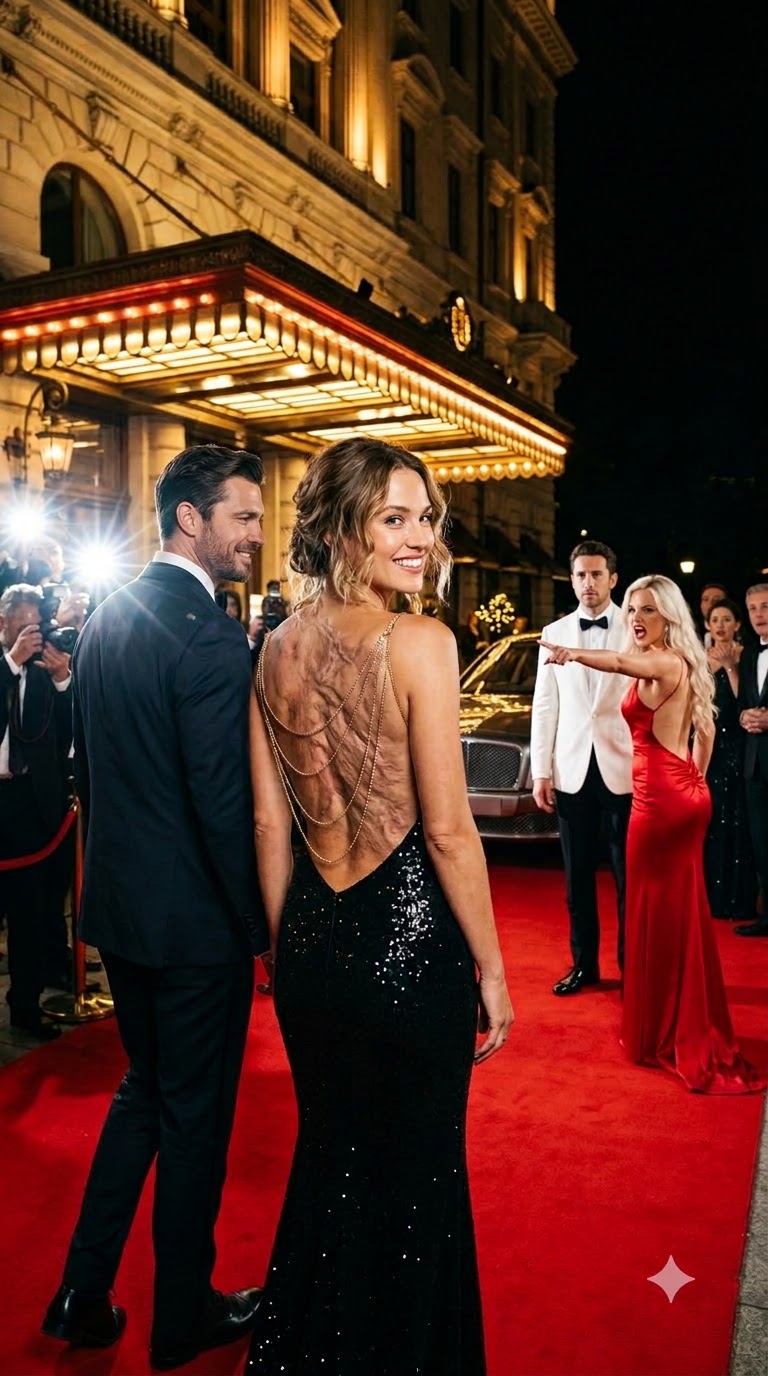
The back was cut completely away, plummeting past the waist to the very base of the tailbone. And across that open expanse, Jean-Luc had drafted an intricate, descending web of delicate, hand-cast chains made of solid 18-karat yellow gold. The chains were engineered to rest precisely within the grooves and valleys of my burn tissue, wrapping around the raised keloids, illuminating the silver-pink ridges, turning every inch of scorched flesh into an armature for molten light.
“We do not hide the fire, Madame,” Jean-Luc whispered, his eyes gleaming behind his spectacles. “We frame it. We make them look at what you survived, and we make them choke on its majesty.”
My fingers reached out, trembling slightly, touching the golden watercolor strokes on the paper. For five years, I had viewed my scars as a ruin. A landscape of loss. But looking at the sketch, I saw the truth: every ridge was proof that the flames had tried to kill me, and the flames had lost.
Dominic walked over, handing me a glass of iced water, his fingers lightly brushing mine. His touch was warm, steady, and anchor-firm.
“On Friday night, Audrey,” Dominic murmured, his voice sending an electric shiver through the room, “you are not going to that gala as Richard’s discarded wife. You are going as my guest of honor. You will wear the gold. You will bare your fire. And while they are blinded by the sun… we will burn their empire to the ground.”
The room faded into a blur of fabric swatches, measurements, and tactical briefings. For the next three days, while Richard spent his nights at Sienna’s apartment, boasting of his impending promotion and mocking the ghost he thought he had left at home, I lived in the shadow of a furnace.
On Friday afternoon at 7:00 PM, the transformation was complete.
I sat in the back of Dominic’s custom, armor-plated Maybach, the engine vibrating like a deep, purring feline beneath the chassis. Outside the tinted glass, Fifth Avenue was choked with black limousines and the flashing red-and-blue lights of police escorts guiding the elite toward the Grand Plaza Hotel.
I smoothed my hands over the cool, heavy midnight silk over my knees. Behind me, the 18-karat chains clinked softly—cool against my skin, settling into the familiar, jagged valleys of my spine like tailored armor.
Dominic sat beside me, checking his cufflink—a platinum coin minted with the head of Minerva. He looked up, his gaze holding mine in the dim, ambient leather interior.
“The market closed three hours ago, Audrey,” he said quietly. “Vanguard filed the hostile acquisition papers. Sterling & Croft is officially insolvent. Eleanor Vance’s process servers are already positioned at the top of the red carpet.”
He leaned closer, his hand reaching out, not hesitating, not flinching, and gently traced the single gold chain resting at the base of my neck.
“Are you ready to kill the ghost?” he asked.
I smiled, and for the first time in five years, the smile reached my eyes—sharp, lethal, and colder than a blade.
“Drive,” I said.