
Chapter 1: The Anatomy of Ash
“That deformed freak won’t dare show her burnt skin next to me.”
The sentence didn’t hit me like a blow; it settled into my marrow like dry ice. It was spoken with a soft, venomous purr that belonged only to Sienna Brooks, drifting through the mahogany-trimmed executive suites of Sterling & Croft. But before that voice became my compass, before the gilded guillotine fell, there was only the quiet, suffocating prison of my own bedroom.
Our Manhattan penthouse, perched thirty-two stories above the frozen arteries of the Upper East Side, was an architectural triumph of glass and white marble. It was also a mausoleum. Everything about it was designed to reflect light, yet for the past five years, I had learned to move through its corridors like a shadow, minimizing my footprint, dimming my presence, apologizing with every breath for still taking up space.
I stood before the tri-fold vanity in our master suite, the November chill bleeding through the floor-to-ceiling glass. I had unbuttoned my ivory silk blouse, letting it slide down my arms, pooling on the parquet floor. In the mirror, my face was still what high society called handsome—high cheekbones, steady hazel eyes, a mouth that had forgotten how to smile without measuring the cost. But as I turned slightly to slip into my nightgown, the reflection fractured into the grotesque tapestry etched across my body.
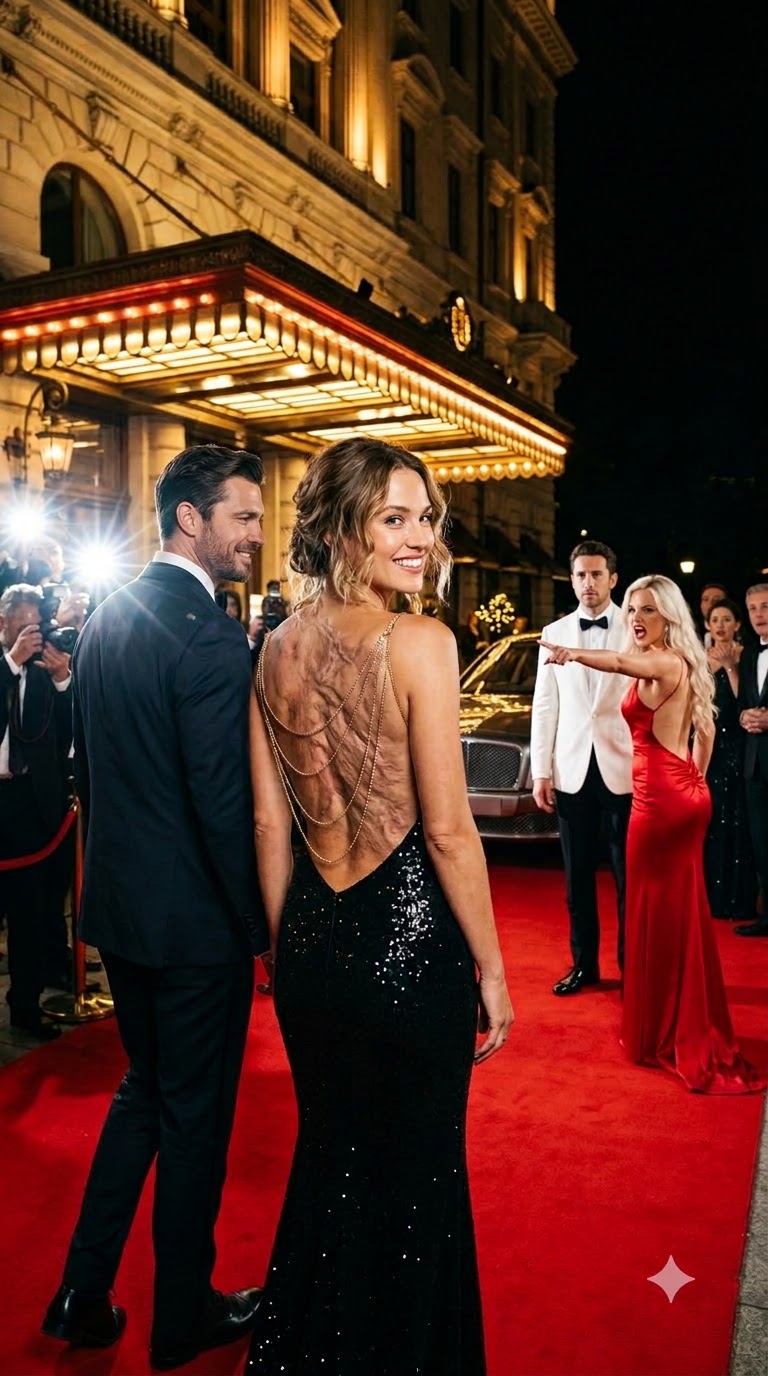
From the base of my neck down to the dimples of my lower spine, my back was not skin. It was an erratic landscape of survival: thick, roped keloids, pale silver ridges, and purplish valleys of grafted tissue where fire had devoured flesh.
Five years ago, we had lived in a charming, turn-of-the-century loft in SoHo. An electrical surge during a winter storm had turned the dry timber of the building into an incinerator within four minutes. I remembered the screaming roar of the air being sucked out of the room. I remembered finding Richard Croft, my husband, pinned beneath a collapsed, flaming roof beam, unconscious, choking on plumes of black synthetic smoke.
I didn’t think. I didn’t calculate the odds. I was a senior financial analyst at Vanguard Horizon Capital; my entire life was built on risk mitigation, but that night, I threw every ledger into the flames. I dragged one hundred and eighty pounds of limp deadweight across a carpet of melting nylon. When a secondary rafter gave way, it didn’t hit Richard. It landed across my spine, pinning me into the embers. The heat didn’t feel like heat—it felt like a million white-hot needles sewing my flesh to my bones. I screamed, but I didn’t let go of his collar. I dragged him through the threshold into the brick stairwell just as the fire department breached the landing.
Richard walked away with second-degree singes on his forearms and mild smoke inhalation. He spent forty-eight hours under observation.
I spent four months in the burn unit of New York-Presbyterian.
I survived thirteen skin graft surgeries, the debridement baths that made me pray for cardiac arrest, and the slow, agonizing process of learning how to twist my torso without tearing newly stitched dermis. During those first months, Richard would sit by my bed, tears streaming down his face, clutching my bandaged hands, whispering, “You saved my life, Audrey. I will spend every second of forever making this up to you.”
Forever, as it turned out, had an expiration date of roughly eighteen months.
As the raw, bleeding trauma settled into permanent, knotted scar tissue, Richard’s gratitude curdled. First came the averted glances. When I stepped out of the steam of the shower, his eyes would flick anywhere else—the tiles, his watch, the ceiling. Then came the cessation of touch. An accidental graze against my back would cause his hand to jerk away as if he had brushed against a corpse. Eventually, he stopped coming to bed while I was awake.
The door to the master bath clicked open. Richard stepped out, enveloped in a cloud of sandalwood aftershave and warm humidity. At thirty-six, he was undeniably handsome in that sharp, predatory, Ivy League manner—raven hair swept back, jawline sculpted by personal trainers, and an air of effortless entitlement.
I reached for my heavy cashmere robe, but before I could pull it around my shoulders, our eyes locked in the mirror.
His jaw tightened. His throat bobbed in a visible swallow of disgust, his upper lip twitching in a micro-expression so fleeting that an untrained eye would have missed it. But I had spent five years studying the topography of his revulsion. He flinched, stepping backward into the threshold, his posture stiffening as if a feral beast had cornered him.
“Jesus, Audrey,” he muttered, his voice taut, looking down at his suede slippers. “Could you put something on? It’s freezing in here.”
“I was just reaching for my robe, Richard,” I said, my voice quiet, devoid of the tremor that used to humiliate me in the early years.
“Right. Well. Do it quicker.” He rubbed the back of his neck, never once bringing his eyes level with mine. “I have emails. Don’t wait up. The Sterling & Croft third-quarter audits are an absolute disaster.”
He moved to his nightstand, picking up his iPhone. As the screen woke, a preview banner illuminated his face with a cool, blue sheen. From where I stood, knotting the belt of my robe tight enough to bruise my ribs, I saw the name: Sienna Brooks.
The text read: Can’t wait to show everyone what a real woman looks like on your arm.
Richard’s thumb swept across the glass with practiced speed, clearing the banner. He didn’t look at me again. He turned on his heel and retreated down the hallway toward his private study, the heavy oak door clicking shut behind him with the finality of a jail cell.
I stood there in the silent bedroom, the silk of my robe rubbing against the raised ridges of my spine. The phantom itch of burned nerve endings flared—a bitter reminder that dead flesh never truly forgets how to hurt. I had swallowed this degradation for years, convincing myself that his disgust was natural, that my body was an objective horror, that his infidelity was a debt I owed him for failing to remain the pristine socialite he had married.
I stepped toward his nightstand to retrieve my book, but as my fingers brushed the polished marble, his secondary work iPad lit up with an incoming calendar sync.
It was an automated notification from the executive event committee of Sterling & Croft. An invitation attachment bounced into the queue, titled: Annual Founders’ Gala – Guest Protocols & Dress Code.
My finger hesitated over the glass. I tapped it. The document expanded, revealing a bespoke PDF trimmed in silver filigree. At the bottom, highlighted in sharp, bold crimson text, was an unprecedented directive:
MANDATORY EVENING ATTIRE: Haute Couture Black Tie. To celebrate this year’s theme, ‘The Bare Truth of Modern Success,’ ladies’ formalwear mandates plunges or open backs—BACKLESS GOWNS ONLY. No stoles, shawls, or cover garments will be permitted past the red carpet checkpoint.
A suffocating cold seized my chest. This wasn’t an aesthetic choice. This was an ambush.