PART 4
The moment I stepped onto the porch, I expected to feel afraid.
I expected my hands to shake.
I expected the familiar voice inside my head—the one that had spent seventy-two years worrying about everyone else—to tell me I was making a mistake.
But it never came.
Instead, I felt something I had almost forgotten existed.
Peace.
The kind of peace I used to feel sitting on my own porch in Hudson, drinking coffee while the morning sun warmed the wooden steps.
For three months, I had lived in a house that was supposed to be my son’s home, but every day I felt like a guest who had overstayed her welcome.
Now I was walking away.
And somehow, leaving felt more like coming home.
I placed my suitcase beside me and took out my phone.
There was one person I needed to call.
Not Michael.
Not Jessica.
Someone who knew me before I became only “Mom,” “Grandma,” or “the person who helps.”
I called my old neighbor, Margaret.
She answered on the second ring.
“Eleanor?”
Her voice immediately softened.
“I was just thinking about you.”
I smiled sadly.
“That’s strange. I was thinking about you too.”
There was a pause.
Margaret had been my neighbor for twenty years. She knew my husband. She knew the story of my life. She knew how carefully I tended my little house, how I planted flowers every spring, how I sat outside every morning with my coffee and newspaper.
“What happened?” she asked.
I looked back at Michael’s house.
The place where I thought I was rebuilding my family.
The place where I realized I had been rebuilding their convenience.
“I’m coming home.”
Silence.
Then Margaret whispered:
“Your house?”
I closed my eyes.
“Yes.”
“But Eleanor…”
“I know,” I said.
My house was supposed to be gone.
Sold.
A memory.
But there was something Margaret didn’t know.
Something Michael and Jessica didn’t know either.
When I signed the papers for the sale, I had not done it blindly.
I had spent forty-eight years married to a man who believed every decision needed a plan.
My husband, David, used to say:
“Love people with your heart, Eleanor. But protect yourself with your mind.”
I remembered laughing the first time he said it.
I told him:
“You make marriage sound like a business meeting.”
He smiled and replied:
“No. I make marriage sound like two people who care enough about each other to prepare for the future.”
After David died, I kept every important document organized.
Every account.
Every receipt.
Every legal paper.
Because that was the woman I was.
The woman Michael had forgotten.
Before I sold my house, I made one condition clear.
The sale would not officially complete until a waiting period passed.
And during that period, I had the right to reconsider.
I had not told Michael because he never asked.
He only saw the money.
He never asked if I was emotionally ready.
He never asked if I was happy.
He only asked when I could move in.
And now I wondered…
Had he ever actually wanted his mother?
Or had he only wanted what his mother could do?
I spent the night at a small hotel near town.
Nothing fancy.
Just a clean room, a soft bed, and silence.
Real silence.
Not the uncomfortable silence of a family dinner after someone wounds you.
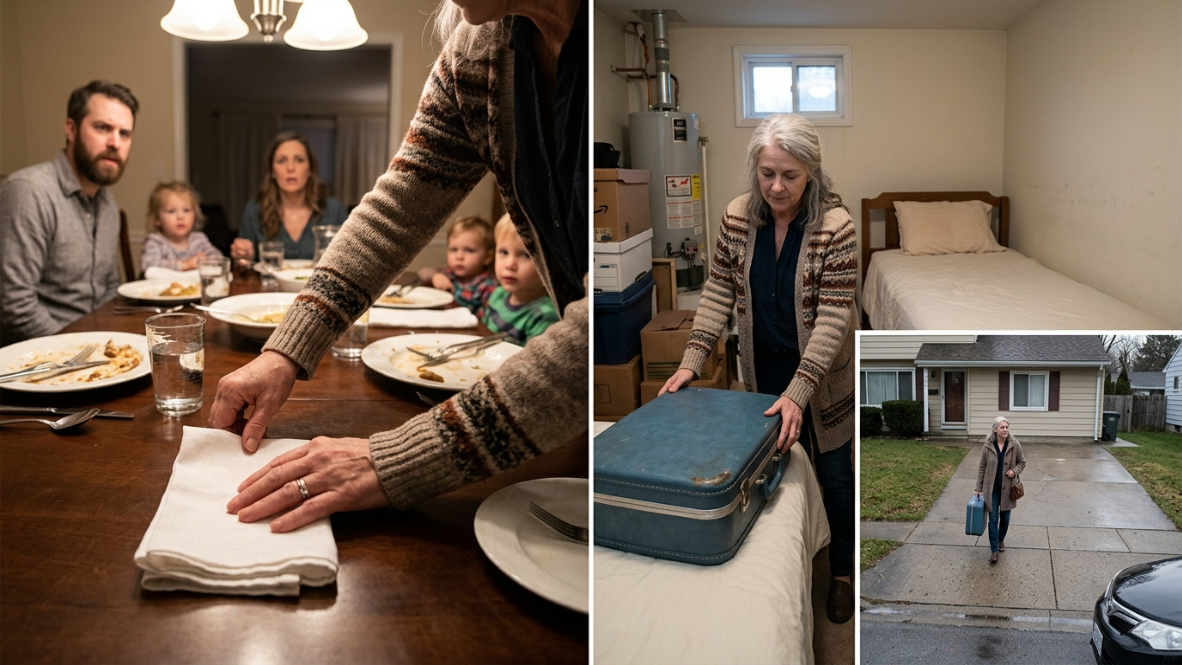
Not the silence of a storage room where you cry quietly so nobody hears.
Peaceful silence.
I placed David’s photograph on the nightstand.
His smile looked the same as always.
“You would have hated that house,” I whispered.
I laughed softly.
“Actually, you probably would have said something much earlier than I did.”
My husband had always been protective of me.
Sometimes too protective.
Years ago, when Michael was twenty-five and wanted to borrow money for a business idea, David warned me.
“Help him if you want,” he said. “But don’t destroy yourself trying to save someone who won’t save himself.”
I had ignored him.
Because I was his mother.
And mothers believe their children will always remember their sacrifices.
Sometimes they do.
Sometimes they don’t.
The next morning, I woke up before sunrise.
Old habits.
I made coffee from the little machine in the hotel room.
It was terrible.
I laughed when I tasted it.
“David would have complained about this,” I said to myself.
Then I packed my suitcase.
I was not going back to beg.
I was going back to collect my life.
When I arrived at my old neighborhood, my heart tightened.
The familiar streets.
The maple trees.
The small bakery on the corner.
The blue house across from mine.
Everything looked exactly the same.
Except me.
Margaret was waiting outside.
The moment she saw me, she rushed over.
“Oh, Eleanor.”
She hugged me tightly.
I almost broke then.
Not because I regretted leaving.
Because after months of feeling invisible, someone was happy I was there.
“You look tired,” Margaret said.
“I am.”
“What happened?”
I looked at my house.
The place where I had lived.
The place where David and I built a lifetime.
“I made a mistake.”
Margaret shook her head.
“No, dear.”
She squeezed my hand.
“You made a choice with love. Someone else took advantage of it.”
Those words stayed with me.
Because they were true.
Inside my house, everything was covered with sheets.
Dust sat on the furniture.
The air smelled like old wood and memories.
But I smiled.
Because this mess belonged to me.
This was my mess.
My life.
My home.
I walked into the kitchen.
The same kitchen where David used to make pancakes on Sundays.
The same counter where Michael sat as a child doing homework.
I ran my hand over the wooden surface.
“I’m back,” I whispered.
Then I noticed something on the counter.
A small envelope.
My name was written on it.
Eleanor.
My heart skipped.
I recognized the handwriting immediately.
David’s handwriting.
Impossible.
I picked it up with trembling hands.
There was no way.
David had been gone for five years.
Slowly, I opened it.
Inside was a letter.
And three pages of documents.
The first sentence made my breath stop.
“My dear Eleanor, if you are reading this, then something has happened that made you question whether you still have a place to call home.”
I sat down.
My hands shook.
Because my husband had written those words years ago.
Before Michael called me.
Before I sold my house.
Before I moved away.
Before I discovered my own son was willing to treat me like a servant.
I continued reading.
“I know our son loves you. But I also know that sometimes people we love become blind to what we give them.”
Tears filled my eyes.
David knew.
Not the details.
Not Michael’s future mistakes.
But he understood something about human nature.
The next line made me stop completely.
“I have arranged something for you. Something that ensures you will always have security, no matter who asks you for help.”
I looked down at the documents.
And my heart started beating faster.
Because hidden inside those papers was a secret I had never known.
A secret that meant Michael had not just underestimated his mother.
He had underestimated the woman who had spent her entire life preparing for the day she would need to stand alone.
And back at Michael’s house…
He was about to discover that the mother he thought he could control had already taken her first step toward leaving him behind.
I read the letter again.
Then a third time.
Because sometimes the truth is so unexpected that your mind refuses to accept it the first time.
David’s handwriting stared back at me.
The same careful letters that had written birthday cards, anniversary notes, and grocery lists for almost fifty years.
My husband had always been a planner.
I used to tease him about it.
If we went on vacation, he had a folder.
If we bought something expensive, he researched it for weeks.
If we had a problem, he didn’t panic.
He prepared.
And now, five years after his death, he had somehow prepared for this moment too.
I unfolded the documents.
The first page was a legal agreement.
My eyes moved slowly across the words.
A trust.
A protected account.
A property arrangement.
I stopped at one sentence.
“The beneficiary, Eleanor Whitmore, shall maintain full control and ownership of all assets placed under this trust.”
I whispered the words aloud.
“Full control.”
Not Michael.
Not anyone else.
Me.
For the first time in months, I felt something return to me.
Not money.
Not power.
My confidence.
Because somewhere along the way, I had started believing Michael’s version of me.
That I was old.
That I needed help.
That my choices were no longer important.
But David had never seen me that way.
He had seen the woman who raised a child while working two jobs.
The woman who sat beside him through cancer treatments.
The woman who rebuilt their life after losing everything during difficult years.
He knew exactly who I was.
I continued reading the letter.
“Eleanor, if our son ever needs help, help him because you choose to, not because you feel obligated. There is a difference between love and surrender.”
I closed my eyes.
Those words hit deeper than anything Michael had said.
Because I realized something painful.
I had not only been giving too much.
I had been teaching people that my needs came last.
I had spent my whole life making sure everyone else had a place at the table.
But when it came time for me to sit down…
They moved me to the corner.
Margaret found me an hour later still sitting in the kitchen.
“Are you okay?”
I looked up.
For once, I could answer honestly.
“I think I will be.”
She noticed the papers.
“What are those?”
I handed her the letter.
She read silently.
Then she looked at me.
“Your husband was a smart man.”
I smiled.
“Yes, he was.”
“What does this mean?”
I folded the documents carefully.
“It means I am not starting over.”
I looked around the kitchen.
“I’m coming back.”
Meanwhile, across town, Michael was discovering that his Sunday night had not gone the way he expected.
At first, he thought I would return.
He waited.
One hour.
Two hours.
Then midnight came.
Still nothing.
Jessica sat on the couch scrolling through her phone.
“She’ll calm down,” she said.
Michael didn’t answer.
He stared at the empty guest room.
The room that wasn’t really a guest room.
The room where his mother had slept.
For the first time, he noticed how small it was.
How uncomfortable it looked.
How little space she had.
He remembered when she first arrived.
She had smiled and said:
“Don’t worry. I don’t need much.”
At the time, he thought she meant it.
Now he wondered if she had meant something else.
Maybe she meant:
“I don’t need much, but I deserve respect.”
Jessica looked up.
“You’re really going to let her do this?”
Michael frowned.
“Do what?”
“Leave.”
He looked at her.
“She’s my mother.”
Jessica shrugged.
“And she’s been helping us for free for months.”
Something about the way she said it bothered him.
Helping us.
Not living with us.
Not being family.
Helping us.
Like a service.
Michael stood up.
“I’m going to call her.”
He dialed.
Straight to voicemail.
Again.
Voicemail.
Again.
Nothing.
His frustration grew.
“She’s ignoring me.”
Jessica rolled her eyes.
“Maybe she needs time.”
But Michael knew something was different.
His mother had always answered.
Always.
Even when she was hurt.
Even when she was angry.
She answered.
Because that was who Eleanor was.
And suddenly, Michael realized the frightening truth:
Maybe this time, she wasn’t angry.
Maybe she was finished.
The next morning, Michael woke up to an unexpected message.
Not from me.
From his bank.
He opened it while drinking coffee.
His face changed.
The message was simple.
“A scheduled transfer request has been canceled.”
He frowned.
Then another notification appeared.
“Account access permissions have been updated.”
His confusion turned into panic.
He immediately called the bank.
“Hi, I need information about a recent change.”
The representative asked for verification.
After several minutes, the employee said:
“Mr. Whitmore, these changes were made by the account owner.”
“My mother?”
A pause.
“Yes.”
Michael went quiet.
“What changes?”
The employee hesitated.
“I’m not authorized to discuss private account details, but I can confirm that Mrs. Eleanor Whitmore has removed previous access permissions.”
Michael’s grip tightened around the phone.
Previous access permissions.
Because months earlier, when I moved in, Michael had convinced me to let him “help organize my finances.”
He said it was easier.
He said he was only trying to protect me.
I believed him.
But now…
I had remembered something.
Something I had forgotten.
The day I signed those papers, the lawyer had warned me:
“Mrs. Whitmore, never give anyone permanent access to your accounts, even family.”
I had smiled and said:
“My son would never misuse my trust.”
The lawyer had simply looked at me and replied:
“Sometimes people don’t hurt us because they are evil. Sometimes they hurt us because they believe we will always forgive them.”
At the time, I thought that was too cynical.
Now I understood.
Michael ended the call.
Jessica immediately noticed his expression.
“What happened?”
He looked at her.
“My mom changed everything.”
“What does that mean?”
“It means she’s not coming back.”
Jessica stood.
“She can’t just leave.”
Michael looked toward the window.
The same window where he had watched me carry groceries.
The same window where he had watched me play with his children.
The same window where he had watched me disappear slowly.
And for the first time…
He wondered if he had lost something that money could never replace.
His mother.
Three days later, I returned to my old house.
The repairs had started.
The windows were open.
Fresh air moved through the rooms.
My rocking chair was back on the porch.
My coffee cup sat beside it.
I thought I was finally getting my life back.
Then my phone rang.
I looked at the screen.
Michael.
I let it ring.
Once.
Twice.
Three times.
Then it stopped.
A minute later, a message appeared.
I opened it.
Only six words.
“Mom, please. We need to talk.”
I stared at the message.
A month ago, those words would have broken my heart.
Now…
They only made me curious.
Because Michael did not sound angry.
He sounded afraid.
And I had a feeling he had finally discovered something I had known for a long time.
A mother’s love is powerful.
But even the strongest love has a limit.
And when someone pushes that limit…
Sometimes the person who leaves is not the one who loses everything.
CONTINUE READ NEXT PART… 👇