
Chapter 1: The Anatomy of a Fall
They tell you that drowning is quiet, but they are wrong. Drowning inside your
own body is deafening.
It is the percussive, mechanical rush of an automated oxygen valve hissed into
plastic tubing. It is the rhythmic, frantic gallop of a fetal heart monitor
pulsing at one hundred and seventy beats per minute—a tiny, terrified bird
fluttering against the cage of my ribs. And above all, it is the sound of bone
grinding against bone every time the diaphragm spasms, pulling cold,
institutional air into lungs that are slowly filling with blood.
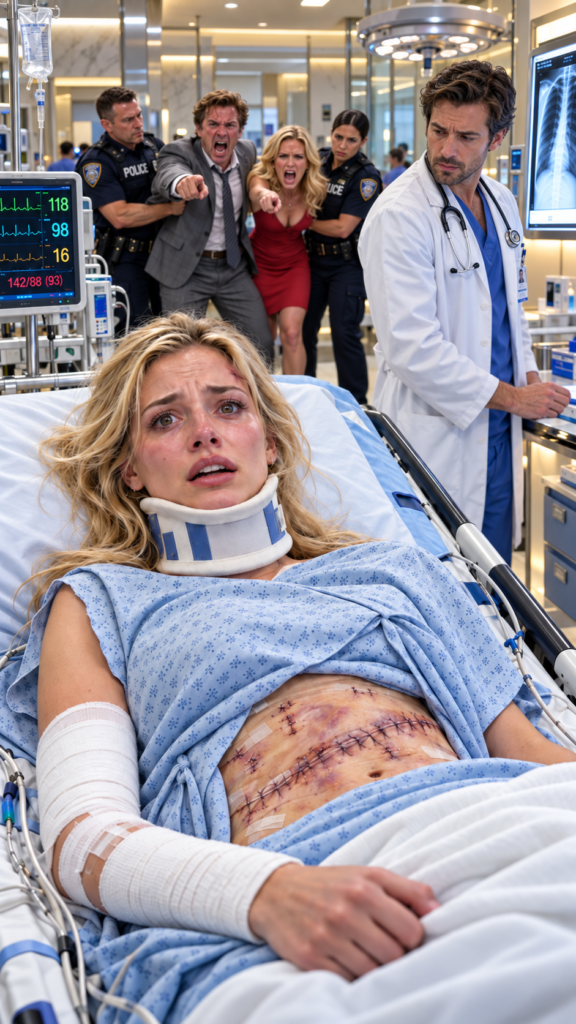
I lay on the narrow, vinyl-covered gurney in Trauma Bay 4 of St. Jude’s Memorial
Hospital, my hands clutched tightly over the rounded swell of my five-month
pregnant belly.
Under the buzzing fluorescent tubes, the white acoustic tiles of the ceiling
seemed to warp and breathe. Every breath was a razor blade dragged across my
pleura. Three ribs on my left side—the eighth, ninth, and tenth—were fractured.
Not cracked. Fractured. The clinical term was displaced segmental fractures, the
kind of damage usually reserved for pedestrian victims of high-speed vehicular
collisions.
Beside my bed, kneeling on the scuffed linoleum, was my husband.
Julian Vance.
Julian was weeping. It was an extraordinary performance, an Oscar-caliber
display of patrician grief that would have moved a stone statue to tears. His
broad shoulders heaved beneath a charcoal cashmere overcoat that cost more than
an average family’s annual mortgage. His handsome, aristocratic face was
flushed, tears tracking with aesthetic perfection down his chiseled jaw, his
hand trembling as he clamped down on my left wrist.
His grip was not a comfort. It was a tourniquet.
Julian’s thumb was pressed flat against my radial artery, his index finger
digging with surgical, sadistic precision into the tender, unmyelinated nerve
cluster between my thumb and forefinger. A silent, excruciating pressure. A
private language developed over seven years of marriage: Speak, and I will
finish what the floorboards started.
“She fell, Doctor,” Julian choked out, his voice cracking with a ragged,
theatrical despair that echoed into the busy corridor. He looked up at the
attending trauma surgeon with eyes wide, brimming with manufactured innocence.
“She was carrying the antique laundry basket down the grand staircase at our
estate in Beacon Hill. She’s five months along, you see… her prenatal balance
has been so erratic. Her balance is terrible. Her physician warned us about her
fragile equilibrium.”
He squeezed my hand harder, the bone in my wrist groaning under the pressure.
“I heard the crash from the library,” Julian sobbed, burying his face against
the thin hospital blanket covering my knees. “I found her at the base of the
landing, tangled in the runner. Please, Dr. Hayes. You have to save my wife. You
have to save my son. They are my entire world.”
Standing at the foot of the gurney was Dr. Samuel Hayes.
The surgeon was forty-five, broad-shouldered, with skin the color of dark
mahogany, close-cropped salt-and-pepper hair, and eyes that held the hard,
unblinking clarity of an optical lens. He wore surgical scrubs stained with
dried iodine at the cuffs, a heavy titanium stethoscope resting against his
collarbone.
Dr. Hayes did not offer a comforting pat on the shoulder. He did not mirror
Julian’s panic.
He stepped around the gurney, his shoes making no sound on the floor, and
reached down with gloved hands. With gentle, immovable authority, Dr. Hayes
slipped his fingers between Julian’s hand and my wrist, cleanly breaking my
husband’s grip.
Julian’s eyes flashed—a microscopic, feral flare of territorial fury that
vanished in a tenth of a second, smoothed back into the wet, weeping eyes of a
doting husband.
“Step back, sir,” Dr. Hayes said. His voice was remarkably quiet, but it
possessed the density of lead. “Give my nurses room to establish the arterial
line.”
“I am her husband,” Julian protested, his voice lowering into that smooth,
Ivy-League baritone that usually bent bank managers and state senators to his
will. “I belong at her side. I have our private chauffeur idling in the
emergency lane; I have already chartered a medical transport to our private
retreat in Newport. She just needs a localized analgesic, a splint, and rest. My
family’s private medical staff can handle her convalescence.”
Dr. Hayes didn’t answer. He picked up an industrial pair of trauma shears from
the stainless steel Mayo stand.
With two clean, decisive strokes, he sliced through the blood-stained silk of my
ruined emerald-green blouse, peeling the fabric away from my torso.
The room seemed to drop ten degrees.
The head trauma nurse let out a sharp, involuntary intake of breath, stepping
back from the cart.
My torso was an oil painting of domestic slaughter.
Across my swollen, pregnant belly, there were no scrapes. No rug burns. No
chaotic abrasions that come from tumbling down fourteen carpeted mahogany
stairs.
Instead, blooming across my lower left ribcage, was a single, violent,
elliptical hematoma—an unmistakable, blunt-force contusion patterned with the
distinct, diamond-tread imprint of an English hand-welted wingtip boot. Julian’s
shoe.
Further up, encircling both of my forearms, were deep, dark-purple fingerprint
contusions where I had thrown my arms over my unborn child to shield her from
the blows. And along the curve of my collarbone were crescent-shaped gouges
where his manicured nails had torn into my flesh as he hauled me up by my hair
to whisper into my ear before calling the private ambulance.
Dr. Hayes leaned down, his face inches from the bruising. He adjusted the
overhead halogen surgical lamp, the harsh white beam illuminating every ruptured
capillary in my skin.
He reached out, his gloved fingers trailing lightly over the heavy, solid-gold
antique locket resting in the hollow of my throat.
The locket was an intricate piece of Victorian mourning jewelry—a heavy, oval
pendant of hand-chased gold, suspended from a thick, diamond-cut link chain that
had no clasp. Julian had personally soldered the links shut around my neck on
our fifth anniversary. A collar of gold, he had whispered that night, locking
the metal to my skin. So the world always knows who owns the ledger.
“A fall down the stairs, Mr. Vance?” Dr. Hayes murmured, his fingers lingering
on the cool metal of the locket.
“Yes,” Julian said, his voice tightening at the edges, the aristocratic mask
beginning to fray. “She lost her footing. The velocity of the descent—”
“A fall down a flight of stairs produces decentralized, chaotic trauma,” Dr.
Hayes said, straightening his spine. He stood six-foot-two, his broad frame
completely blotting out the fluorescent lights above me, casting a long,
protective shadow over my broken body. “It produces lacerations to the scalp,
fractures to the extremities, and rotational sprains to the ankles. It does not
produce isolated, localized transverse fractures of the lower ribcage with the
tread pattern of an eight-hundred-dollar dress shoe.”
Julian froze.
The weeping stopped. The tears on his cheeks seemed to dry instantly, like water
dropped onto a red-hot iron skillet.
His posture shifted. The slumped, grieving husband evaporated in the span of a
single heartbeat, replaced by the rigid, calculating, predatory titan who
managed four billion dollars in generational real estate and political
influence.
“Dr. Hayes,” Julian whispered, his voice smooth, cold, and vibrating with an
ancient, dangerous arrogance. “I suggest you take a very careful breath before
you finish that sentence. You are an employee of this municipal hospital system.
My family’s charitable foundation endowed the entire surgical pavilion you are
currently standing in. My mother, Eleanor Vance, chairs the medical licensing
ethics board for this commonwealth.”
Julian took a slow, deliberate step toward the gurney, his hand reaching out,
his fingers curving like talons toward my throat.
“My wife is going home with me. Tonight. Unhook the monitors.”
Dr. Hayes did not flinch. He did not look at the door.
He stepped directly into Julian’s path, his chest inches from my husband’s
designer lapels.
“Initiate an emergency protective medical hold under suspicion of felony
domestic assault,” Dr. Hayes barked to the charge nurse, never breaking eye
contact with Julian. “Lock the wing doors. Call hospital security. And get the
county police down here right now.”
Julian’s eyes widened, a feral, unhinged rage ripping across his features.
“You miserable son of a bitch!” Julian snarled, his hand flashing out with
lightning speed, aiming straight for my throat to rip the gold locket off my
neck before anyone could examine it.
His manicured fingers brushed the gold chain.
Before the links could break, I shoved my right arm upward, catching his thumb,
twisting it violently backward with the last reserve of my adrenaline.
Julian let out a sharp, guttural gasp of shock as two heavy, armored hospital
security guards burst through the curtain, tackling my husband into the glass
wall of the trauma bay.