PART 4
The photograph stayed on the screen between us.
I couldn’t look away.
There I was, standing beside a lake I had never visited, wearing a blue sweater I remembered owning when I was nine.
Behind me was the cabin.
And behind the cabin stood a woman holding a little girl who looked exactly like me.
For several seconds, nobody spoke.
Then I whispered the question that had been burning inside me.
“Is that my twin?”
Derek’s face changed.
Elena looked at him.
He slowly shook his head.
“We don’t know.”
“But she looks like me.”
“I know.”
“Then who is she?”
“We’re trying to find out.”
I pushed the phone away.
“I want my mom.”
Derek looked down.
“I know.”
“I want to ask her.”
“I know.”
“Then call her.”
Nobody moved.
“Call her!”
My voice cracked.
Derek finally picked up his phone.
He dialed.
The call went unanswered.
He tried again.
Nothing.
Then a message appeared.
I’m unavailable. Stop calling.
Derek stared at it.
“She sent that to me earlier.”
I felt something inside me break.
My mother knew I was safe.
She knew the police had found me.
She knew I was asking for her.
And she still wasn’t coming home.
That was when I stopped hoping she would walk through the door and explain everything.
Something had changed.
I no longer wanted an explanation that made everything okay.
I wanted the truth.
Three days later, investigators found the cabin.
It wasn’t in Hawaii.
It wasn’t in California.
It was in a small mountain community nearly four hours from our home.
The property belonged to a woman named Rebecca Mercer.
Rebecca had never met me.
At least, that’s what she claimed.
But when investigators showed her the photograph, she immediately started crying.
And when they showed her my picture, she said something that made everyone in the room go silent.
“That isn’t the girl you think it is.”
The girl in the photograph wasn’t me.
Her name was Lily.
She was Rebecca’s daughter.
And she had been born eleven years earlier.
Rebecca explained that Lily had a rare resemblance to another child she had once known.
A child named Maya.
My name.
The investigators asked her how she knew that name.
Rebecca told them the story.
Eleven years earlier, before I was born, my mother had been pregnant.
She had been married to my father.
At the time, my father had a younger sister named Rebecca.
Rebecca and Valerie had been close.
Very close.
Until something happened.
A family dispute over money.
A missing inheritance.
A secret bank account.
And an accusation that had destroyed the family.
Rebecca had accused Valerie of stealing money from their grandmother.
Valerie denied it.
The family eventually sided with Valerie’s version of events.
Rebecca left.
She moved away.
She got married.
And years later, she had Lily.
But Rebecca had never forgotten her brother.
Or his first child.
My father.
The investigators asked where my father was.
Rebecca said:
“He died before Maya was born.”
I had always known my father had died.
My mother had told me he had been killed in an accident.
That was all I knew.
But Rebecca told investigators something else.
“My brother didn’t die in an accident.”
The words eventually reached me through Elena.
I stared at her.
“What happened to my father?”
“We’re still investigating.”
“But you know something.”
She hesitated.
“We know the original report described an accident.”
“And?”
“There are inconsistencies.”
I felt sick.
“Was my mother there?”
“We don’t know.”
“But she knows something.”
“We believe she does.”
That night, I sat by the window of my temporary room and watched rain slide down the glass.
I thought about my mother.
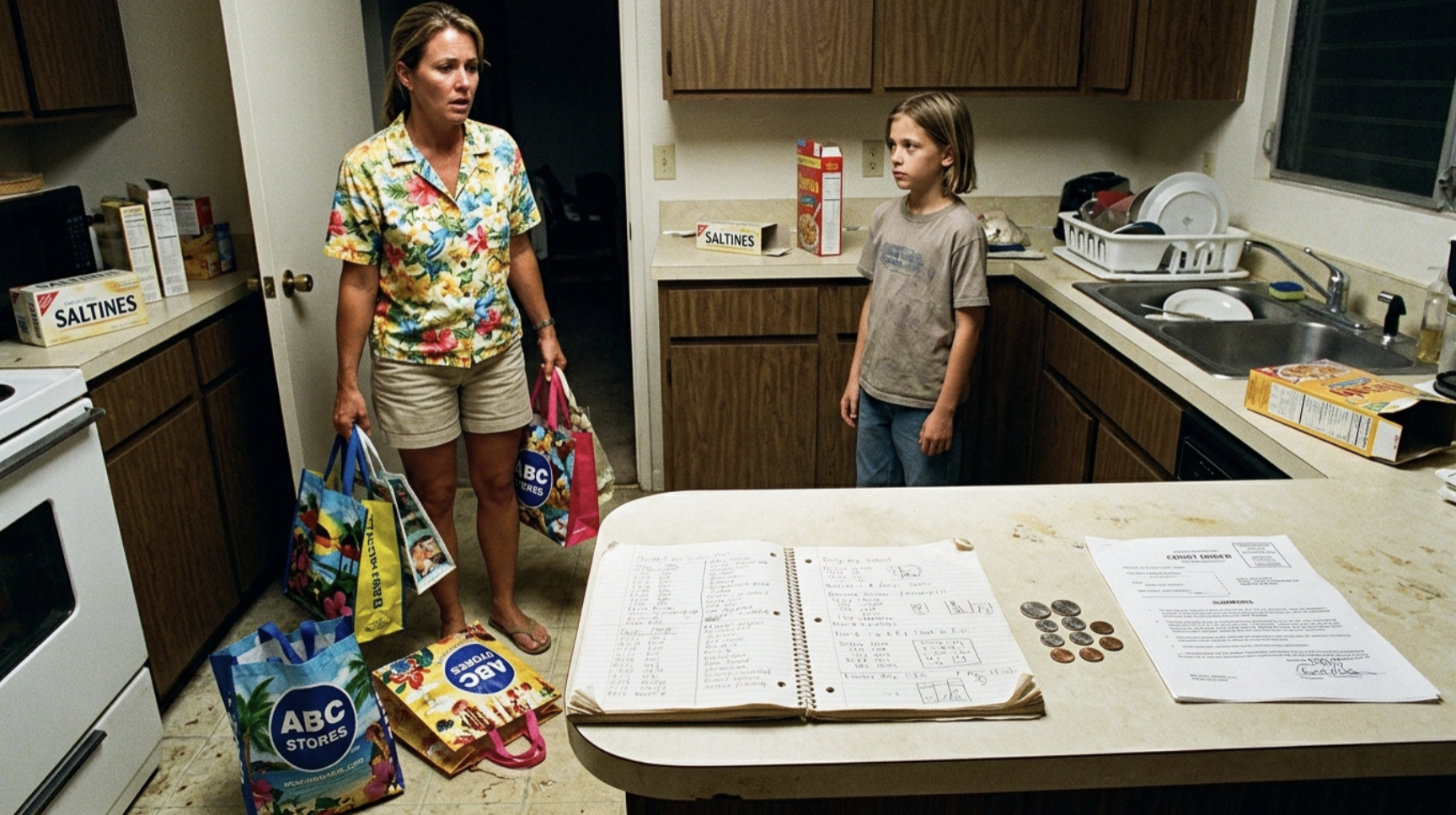
About the twenty dollars.
About the hidden phone.
About the photograph.
About my father.
About the woman who looked like she had been waiting eleven years for someone to uncover the truth.
Then I remembered something from my notebook.
Day 1.
I had written:
Mom left at 8:32 a.m.
Why had I written the exact time?
Because I was scared.
Because I thought maybe nobody would believe me.
I had documented everything.
And now those little details were helping investigators rebuild what happened.
The next morning, Elena came in carrying a folder.
She placed it on the table.
“Maya, there’s something you should see.”
Inside was a copy of my mother’s travel itinerary.
Hawaii.
California.
Virgin Islands.
Thirty days.
But there was another booking.
One that had never been mentioned.
A flight scheduled for Day 17.
To another state.
“What is this?”
“We don’t know yet.”
“Where was she going?”
Elena looked at me.
“To meet someone.”
“Who?”
“Your mother’s former attorney.”
My heart started racing.
“Why?”
“We don’t know.”
Then Elena opened another document.
A financial record.
There were several large transfers from an account in my mother’s name.
One had been made eleven years ago.
Another nine years ago.
Another six months before the trip.
The newest transfer was for $180,000.
My mother had moved the money into an account under a different name.
The name was:
Lily Mercer.
I stared at it.
“Why would she send money to that girl?”
Nobody knew.
Then Derek arrived.
He looked exhausted.
He sat down beside me.
“I found something.”
He placed an envelope on the table.
“This was in Valerie’s suitcase.”
My hands trembled.
“What is it?”
“I haven’t opened it.”
“Why?”
“Because it has your name on it.”
I slowly picked it up.
The envelope was old.
The paper was yellowed.
My name was written across the front.
Not in my mother’s handwriting.
In my father’s.
I knew immediately.
I had seen his handwriting before.
There was a birthday card he had written before I was born.
Mom had kept it in a box.
I opened the envelope.
Inside was a letter.
It began:
Maya,
If you’re reading this, something happened to me before I could tell you the truth.
My hands began shaking.
I continued.
My father wrote that he had discovered Valerie had been secretly moving money from a family trust.
He had confronted her.
She told him she would return it.
But he didn’t believe her.
He had started collecting evidence.
Bank records.
Photographs.
Messages.
He intended to take everything to a lawyer.
Then the letter changed.
Valerie knows I found out.
If something happens to me, do not believe the accident story.
I stopped reading.
I couldn’t breathe.
Derek took the letter from my hands.
Elena read the rest.
My father had written that he believed Valerie was planning to leave the country with me.
He had also discovered that Valerie had secretly contacted Rebecca.
The woman in the photograph.
There had been an agreement.
Valerie had intended to give Rebecca money to keep quiet about the family trust.
But Rebecca refused.
My father planned to expose everything.
Then he died.
The accident happened two days later.
The official report said his car had lost control on a wet road.
But the letter suggested something else.
My father believed his brakes had been tampered with.
And at the bottom of the letter was one final sentence.
If Valerie tells Maya I died because of an accident, she is lying.
I cried.
Not because I had suddenly discovered that my mother might have been involved.
I cried because my father had known I might one day need the truth.
And he had tried to leave it somewhere I could find it.
My mother returned on Day 13.
Not because she wanted to.
Because investigators located her.
She arrived at the courthouse wearing the same expensive clothes she had worn in her vacation photographs.
But she no longer looked sun-kissed.
She looked frightened.
When she saw me, she stopped.
“Maya.”
I stared at her.
She took a step toward me.
I stepped back.
Her face collapsed.
“You’re angry.”
I said nothing.
“I can explain.”
“You left me.”
“I know.”
“You gave me twenty dollars.”
“I thought there was food.”
“There wasn’t.”
“I didn’t know.”
“You didn’t check.”
She opened her mouth.
Nothing came out.
“You told Derek I was at the lake.”
She looked at him.
“You told him I was safe.”
Her eyes filled with tears.
“I made a terrible mistake.”
“No.”
My voice was quiet.
“You made many choices.”
She looked at me.
I continued.
“You chose to leave.”
“You chose to lie.”
“You chose not to answer.”
“You chose not to come home.”
“And you chose to hide the phone.”
Her face went white.
She looked at the investigators.
Then at Derek.
Then back at me.
“I never wanted you hurt.”
“Then why did you leave me?”
She couldn’t answer.
Finally, she whispered:
“Because I was afraid.”
“Of what?”
She started crying.
“Everything.”
“Were you afraid I’d find out about Dad?”
She closed her eyes.
That was the answer.
She didn’t need to say anything.
I knew.
The investigation continued for months.
My mother was charged with child abandonment and several financial crimes related to the family trust.
The circumstances surrounding my father’s death were reopened.
Investigators eventually discovered that the original accident report had missed evidence from the vehicle.
The brakes had indeed been tampered with.
But proving who had done it was another matter.
There wasn’t enough evidence to establish that my mother had caused the crash.
There were suspicions.
There were documents.
There were contradictory statements.
There were missing records.
But there was no final answer.
And I learned something important during those months.
Sometimes the truth doesn’t arrive as a perfect ending.
Sometimes it arrives as pieces.
A receipt.
A photograph.
A notebook.
A letter.
A forgotten phone.
A person finally deciding to speak.
Piece by piece, you build a picture.
And sometimes that picture is painful.
But it is still better than living inside a lie.
I didn’t go back to live with my mother.
For a while, I stayed with Sarah and her family.
The woman who had stood outside my kitchen window became one of the most important people in my life.
She never treated me like a problem.
She never told me I was dramatic.
She never said I was too young to understand.
When I was scared, she listened.
When I was angry, she listened.
When I asked the same question five times, she answered it five times.
And slowly, I learned what a safe home felt like.
It wasn’t a house where nobody argued.
It wasn’t a house where everything was perfect.
It was simply a house where you didn’t have to be afraid of asking for help.
Derek eventually disappeared from our lives.
He testified during the investigation and admitted that he had believed Valerie’s lies.
He apologized to me one final time.
“I should have asked questions,” he said.
I told him:
“Yes.
You should have.”
Then I walked away.
Years passed.
I kept the notebook.
The original one.
The pages were bent.
The cover was stained.
Some of the writing had faded.
But I kept it.
Because it reminded me of the girl I had been.
The eleven-year-old who thought surviving meant staying quiet.
The girl who believed adults automatically knew better.
The girl who thought asking for help meant she had failed.
She hadn’t failed.
She had survived.
And I wanted her to know that.
When I turned eighteen, I received a letter from my mother.
She was serving her sentence.
The letter was four pages long.
She apologized.
She explained.
She blamed circumstances.
Then she apologized again.
At the very end, she wrote:
I hope one day you understand that I loved you.
I stared at that sentence for a long time.
Then I wrote my response.
I didn’t tell her I forgave her.
I wasn’t ready.
Instead, I wrote:
I believe you loved me.
But love isn’t enough when someone isn’t safe.
I needed you to protect me.
You chose something else.
Maybe someday I’ll understand why.
But understanding isn’t the same as forgetting.
I mailed the letter.
And I never regretted it.
Years later, I visited the lake from the photograph.
The cabin was still there.
Rebecca had sold the property, but she had given me the address.
I stood beside the water.
For years, I had imagined that photograph as proof that someone had stolen my childhood.
Now I understood something different.
The photograph had become a symbol of everything my mother had tried to hide.
I took out my old notebook.
I opened it to the first page.
Day 1: Mom left at 8:32 a.m.
I smiled sadly.
Then I turned to the last page.
There was only one sentence.
I had written it years after everything happened.
I survived the day she left me, but I became myself the day I stopped blaming myself.
I closed the notebook.
The wind moved across the lake.
For a moment, I imagined the eleven-year-old version of me standing beside the water.
She was holding a twenty-dollar bill.
She was scared.
She didn’t know anyone was coming.
She didn’t know Sarah would find her.
She didn’t know the police would believe her.
She didn’t know the notebook would become evidence.
She didn’t know the truth about her father would eventually come out.
She didn’t know her mother would lose the life she had tried so desperately to protect.
And most importantly, she didn’t know that the life waiting for her would be bigger than the house she had been abandoned in.
I whispered:
“You made it.”
The lake gave no answer.
But for the first time, I didn’t need one.
I never got the perfect ending.
My father never came back.
My childhood could never be returned.
My mother could never erase those thirty days.
And there were questions about my father’s death that might never have complete answers.
But I got something more important.
I got a life that belonged to me.
I finished school.
I went to college.
I built a career helping children who found themselves in situations where adults had failed them.
Whenever I met a frightened child who whispered, “Nobody will believe me,” I knew exactly what to say.
“I will listen.”
Because once, I had been that child.
The child with twenty dollars.
The child with an empty refrigerator.
The child sleeping beside the front door.
The child who thought she had to survive quietly.
And if there was one thing I wanted every child like me to understand, it was this:
Being abandoned is never your fault.
Being hungry is not being dramatic.
Being afraid is not being weak.
And asking for help is not ruining anyone’s life.
Sometimes asking for help is the first step toward getting your life back.
I kept the 64 cents from that summer too.
Not because it was valuable.
It wasn’t.
It was just three quarters short of a dollar.
But it represented the moment I realized that I couldn’t depend on the person who was supposed to protect me.
And years later, I finally understood something else.
Those 64 cents weren’t what I had left.
They were what I had survived with.
And somehow, from that tiny amount, I built an entire life.
A life my mother didn’t choose.
A life Derek didn’t control.
A life no one could take away.
My own.
And that was the ending I never knew I was fighting for.
THE END
Continue Reading