PART 3
My hand hovered beside the doorknob.
Advertisement
I suddenly wished I hadn’t walked down the hallway.
But I didn’t leave.
I listened.
Marlene’s voice was too muffled for me to hear clearly through the door, but Claire’s responses were unmistakable.
Advertisement
“No. He didn’t hit me.”
I swallowed.
“He hasn’t threatened me.”
Another pause.
“I know that doesn’t make it okay.”
I stepped backward.
The hallway suddenly felt much colder.
Claire continued.
“He just… doesn’t see me.”
I stared at the closed door.
Those four words landed harder than an accusation.
He just doesn’t see me.
I wanted to knock.
I wanted to open the door and demand to know what she meant.
Instead, I stood there listening to my wife describe me to her mother.
“He thinks because he’s tired, he’s doing enough.”
Pause.
“I told him about the medicine three times.”
Pause.
“No. He didn’t pick it up.”
I closed my eyes.
“He asked me what was for dinner.”
My face burned.
“I know.”
Then Claire’s voice cracked.
“I had seventeen staples, Mom.”
Silence.
“I know.”
She started crying.
Quietly.
The kind of crying someone does when they’re trying desperately not to let the person in the next room hear them.
“I know I agreed to this life,” she whispered. “But I didn’t agree to be alone in it.”
That sentence stayed with me.
I could have knocked.
I could have apologized.
I could have walked into the room, taken Luca, gotten the medication, and admitted that I had been wrong.
Instead, I did what I had been doing for months whenever something uncomfortable happened.
I walked away.
I went to the kitchen.
I sat on the couch.
And I told myself Claire was exaggerating.
Because accepting the truth would have meant accepting something much harder:
I wasn’t failing to help because I didn’t know what she needed.
I was failing because I expected her to ask for everything.
Even things I should have noticed myself.
I went to bed at 12:30.
Claire didn’t.
At some point during the night, I woke up and heard the bedroom door open.
Claire walked past me.
She was carrying Luca.
She moved so slowly that I realized she was in pain.
I watched from beneath the blanket.
She went into the kitchen.
She opened the refrigerator.
She stood there for several seconds.
Then she closed it.
She opened a cabinet.
Nothing.
Finally, she took a granola bar from the pantry.
She sat at the kitchen table.
Luca slept against her chest.
She ate with one hand.
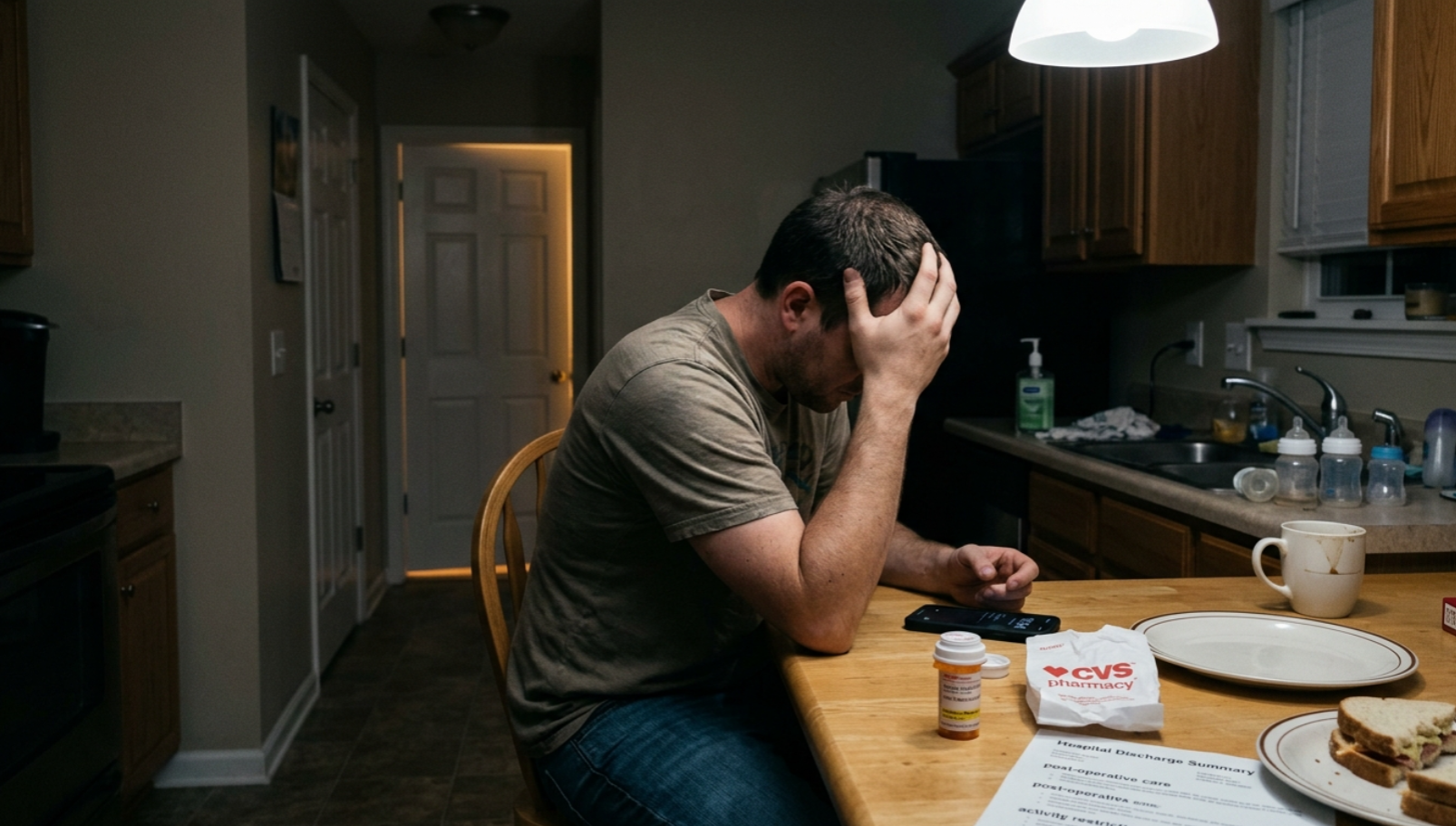
I watched my wife eat a granola bar at 2:17 in the morning while recovering from surgery because I had asked what was for dinner.
And I still didn’t get up.
That is the memory I hate most.
Not the argument.
Not the phone call.
That.
The next morning, I woke to Luca crying.
Claire was already awake.
She was sitting on the edge of the bed, pale and exhausted.
“Can you take him?” she asked.
I reached for him.
“Sure.”
She tried to stand.
Her knees buckled slightly.
I caught her elbow.
“Careful.”
She looked at me.
“I know.”
I carried Luca into the living room.
Claire followed slowly.
She lowered herself onto the couch.
Then she looked at me.
“Did you get the prescription?”
I had forgotten.
Again.
Her face changed.
Not dramatically.
She simply stopped expecting an answer.
She picked up her phone.
“I’ll have someone bring it.”
“Who?”
“My sister.”
“You called her?”
“Yes.”
“When?”
“Last night.”
I felt defensive again.
“You could have told me.”
Claire looked at me for a long moment.
“I did.”
I had no response.
Her sister arrived twenty minutes later.
Her name was Natalie.
She stepped through the front door carrying a pharmacy bag, a grocery bag, and a small paper cup of coffee.
She looked at Claire.
Then she looked at me.
She didn’t say hello.
She went directly to my wife.
“How bad is it?”
Claire shook her head.
“I’m okay.”
Natalie looked at me.
“She’s not okay.”
I immediately felt irritated.
“I know she’s recovering.”
Natalie stared at me.
“Do you?”
I opened my mouth.
Nothing came out.
She placed the pharmacy bag on the table.
“Her medication was ready yesterday.”
I looked down.
“I was going to pick it up.”
Natalie laughed once.
There was no humor in it.
“Apparently.”
She turned toward Claire.
“I brought food.”
Claire’s eyes filled with tears.
Not because of the food.
Because somebody had thought to bring it.
Natalie unpacked containers.
Soup.
Rice.
Fruit.
Sandwiches.
A bottle of water.
Then she placed a small notebook beside Claire.
“What’s that?”
“Medication schedule.”
Natalie tapped the notebook.
“I wrote down the times.”
I looked at it.
There were alarms listed every few hours.
Pain medicine.
Antibiotics.
Water.
Food.
Rest.
I stared at the page.
It looked like something that should have been my responsibility.
Natalie noticed.
She didn’t say anything.
That was somehow worse.
Around noon, Claire took her medication.
For the first time since she came home, her shoulders relaxed.
She closed her eyes.
Luca slept against her chest.
I stood nearby.
I wanted to say something.
Instead I said:
“Do you want me to order lunch?”
Claire opened her eyes.
“No.”
“Okay.”
I walked away.
That afternoon, I went to work remotely.
I sat at the dining table with my laptop open while Claire remained in the bedroom.
Every few hours I heard Luca cry.
Every time, Claire got up.
I told myself I was giving her space.
But eventually I realized what I was actually doing.
I was waiting for her to ask.
And she had stopped asking.
That evening, my mother called.
I told her we were struggling.
She immediately asked what Claire was doing wrong.
I didn’t answer.
“Is she being difficult?” Mom asked.
I said, “I don’t know.”
“Well, remember, women can get emotional after childbirth.”
I looked toward the bedroom.
Then I said something I had never said to my mother before.
“Mom, she had surgery.”
“I know.”
“No. I mean… major surgery.”
“She’ll be fine.”
“She has seventeen staples.”
My mother paused.
Then she said:
“I had three children.”
I stared at the wall.
“I know.”
“And I was back in the kitchen in two days.”
I suddenly understood something.
My mother wasn’t trying to hurt Claire.
She genuinely believed she was describing strength.
But she had confused suffering with strength.
She had spent decades surviving without asking for help.
And somehow, I had learned from her that needing help was a character flaw.
I ended the call.
That night, I went into the bedroom.
Claire was awake.
Luca was asleep in the bassinet.
I stood beside the bed.
“Claire.”
She didn’t look at me.
“I know you’re upset.”
She remained silent.
“I know I messed up.”
Still nothing.
“I should have gotten your medicine.”
Her eyes moved toward me.
“Yes.”
“I should have cooked.”
“Yes.”
“I should have taken care of the house.”
“Yes.”
“I should have—”
“You should have noticed.”
I stopped.
Claire’s voice was calm.
“You shouldn’t have needed me to give you instructions.”
I sat on the edge of the bed.
“I know.”
“No, Evan. I don’t think you do.”
She looked directly at me.
“When Luca was born, I was terrified.”
“I know.”
“No. You don’t.”
Her voice trembled.
“I thought I was going to die when they rushed me into surgery.”
I looked down.
“I remember.”
“I remember looking at you.”
She wiped a tear from her cheek.
“And thinking, ‘At least I’m not alone.’”
My chest tightened.
“Then we came home.”
She looked around the room.
“And I was.”
I had no defense.
Because she was right.
Then she said something that changed the entire conversation.
“I called Mom last night because I needed to know whether I could leave.”
I looked up.
“Leave?”
She nodded.
“Not forever.”
Her voice broke.
“Just somewhere I could recover without feeling like taking care of you was another responsibility.”
I stared at her.
“Where would you go?”
“My parents’ house.”
I felt panic rise.
“What about Luca?”
“He would come with me.”
“Claire—”
“I haven’t decided.”
I suddenly understood.
She wasn’t threatening me.
She was preparing herself.
That frightened me more than any argument could have.
“Please don’t leave.”
Claire closed her eyes.
“Then give me a reason to stay.”
I didn’t sleep that night.
The next morning, I did something I should have done four days earlier.
I got up before Claire.
I cleaned the kitchen.
I washed the towels.
I took out the trash.
I sterilized the bottles.
I assembled the bassinet properly.
Then I drove to the pharmacy.
When I returned, Claire was sitting on the couch holding Luca.
She looked at the cleaned kitchen.
Then at me.
I handed her the pharmacy bag.
“I got everything.”
She nodded.
“Thank you.”
It wasn’t forgiveness.
I knew that.
So I didn’t ask for it.
Instead, I asked:
“What else do you need?”
Claire looked at me for several seconds.
Then she said:
“I need you to stop waiting for me to tell you.”
That sentence became the beginning of the hardest week of my life.
Because I started noticing things.
The laundry.
The dishes.
The food.
The doctor’s appointments.
The medication schedule.
The diapers.
The bottles.
The way Claire moved carefully when she stood.
The way she sometimes held her abdomen before coughing.
The way she cried silently when she thought I wasn’t watching.
And the way Luca’s entire face changed when he heard his mother’s voice.
I started taking the night shifts.
I learned how to swaddle him.
I learned which cry meant hunger and which meant he needed to be burped.
I cooked.
Badly at first.
Then better.
I apologized to Claire without saying “but.”
That was harder than I expected.
Because every apology I had ever given included an explanation.
“I was tired.”
“I didn’t know.”
“You could have told me.”
This time I said:
“I was wrong.”
And stopped.
For three days, things slowly improved.
Not perfectly.
But enough that Claire started speaking to me again.
Then, on Sunday morning, while I was feeding Luca, Claire walked into the kitchen.
She stood behind me.
“Evan?”
“Yeah?”
“I need to tell you something.”
I turned.
She was holding her phone.
Her face was pale.
“What happened?”
She looked at me.
“Mom found something.”
“What?”
“She called me this morning.”
I waited.
Claire swallowed.
“She said she found an old document in the storage room.”
“What kind of document?”
She looked toward Luca.
Then back at me.
“It has your father’s name on it.”
I frowned.
“My father?”
Claire nodded.
“And yours.”
I felt confused.
“My father’s been dead for twelve years.”
“I know.”
“What does he have to do with us?”
Claire didn’t answer immediately.
Then she said:
“Mom thinks your father may have known my father.”
I laughed nervously.
“That doesn’t make any sense.”
“I know.”
She handed me her phone.
There was a photograph of an old envelope.
My father’s handwriting was on the front.
My name was written beneath it.
And beneath my name were three words:
Do not give Evan this until Claire is safe.
I stared at the screen.
My hands went cold.
“What does that mean?”
Claire shook her head.
“I don’t know.”
I looked at the photograph again.
Then I noticed the date written in the corner.
It was dated eleven years ago.
One year before my father died.
And suddenly, the argument about dinner felt very small.
Because whatever my father had hidden from me…
he had somehow known Claire would one day need to be protected from something.
And I had no idea what that something was.
CONTINUE READ NEXT PART… 👇