PART 3
A black Mercedes with a shattered windshield, a dented hood, and a distinctive silver scratch along the passenger-side door.
Advertisement
Olivia’s car.
The same car my father had insisted was in the repair shop that night.
The same car my mother had told the police I had borrowed.
The same car Ethan had secretly driven away from our family garage before investigators arrived.
Advertisement
And now, for the first time in four years, its photograph was sitting in the middle of a courtroom where my entire family had expected me to confess.
Attorney Collins placed the photograph on the evidence table.
“Your Honor,” he said calmly, “the defense requests permission to introduce evidence that directly contradicts the prosecution’s current understanding of the defendant’s identity and involvement in the alleged offense.”
The prosecutor, Ms. Harper, leaned forward.
“What evidence are we discussing?”
Collins opened the folder again.
“Vehicle ownership records, original surveillance footage, a forensic examination, and sworn statements that were never included in the original investigation.”
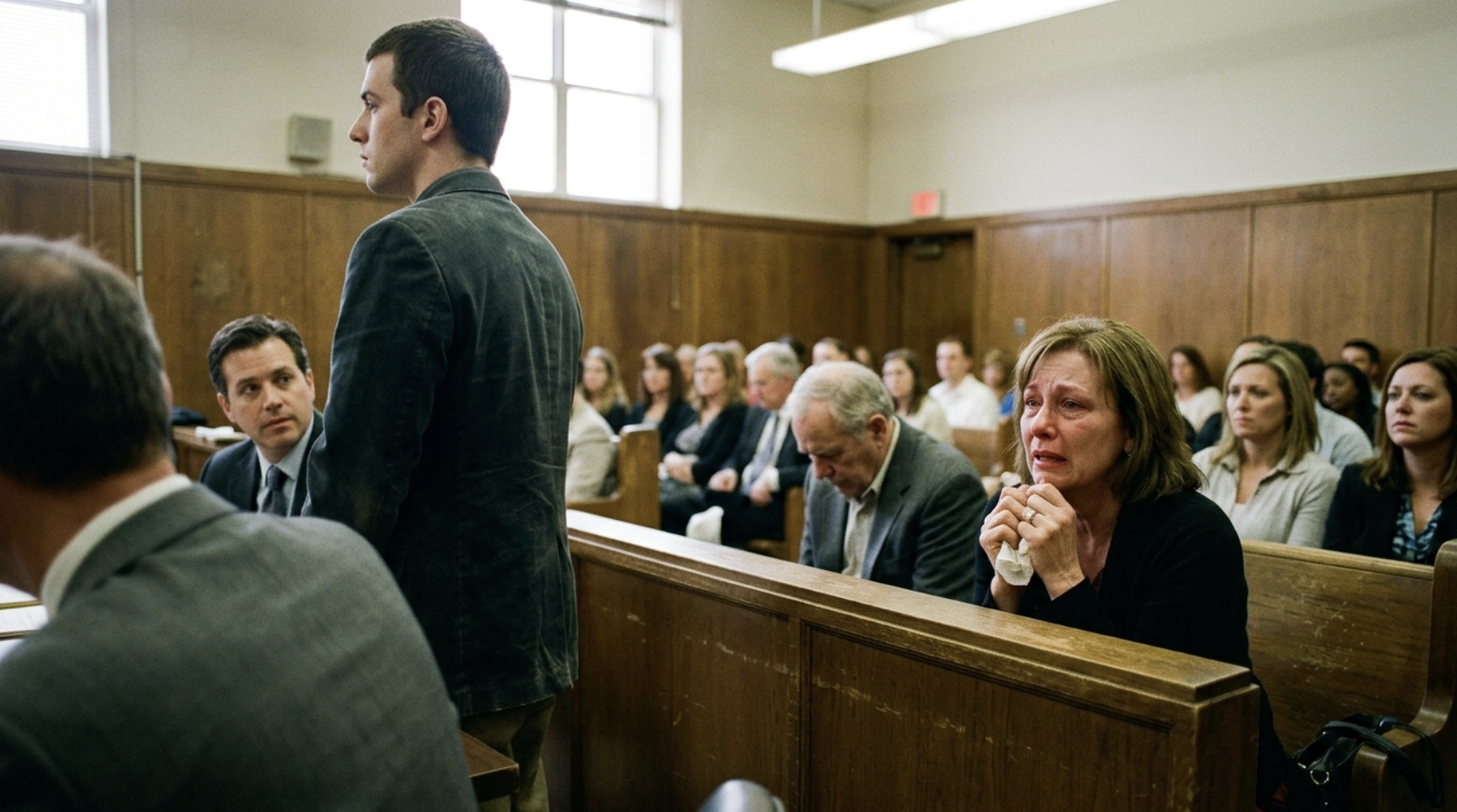
My mother made a small, broken sound.
Olivia immediately covered her mouth with both hands.
Ethan remained standing.
I watched all three of them.
For years, I had imagined this moment so many times that I used to rehearse it in my bedroom at night.
I imagined screaming at them.
I imagined demanding to know why my own parents had chosen Olivia over me.
I imagined watching Ethan lose the confidence he had carried since childhood.
But now that the moment had arrived, I felt something entirely different.
I felt tired.
Not weak. Not defeated.
Just tired of carrying a crime that had never belonged to me.
“Proceed,” the judge said.
Attorney Collins removed the first document.
“This is the original vehicle registration. The Mercedes involved in the collision was registered to Olivia Bennett.”
“That doesn’t prove who was driving,” the prosecutor replied.
“No, it doesn’t,” Collins agreed. “Which is why we have additional evidence.”
He placed a second document on the table.
“This is a copy of the original traffic-camera extraction report. The footage was recovered from a backup server after the original investigator’s office claimed that the relevant files were unavailable.”
Olivia’s fingers tightened around the blanket covering her knees.
I noticed.
So did Attorney Collins.
“Would the court like to review the footage?”
The judge nodded.
A courtroom technician approached the screen.
The lights dimmed.
And suddenly, everyone was looking at a video recorded four years earlier.
The footage showed a busy Chicago intersection at 11:42 p.m.
A black Mercedes moved through the frame.
Its headlights illuminated the wet pavement.
The car swerved sharply, crossed the center line, and struck a young man crossing the street.
Daniel Reeves fell.
The Mercedes stopped for less than three seconds.
Then it accelerated and disappeared into the darkness.
The courtroom went silent.
Daniel’s mother pressed the black-and-white photograph against her chest and began to cry.
I couldn’t look away from the screen.
I had seen that footage before.
Not the entire recording.
Only a few seconds of it, four years earlier, when an investigator had briefly shown me a still image of the car.
At the time, my family had already convinced everyone that I had been driving.
They had told the police that I had borrowed Olivia’s vehicle.
They had told our relatives that I had been drinking.
They had even told my university that I had abandoned my studies because of a personal crisis.
Every story had been carefully constructed.
Every lie had been designed to make the next lie easier to believe.
But now the footage was playing before a judge.
And it was only the beginning.
Attorney Collins paused the recording.
“Please look at the driver’s side window.”
The image enlarged.
The driver’s face was partially visible beneath the streetlight.
The video was grainy, but the person behind the wheel had long, dark hair.
Olivia’s hair had been long and dark that year.
Mine had been cut short.
The prosecutor stood.
“Objection. The image quality is insufficient to establish the driver’s identity.”
“I agree that this footage alone may not conclusively identify the driver,” Collins replied. “However, it establishes that the original investigative record was incomplete. We are asking that the recovered footage be preserved and reviewed alongside the additional evidence.”
The judge nodded.
“Admitted for the limited purpose of the preliminary evidentiary issue. The court will consider its proper use as the proceedings continue.”
My mother shook her head repeatedly.
“No. No, this can’t be happening.”
Olivia turned toward her.
“Mom, please.”
That small sentence told me everything I needed to know.
Olivia was not confused.
She was not shocked by the footage.
She was terrified of what else I had brought into that courtroom.
And when she looked at me, I finally saw the expression I had been waiting four years to see.
She knew I had stopped protecting her.
Four years earlier, I had been twenty-two years old.
I was living in a cramped apartment near the university, working part-time at a bookstore, and trying to finish my accounting degree.
My family had never considered my education particularly important.
My father owned a successful construction company.
My mother managed the household and the family’s social calendar.
Ethan had graduated from a prestigious business school and joined our father’s company.
And Olivia, our adopted daughter, was the one everyone described as exceptional.
She was beautiful, charming, intelligent, and endlessly capable of making people believe that her problems were someone else’s responsibility.
My parents had adopted Olivia when she was eight years old.
I had been ten.
At first, I was happy to have a sister.
I shared my toys with her. I helped her with homework. I taught her how to ride a bicycle.
When she woke from nightmares during her first year with us, I let her sleep beside me.
I thought we were becoming a real family.
I did not understand that my parents had begun making a quiet distinction between us.
Olivia needed more attention because she had suffered before joining our family.
Olivia needed better clothes because she had to feel accepted.
Olivia needed expensive tutors because she had experienced educational disruption.
Olivia needed private counseling because she had experienced abandonment.
Every need was reasonable when considered individually.
But over time, every exception became a rule.
When I received a scholarship, my mother said I should be grateful because it reduced the financial burden on the family.
When Olivia received a lower grade, my father hired a private tutor.
When I asked for help paying my university fees, my parents told me to find another part-time job.
When Olivia decided she wanted to attend an expensive preparatory program, my father paid for it without hesitation.
I never hated her for those differences.
At least, not then.
I simply believed that if I worked hard enough, eventually my family would see me.
That belief ended during the winter of my final university year.
I had applied to a competitive graduate fellowship that would have allowed me to study financial investigation and forensic accounting.
It was the first opportunity I had ever wanted entirely for myself.
I had spent months preparing my application.
I gathered recommendation letters, polished my personal statement, and completed an examination that nearly made me sick with anxiety.
When the acceptance email finally arrived, I was sitting at the kitchen table.
I remember the exact moment.
My phone vibrated.
I opened the email.
Then I read it again.
And again.
I had been accepted.
I was going to leave Chicago for a specialized program that could lead to a career investigating financial fraud.
For the first time in my life, I could see a future that belonged to me.
I ran upstairs and knocked on Olivia’s bedroom door.
“Liv! I got in!”
She was sitting at her desk, looking at her laptop.
“What?”
“The fellowship. I got accepted!”
She smiled.
“That’s great, Clara.”
I hugged her.
She hugged me back.
But when I stepped away, her expression changed.
“Does that mean you’ll be leaving?”
“For a year, maybe two. Depending on the program.”
She looked down at her screen.
“Oh.”
I should have paid attention to that reaction.
Instead, I was too happy to notice.
Three days later, my acceptance letter disappeared.
I searched my apartment, my university email, and the folders where I kept important documents.
Then I called the fellowship office.
They informed me that someone had contacted them to decline my place.
The withdrawal had been submitted through my online account.
My password had been changed.
The confirmation email had been deleted.
I was told that the position had already been offered to another candidate.
I went home and demanded an explanation.
My mother said perhaps I had made the decision while stressed.
My father said I should concentrate on finishing my degree.
Ethan told me that graduate school could wait.
Olivia cried.
She said she felt terrible that my opportunity had disappeared.
She even offered to help me apply again the following year.
For a while, I believed them.
Then, months later, I found a university document in Olivia’s bedroom.
It was a draft application for the same fellowship.
My name appeared at the top.
My personal statement was attached.
My academic records had been copied.
And in the margins, someone had written Olivia’s name beside the scholarship reference number.
I stood in her doorway holding the papers.
“What is this?”
Olivia looked at the document.
Then she looked at me.
For one brief moment, neither of us spoke.
Finally, she said, “I was going to tell you.”
“Tell me what?”
“I needed the opportunity more than you did.”
I stared at her.
“You used my application?”
“I only wanted to see whether I could qualify.”
“You used my name.”
Her expression hardened.
“You already have a degree. You’ll find another opportunity.”
“That isn’t the point.”
“Then what is the point, Clara?”
She stood up.
“You always act as if everything should belong to you because you were born first. You have a family. You have a home. You have parents who love you. I had nothing before they adopted me.”
“I was ten years old when you came here. I gave you half my bedroom.”
“And everyone still loved you more.”
I had no answer.
Not because she was right.
Because I had finally understood that no amount of kindness could convince someone to stop resenting the things they believed they deserved.
I took the documents downstairs.
My mother listened to my explanation.
Then she asked me a question I would remember for the rest of my life.
“Why were you looking through your sister’s things?”
I told her what I had found.
She looked at the papers.
She looked at Olivia.
Then she turned back to me.
“Perhaps this is a misunderstanding.”
“It has my name on it.”
“Olivia is under a great deal of pressure.”
“Mom, she used my application.”
“Enough, Clara.”
My father walked into the room.
After hearing a few sentences, he took the documents from my hands.
He read them slowly.
Then he placed them on the table.
“Your sister made a mistake.”
“She used my identity.”
“She is young.”
“So am I!”
My voice broke.
For the first time, I shouted at my father.
“Why does she get to make mistakes while I have to pay for everything?”
The room fell silent.
Then my father delivered the answer that destroyed whatever remained of my faith in him.
“Because you know how to survive, Clara. Olivia doesn’t.”
I left the house that night.
I moved into a friend’s apartment and stopped answering most of my family’s calls.
I thought distance would protect me.
I was wrong.
Because the worst thing Olivia ever took from me was not a scholarship, an application, or an academic opportunity.
It was a life I could never get back.
And she did it on a rainy November night.
The courtroom lights returned.
Attorney Collins was still standing beside the evidence table.
I blinked away the memory and focused on the present.
The judge had ordered a brief recess while the attorneys reviewed the recovered footage.
My family immediately gathered around Olivia.
My mother adjusted her blanket.
My father whispered to her.
Ethan paced behind the wheelchair, speaking in a low voice.
I remained seated.
I didn’t need to hear what they were saying.
I had spent four years listening to them explain why Olivia’s needs mattered more than the truth.
Eventually, my mother approached me.
She stopped beside my chair and bent down.
“Clara, please.”
I looked at her.
“Please what?”
“Don’t destroy this family.”
I almost smiled.
“Mom, you destroyed it four years ago.”
Her eyes filled with tears.
“We made mistakes.”
“You made decisions.”
“We were trying to protect Olivia.”
“From what?”
She glanced toward the hallway.
“From losing everything.”
I looked at her for a long moment.
“Daniel lost his life. His mother lost her son. And you were worried about Olivia losing a scholarship?”
My mother began crying.
“You don’t understand how complicated it was.”
“Then explain it.”
She opened her mouth.
Nothing came out.
“Tell me what happened that night,” I said. “Tell me the truth, just once.”
She looked toward the courtroom doors.
Then she whispered, “Your father will explain everything.”
“No. You will.”
Her face crumpled.
Before she could answer, Ethan appeared behind her.
“That’s enough.”
He grabbed my mother’s arm and pulled her away from me.
“You’ve made your point, Clara. You don’t need to humiliate everyone.”
I stood up.
“Humiliate everyone? You mean reveal what you did?”
His jaw tightened.
“You have no idea what you’re doing.”
“I know exactly what I’m doing.”
He leaned closer.
“You think a video is going to save you? You think you’re the only person who can bring evidence into a courtroom?”
“No,” I said. “I think the truth is going to save me.”
For a moment, I thought he might strike me.
Then he looked at Attorney Collins, who had appeared at the doorway.
Ethan stepped back.
“This isn’t over,” he muttered.
“No,” I replied. “It isn’t.”
When the hearing resumed, the prosecutor made a request that surprised everyone.
“Your Honor, given the newly presented material, the prosecution requests additional time to review the recovered evidence and investigate the chain of custody.”
The judge nodded.
“That request is reasonable. However, I am also concerned about the apparent inconsistencies in the original investigation.”
He turned toward the prosecution.
“Was the existence of this surveillance footage documented in the original case file?”
The prosecutor reviewed her notes.
“Not in the material currently available to us, Your Honor.”
“Was the vehicle’s registered owner interviewed?”
“Yes, Your Honor. However, I cannot confirm at this time whether that interview was conducted in sufficient detail.”
The judge looked toward Collins.
“And the forensic report?”
Collins stood.
“It contains evidence that may materially affect the identification of the driver. We ask that the court allow the defense to submit the complete report and the supporting laboratory records.”
“Granted, subject to the usual evidentiary requirements.”
Olivia began to cry again.
This time, nobody rushed to comfort her.
Even my mother remained still.
Attorney Collins placed the forensic report on the table.
“Your Honor, the recovered vehicle was examined shortly after the collision. The report identifies biological material on the deployed driver’s-side airbag and records a preliminary DNA comparison.”
The prosecutor’s expression changed.
“Are you saying the report identifies another driver?”
“I’m saying that the original laboratory record contains findings inconsistent with the assumption that Clara Bennett was driving. The full results need to be authenticated and evaluated.”
The judge leaned forward.
“Then that is precisely what this court will do.”
For the first time in four years, the legal process was moving toward the question my family had spent so much time avoiding.
Who had actually been behind the wheel?
But Attorney Collins wasn’t finished.
He removed another document from the folder.
“This concerns the defendant’s identity and the events leading up to the collision.”
He handed copies to the judge and the attorneys.
“Four years ago, Clara Bennett’s university credentials were used to access academic records, scholarship applications, and correspondence with several institutions. Those records were later linked to Olivia Bennett.”
The prosecutor read the first page.
“Are you alleging identity theft?”
“We are presenting evidence of identity misuse. Whether it constitutes a separate offense is a matter for the appropriate investigation.”
Olivia’s tears stopped.
Her face went completely still.
Attorney Collins continued.
“Several documents submitted under Clara’s name contain digital signatures and account-access records that warrant further examination. The defense has obtained records indicating that some of these actions occurred from devices associated with the Bennett family residence.”
Ethan suddenly spoke.
“That’s impossible.”
The judge turned toward him.
“Mr. Bennett, one more interruption and I will have you removed from the courtroom.”
Ethan sat down.
But his expression had changed.
He was no longer angry with me.
He was afraid of what the documents might reveal about him.
And I finally understood why.
The scholarship had never been Olivia’s only secret.
Four years earlier, after leaving my parents’ house, I had tried to rebuild my life.
I completed my degree.
I found a small accounting position.
I paid my rent.
I stopped asking my family for anything.
For a while, I thought I had escaped them.
Then Daniel Reeves died.
I didn’t know Daniel personally, but I remembered seeing his photograph on the local news.
He was twenty-six years old, an architectural designer who had been walking home from a late shift.
His mother, Margaret Reeves, appeared in every interview.
She spoke about her son’s plans to open a small design studio.
She spoke about the apartment he had been saving to buy.
She spoke about how he always called her when he was late.
And she spoke about the unanswered call she had received from him that night.
I watched the news report from my apartment.
When the reporter mentioned my name as the suspected driver, I dropped my coffee cup.
I had never even seen the Mercedes involved in the collision.
But the police believed I had been driving it.
My father arrived at my apartment the following morning.
He brought a lawyer.
He brought a prepared statement.
And he brought a promise.
“If you cooperate, this will be easier for everyone.”
I read the statement.
It said that I had borrowed Olivia’s car, consumed alcohol, struck Daniel, and panicked before leaving the scene.
It also said that I had contacted my family afterward.
Every sentence was a lie.
“I didn’t do this,” I told him.
My father sat across from me.
“Olivia was driving.”
The room seemed to tilt.
I stared at him.
“You know?”
He looked away.
“She made a terrible mistake.”
“Then tell the police!”
He rubbed his forehead.
“Olivia has a future. You know how fragile she is.”
“Daniel is dead!”
“I know.”
“His mother will never see him again!”
My father closed his eyes.
For one second, I believed he might finally understand.
Then he opened them.
“If you take responsibility, we can make sure you have the best legal representation. We can support you financially. When you get out, you can start over.”
I couldn’t speak.
My own father was offering to help me survive a prison sentence for a crime committed by the daughter he loved more.
I stood up and opened the door.
“Get out.”
He didn’t move.
“Clara, listen to me.”
“Get out of my apartment.”
He left eventually.
But the next morning, a message arrived from my mother.
Your father is trying to protect this family. Please don’t make things worse.
Then Ethan called.
“Don’t be stupid,” he said. “You have no children, no husband, and no real career. Olivia has a chance to become someone important.”
I hung up.
That afternoon, I hired my first lawyer.
I believed that the evidence would clear me quickly.
I was wrong again.
The original surveillance footage was missing.
The Mercedes had been repaired before a complete independent examination could be arranged.
The police report contained my name.
My father’s statement supported it.
My mother claimed I had come home distressed that night.
Ethan said he had seen me drinking earlier in the evening.
And Olivia told investigators that I had borrowed her car.
My family had built a wall around the truth.
Every time I found a crack, another lie covered it.
My first lawyer advised me to consider a plea agreement.
I refused.
The legal costs consumed my savings.
I lost my job when the allegations became public.
The university suspended my remaining academic privileges while it investigated the identity misuse.
People I had known for years stopped answering my calls.
And through it all, my family continued to insist that I should admit guilt.
They believed exhaustion would eventually break me.
They were almost right.
The night before my preliminary hearing, I sat alone in my apartment, staring at the ceiling.
I had thirty-seven dollars in my bank account.
My landlord had given me a notice.
My attorney had warned me that the case could last years.
For the first time, I considered giving up.
Then I received a letter.
It came from an unfamiliar address.
Inside was a single sheet of paper.
Miss Bennett,
I worked briefly on the investigation into Daniel Reeves’s death. I believe important evidence was overlooked. I cannot explain everything in writing, but I have retained copies of certain records. If you still intend to fight the charges, contact the attorney whose name is enclosed.
There was no signature.
Only a name.
And a telephone number.
That was how I found Attorney Collins.
He was not impressed by my story at first.
He listened quietly, examined the documents I had saved, and asked me a question no one else had thought to ask.
“Why would your family be so certain you were guilty if they had never seen you commit the crime?”
I told him I didn’t know.
He studied the file for another hour.
Then he said, “I don’t think we should focus only on proving that you weren’t driving. We need to understand how your identity became attached to this case in the first place.”
That changed everything.
Collins began tracing the records.
The university account.
The vehicle registration.
The telephone calls.
The repair invoices.
The original police interviews.
He found inconsistencies in the timeline and missing attachments in the case file.
He discovered that the Mercedes had been taken to a repair shop before investigators had completed their initial examination.
He found that the person who authorized the repair was not listed in the original police report.
And he found a reference to a traffic-camera backup that had never been included in the evidence inventory.
For months, he pursued it.
Some requests were denied.
Others were delayed.
A server had been replaced.
A former employee had left the company.
One record existed only as a compressed archive.
But Collins refused to abandon the search.
Finally, a technician confirmed that the relevant footage had survived on a backup system.
That was when we discovered the black Mercedes turning through the intersection at 11:42 p.m.
It wasn’t enough to prove everything.
But it was enough to reopen the questions my family had tried to bury.
And four years after Daniel’s death, I finally had a chance to answer the judge honestly.
Not guilty.
Back in the courtroom, Attorney Collins handed another sealed envelope to the clerk.
“This document contains the sworn statement of a witness who has agreed to testify about the vehicle and the events immediately following the collision.”
The judge examined the envelope.
“Is the witness present?”
“Yes, Your Honor.”
The courtroom doors opened.
A man in his late fifties walked inside.
He wore a dark suit and carried a thin leather briefcase.
I recognized him immediately.
Mr. Harris.
The owner of the repair shop where Olivia’s Mercedes had been taken after the collision.
He had been the last person I expected to see.
Four years earlier, when Collins first contacted him, Harris had refused to speak.
He said he didn’t remember the vehicle.
He said his records had been lost.
He said he wanted no part in a family dispute.
Then, two months ago, he called Collins.
He had found an old ledger in a storage cabinet.
And with it, he had found a copy of the original repair authorization.
The judge instructed him to take the witness stand.
After he was sworn in, the prosecutor approached.
“Mr. Harris, do you recognize this document?”
She held up a copy of the repair invoice.
“Yes.”
“What does it represent?”
“A repair order for a black Mercedes involved in a collision four years ago.”
“Who brought the vehicle to your shop?”
Harris hesitated.
Then he looked toward the defense table.
“Ethan Bennett.”
My brother stood up.
“That’s a lie!”
The judge struck the gavel.
“Mr. Bennett, sit down immediately.”
Ethan sat.
But his face had turned red.
The prosecutor continued.
“Did Mr. Bennett explain why the vehicle needed repairs?”
“He said his sister had been in an accident.”
“Which sister?”
Harris looked at Olivia.
“Olivia.”
CONTINUE READ NEXT PART… 👇