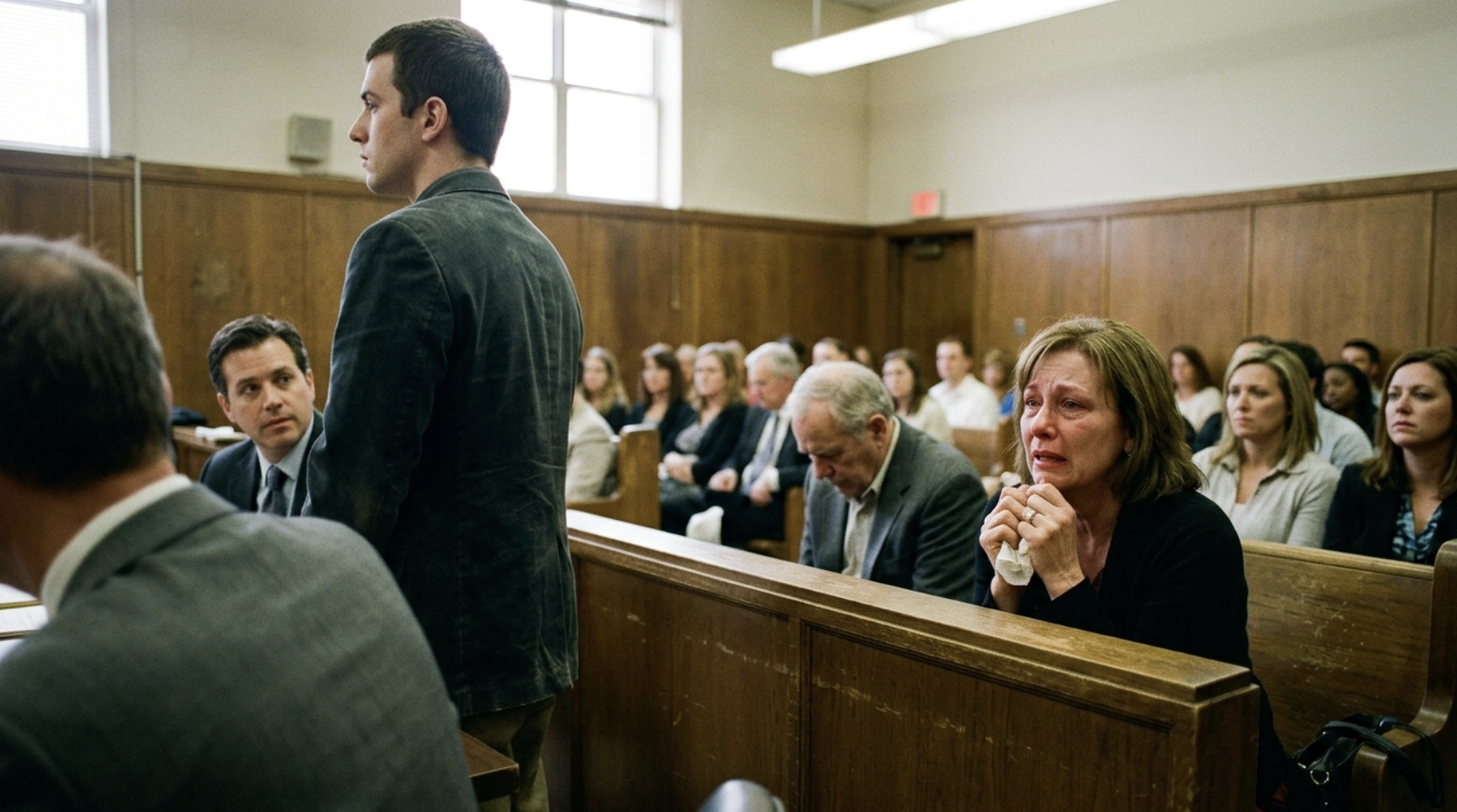
A wave of whispers moved through the courtroom.
Olivia shook her head.
“No. That’s not true.”
The judge ordered silence.
The prosecutor held up another document.
“Mr. Harris, does this invoice identify the person who authorized the work?”
“Yes.”
“And whose signature appears here?”
Harris swallowed.
“Ethan Bennett’s.”
Ethan’s attorney, who had been sitting behind the family, leaned forward and whispered urgently in his ear.
But Ethan wasn’t listening.
He was staring at me.
For years, he had treated me as someone he could control.
He had decided when I should apologize, when I should remain silent, and when I should sacrifice my future for Olivia’s convenience.
Now, he was watching his own decisions catch up with him.
Attorney Collins rose for cross-examination.
“Mr. Harris, was the vehicle damaged in a way consistent with a collision involving a pedestrian?”
“Yes.”
“Was the front windshield damaged?”
“Yes.”
“Was there damage to the hood?”
“Yes.”
“Did you record the mileage?”
“I did.”
“Was the mileage consistent with the route described in the original police report?”
Harris opened his briefcase.
“I brought the original ledger. The mileage was recorded before the repairs.”
Collins handed it to the clerk.
“Your Honor, we request that the original record be marked for identification and examined by the appropriate experts.”
The judge agreed.
Collins returned to his seat.
For the first time, I saw a trace of uncertainty in the prosecutor’s expression.
The case was no longer a simple question of whether Clara Bennett had confessed.
It was becoming a question of how a false account had been constructed, who had helped construct it, and whether the evidence had been deliberately concealed.
But there was one more question.
Why had Ethan taken the car to the repair shop?
Why had he signed the authorization?
And why had he spent four years insisting that I was responsible?
The answer came from the witness himself.
Attorney Collins asked, “Mr. Harris, did you speak with Ethan Bennett again after the repairs were completed?”
“Yes.”
“When?”
“Two days later.”
“What did he say?”
Harris looked uncomfortable.
“He asked me whether I still had the damaged parts.”
“What did you tell him?”
“I said the parts had been disposed of.”
“Did he ask you to change any records?”
Harris hesitated.
The judge leaned forward.
“Mr. Harris, answer the question.”
“Yes,” he said quietly. “He asked me to make the invoice show that the car had been brought in for ordinary bodywork several days before the collision.”
The courtroom erupted.
Ethan shot to his feet again.
“That’s a lie! He was paid to say that!”
The judge ordered the courtroom cleared of unnecessary interruptions and warned Ethan that he would be removed if he continued.
My father stood beside my mother.
He looked as though he had aged ten years in a single hour.
Olivia was no longer crying.
She was staring at her brother.
And Ethan, for the first time, seemed to realize that the people he had been protecting might not protect him in return.
The judge called for a recess.
As the attorneys gathered their papers, Harris passed near my table.
He stopped briefly.
“I should have spoken sooner,” he whispered.
I looked at him.
“Why didn’t you?”
His eyes dropped.
“I was afraid of your father. He was one of my biggest customers. I told myself I was staying out of it.”
He swallowed.
“But then I saw your face in the newspaper again. Four years had passed, and you were still being called the woman who killed that young man. I couldn’t keep pretending I hadn’t seen anything.”
I didn’t know what to say.
His confession would not erase the years I had lost.
It would not give Daniel back to his mother.
But it was the first time someone who had helped the truth disappear had chosen to bring it back.
“Tell everything you know,” I said.
He nodded.
“I will.”
During the recess, my father finally approached me alone.
My mother and Ethan had gone into the hallway with their attorneys.
Olivia had been taken to a private room after complaining of dizziness.
My father stopped several feet away from me.
For a moment, he looked like the man who used to carry me on his shoulders when I was little.
Then I remembered the statement he had brought to my apartment.
I remembered his words.
Olivia has a future. You know how fragile she is.
He sat down.
“Clara.”
I waited.
“I never wanted it to come to this.”
I looked at him.
“Then why did you let it happen?”
He rubbed his hands together.
“Everything happened so quickly.”
“No. It happened one decision at a time.”
He lowered his head.
“Olivia called Ethan that night. She was crying. She said she’d hit someone.”
I felt my stomach tighten.
“What happened next?”
“My son drove to the scene.”
“Why?”
“He wanted to find her.”
“And then?”
My father took a shaky breath.
“He found Olivia standing beside the car. She was frightened. He brought her home.”
“What time?”
“Shortly after midnight.”
“Did he call an ambulance?”
My father closed his eyes.
“I don’t know.”
I stared at him.
“You don’t know?”
“I wasn’t there.”
“But you knew Olivia had been driving.”
He didn’t answer.
“Dad, did you know?”
“Yes.”
The word was barely audible.
For four years, I had wanted him to say it.
I thought hearing the truth would bring relief.
Instead, it felt as if someone had opened an old wound and poured cold water into it.
“Why didn’t you tell the police?”
He looked at me with wet eyes.
“Your mother said Olivia would never survive prison. Ethan said the company would be ruined if the scandal became public. We thought we could find a way to protect everyone.”
“Everyone except me.”
He covered his face.
“I thought you were strong.”
I leaned back in my chair.
“That was always your excuse.”
He looked up.
“What?”
“You called me strong whenever you wanted me to accept something that would have destroyed Olivia. You called me mature whenever you wanted me to forgive her. You called me selfish whenever I asked for something of my own.”
My voice shook, but I continued.
“You didn’t protect me because you thought I could survive. You sacrificed me because you believed I would survive.”
My father began to cry.
I had seen him angry.
I had seen him arrogant.
I had seen him dismiss my pain as childish jealousy.
I had never seen him cry like that.
But I could not comfort him.
Not anymore.
“Did you know Ethan had the car repaired?”
He nodded.
“Did you know he asked the repair shop to change the records?”
My father hesitated.
Then he nodded again.
I looked away.
“Did you know Olivia had been using my identity for years?”
He went completely still.
“What?”
I turned back toward him.
“You heard me.”
“I knew about the scholarship application,” he said slowly. “I didn’t know about the other things.”
“Did you know she had used my name to apply to law school?”
“No.”
“Did you know she had used my records to obtain financial aid?”
“No.”
“Did you know she had been attending classes under my identity?”
He shook his head.
I believed him.
Not because he deserved my trust.
Because his reaction was different.
My father had known about the first lie and chosen to ignore it. Then he had spent four years helping protect the second.
He had never asked how far Olivia’s deception extended because he had never wanted to know.
And that, too, was a choice.
“Dad,” I said quietly, “I don’t need you to tell the court that you love me.”
He looked at me.
“I need you to tell the court what happened.”
He nodded.
“I will.”
I stood up.
“Then do it.”
As I walked away, he called after me.
“Clara, can you ever forgive me?”
I stopped.
I wanted to say yes.
Some part of me still wanted to be the little girl who believed her father could make everything right.
But I had learned that forgiveness offered too early could become another excuse for someone else to avoid responsibility.
“I don’t know,” I said honestly. “Maybe one day. But it won’t change what you have to do now.”
Then I left him sitting alone.
The hearing resumed the following morning.
By then, the prosecutor had reviewed the additional evidence and requested an expanded investigation into the identity records, vehicle repairs, and statements made during the original inquiry.
The judge agreed that the new information required careful examination.
No one was convicted that day.
No dramatic verdict was announced.
The judge did not suddenly declare my innocence based on a single video.
Instead, he ordered the evidence preserved, directed the parties to complete the necessary forensic reviews, and made clear that the allegations against me could not be evaluated fairly without addressing the new material.
It was not the ending I had imagined.
But it was the beginning of something real.
For four years, I had lived inside a story written by my family.
Now, the court was finally asking for the facts.
Outside the courthouse, reporters crowded behind the barriers.
They shouted questions as my attorney guided me toward the waiting car.
“Miss Bennett, did you kill Daniel Reeves?”
“Are you accusing your sister of murder?”
“Did your family pay someone to conceal evidence?”
“Do you believe your father helped cover up the crime?”
I kept walking.
I wasn’t ready to speak publicly about everything.
Daniel’s mother deserved more than a sensational headline.
She deserved answers.
And I wanted to give them to her only when I could do so honestly.
As we reached the car, I saw Margaret Reeves standing near the courthouse steps.
She held the same photograph she had carried during the hearing.
For a moment, I thought she might turn away when she saw me.
Instead, she approached.
My lawyer moved slightly closer, ready to intervene if necessary.
Margaret stopped a few feet away.
“Miss Bennett?”
“Yes.”
Her eyes were red.
“I watched the footage.”
I swallowed.
“I know.”
“Were you driving?”
“No, ma’am.”
She stared at me for a long moment.
Then she asked, “Did you know who was driving?”
I could have lied.
I could have pretended that I had only recently discovered the truth.
Instead, I told her everything I knew.
“I learned that Olivia had been driving from the evidence we recovered. I also learned that my family knew more than they told the police. I’m sorry I didn’t discover it sooner.”
Her face twisted with pain.
“My son is dead.”
“I know.”
“No, you don’t.”
She was right.
I could never know what it felt like to lose a child and then spend four years watching another person be accused of the crime.
I could never know what it felt like to wait for a phone call that would never come.
I lowered my head.
“You’re right. I don’t know what that feels like. I won’t pretend I do.”
She looked down at Daniel’s photograph.
“He was supposed to come home that night. He had promised to help me fix the kitchen cabinet the next morning.”
Her voice cracked.
“He always complained that I never asked anyone else for help.”
A tear slipped down her cheek.
“He was going to open his own design studio. He had saved almost every penny. He wanted to design affordable homes for families who couldn’t afford expensive architects.”
I listened.
She told me about Daniel’s terrible cooking, his habit of buying books he never finished, and the way he used to call her whenever he saw a dog wearing a sweater.
She spoke for nearly ten minutes.
I didn’t interrupt.
When she finally stopped, she looked at me.
“I don’t know whether you are telling the truth.”
I nodded.
“You have every reason to question what people tell you.”
“But I want the truth. I don’t want another lie. I don’t want anyone going to prison just because someone else has decided they should.”
My throat tightened.
“Neither do I.”
She held the photograph against her chest.
“Then don’t stop.”
I watched her walk away.
For the first time since the charges were filed, I understood that my fight had never been only about getting my life back.
It was also about making sure Daniel’s life was not reduced to a name in a court file and a photograph held by a grieving mother.
He deserved the truth.
And I would not stop until it was found.
That evening, Olivia called me.
I almost ignored it.
Her name appeared on my phone, followed by the photograph she had chosen years ago, smiling beneath the summer sun.
I stared at it until the call nearly ended.
Then I answered.
“What do you want?”
She was silent for several seconds.
“Clara.”
I waited.
“Can we talk?”
“No.”
“Please.”
“You’ve had four years to talk.”
“I know.”
“Then what could you possibly say now?”
She began to cry.
“I never thought it would go this far.”
I closed my eyes.
There it was again.
The sentence that had protected her from consequences for most of her life.
“I never thought it would go this far.”
She had never thought the scholarship application would be discovered.
She had never thought the police would connect her to the car.
She had never thought the video would be recovered.
She had never thought I would stand up in court and refuse to accept responsibility for her actions.
Every time the truth threatened to emerge, she had believed someone would save her.
And usually, someone had.
“Clara, please. I need you to understand.”
“Understand what?”
“I was scared.”
“So was I.”
“I didn’t know what to do.”
“You could have called an ambulance.”
She went silent.
“You could have stayed with Daniel. You could have told the police. You could have admitted you were driving.”
“I know.”
“You could have told the truth four years ago.”
“I know!”
Her voice rose.
Then she began sobbing.
I let the silence stretch between us.
Finally, she whispered, “I am sorry.”
I stared at the dark window beside my desk.
For years, I had imagined Olivia apologizing.
I thought I would feel vindicated.
I thought I would finally hear the words that proved she understood what she had done.
But an apology could not return my lost years.
It could not restore the education I had been forced to abandon.
It could not erase the headlines that had called me a killer.
And it could not bring Daniel home.
“Are you sorry because you hurt me,” I asked, “or because you might have to face the consequences?”
She didn’t answer.
That silence told me more than her tears.
“Clara, I don’t want to go to prison.”
“Neither did I.”
“I have my whole life ahead of me.”
I laughed once, bitterly.
“That was what Ethan told me.”
She began crying harder.
“I know I don’t deserve your help.”
“No, you don’t.”
“But you’re my sister.”
The words hung between us.
Once, they would have broken me.
Once, I would have forgiven her simply because she asked.
Once, I would have accepted the blame because I believed family meant protecting one another, no matter the cost.
But I was no longer the young woman who had stood in my parents’ kitchen holding stolen documents while everyone explained why Olivia’s future mattered more than mine.
“Being your sister never meant I had to become your shield,” I said.
“I know.”
“Do you?”
She said nothing.
“If you want to make things right, tell the truth. Tell your lawyers. Tell the prosecutor. Tell Daniel’s mother what happened. Don’t ask me to lie for you again.”
“I can’t.”
“Then I can’t help you.”
I ended the call.
My hands trembled afterward.
Not because I regretted what I had said.
Because I had finally done something I had spent my entire life believing was wrong.
I had refused to save Olivia from the consequences of her own choices.
And for the first time, I felt free.
The next morning, Attorney Collins arrived at my apartment carrying a new file.
He looked exhausted.
But there was something different in his expression.
“We have a development,” he said.
I stepped aside to let him in.
“What happened?”
“Your sister has agreed to provide a formal statement.”
I stared at him.
“About the accident?”
“About the accident, the vehicle, and the events leading up to the original investigation.”
“Why now?”
Collins placed the file on my table.
“Because the evidence is no longer limited to your testimony. The repair invoice, the recovered footage, and the digital records have created a situation she can no longer dismiss.”
I sat down.
“Does she admit she was driving?”
“She has not yet provided a complete statement under oath. Her attorney has informed the prosecution that she intends to cooperate, but we must wait for the formal process.”
I nodded.
I wouldn’t celebrate until the evidence was tested and the truth was established.
“What about Ethan?”
Collins opened the file.
“His involvement is also under investigation. The repair records are significant, and the authorities are examining whether any evidence was deliberately altered or concealed.”
“And my father?”
“He has agreed to provide information.”
I looked toward the window.
For four years, I had believed that the truth would arrive as one great revelation.
A video.
A confession.
A single moment when everyone finally understood what had happened.
But the truth was arriving piece by piece.
A repair invoice.
A witness statement.
A recovered recording.
A digital record.
And now, perhaps, a confession.
“There’s something else,” Collins said.
He removed a document from the file.
“This concerns your university records.”
I looked at it.
The heading contained the name of the institution I had attended before everything fell apart.
“What is this?”
“An internal audit. The university has begun reviewing the identity discrepancies we brought to its attention.”
My heart began beating faster.
“What did they find?”
“Several applications and academic records appear to have been submitted under your name but may have been completed by another person. The university is reviewing those records separately from the criminal case.”
I stared at the pages.
My grades.
My course history.
My student identification number.
Records from years when I had been working nights, studying for exams, and trying to build a future that I believed I had lost.
“How much did she use?”
“We don’t know the full extent yet.”
I lowered the document.
“Can I get my records back?”
“That is one of the things we’re working toward.”
I pressed my hands together.
I had spent four years trying to prove I wasn’t the person my family had described.
Now I was beginning to discover how much of my actual identity had been buried beneath their lies.
“Clara,” Collins said gently, “I need you to understand something. Even if the criminal investigation moves in your favor, rebuilding your life will take time. We cannot promise that every institution will immediately correct every record.”
“I understand.”
“And the investigation may reveal things you don’t want to hear.”
I looked at him.
“I’ve spent four years hearing things I didn’t want to hear.”
He nodded.
“Then we’ll proceed carefully.”
After he left, I sat alone at my table.
For the first time, I allowed myself to imagine a future that wasn’t defined by the accusation.
Perhaps I could return to school.
Perhaps I could finish the fellowship application I had once dreamed of completing.
Perhaps I could become the forensic accountant I had wanted to be before my own life became a case file.
I didn’t know.
But for the first time in four years, not knowing didn’t feel like the end of everything.
It felt like a beginning.
And somewhere across Chicago, Olivia was preparing to tell the truth.
Or at least, I hoped she was.
Because the next time she spoke, I would no longer be the sister who silently accepted her lies.
I would be the woman who had waited four years for the truth to reach the courtroom.
And this time, I intended to hear every word.
PART 4
Three weeks later, Olivia finally confessed.
She admitted that she had been driving the Mercedes the night Daniel Reeves died. She had been drinking at a party, lost control of the car, and panicked after the collision. Instead of calling for help, she called Ethan.
Ethan had driven her home, and together they had convinced our parents to help conceal the truth. My father had supported their plan, while my mother had helped create the story that I had borrowed Olivia’s car that night.
But the truth they had buried for four years was finally impossible to deny.
The recovered footage, repair records, forensic evidence, and Olivia’s confession changed everything.
After the evidence was fully reviewed, the charges against me were dismissed.
I walked out of the courthouse a free woman.
For the first time in four years, I could breathe without feeling as though the whole world was waiting to call me a criminal.
Outside, Margaret Reeves was waiting.
She approached me slowly, holding the photograph of her son.
“I’m sorry,” she whispered. “I’m sorry you lost so much of your life because of what they did.”
Tears filled my eyes.
“You don’t have to apologize to me. You lost your son. Nothing I experienced can compare to that.”
She took my hands.
“Then promise me something. Don’t let what happened turn you into someone who stops believing in good people.”
I nodded.
“I promise.”
We stood together for a moment, two women whose lives had been changed by the same terrible night in different ways.
Daniel could never come home.
But at least the truth about his death would no longer be hidden.
In the months that followed, Olivia faced the legal consequences of her actions. Ethan was investigated for his role in concealing evidence, and my father was required to answer questions about what he had known. Their cases proceeded separately, and none of them could escape accountability simply by calling themselves a family.
My mother sent me letters.
In every letter, she wrote that she loved me.
Eventually, I wrote back.
Mom, I believe you may love me in your own way. But love without honesty hurt me more than you will ever understand. I need time, and I need you to accept that I may never return to the relationship we once had.
I didn’t hate her.
But I stopped confusing forgiveness with giving someone another opportunity to hurt me.
With Attorney Collins’s help, I began correcting my academic records. The university reviewed the evidence of identity misuse and offered me a path to complete my interrupted education.
A year later, I received another acceptance letter.
This time, it arrived in my own name, earned through my own work, and delivered to an address where nobody could take it away from me.
I cried when I opened it.
Not because it was a perfect ending.
Because, after everything, I had finally reclaimed the right to choose my own future.
I eventually returned to my studies and pursued financial investigation, determined to help people whose lives had been damaged by fraud and deception.
On the anniversary of Daniel’s death, I visited his grave with Margaret.
We brought white flowers.
She told me about the design studio her son had dreamed of opening. With help from several of his former colleagues, she had established a small scholarship in his memory for students studying architecture.
I made a contribution when I could afford it.
It wasn’t enough to repay what had happened.
Nothing could be.
But it was one small way to ensure that Daniel’s name would be remembered for something more than the night he died.
As I turned to leave, Margaret called after me.
“Clara?”
I looked back.
“You waited four years for the truth. What are you going to do with your life now?”
I thought about the girl I had been before everything happened—the girl who believed being a good daughter meant always sacrificing herself, the girl who thought keeping her family together was more important than protecting her own future.
Then I smiled.
“I’m going to live it.”
And I did.
I built a career. I made friends who valued honesty. I learned that family could be created through kindness and trust, not merely determined by blood or adoption.
I didn’t know whether I would ever fully forgive my parents or Olivia.
But I no longer needed their apologies to move forward.
Four years earlier, my family had stood in a courtroom expecting me to plead guilty so Olivia could keep her future.
They believed I would remain silent because I had always been the one who gave in.
They were wrong.
I had not waited four years because I wanted revenge.
I had waited because I refused to let a lie become the final truth of my life.
And when the truth finally came, I discovered something more valuable than watching my family face the consequences of their choices.
I discovered that I could lose almost everything and still find the courage to begin again.
My name was Clara Bennett.
I was innocent.
And at last, my life belonged to me.