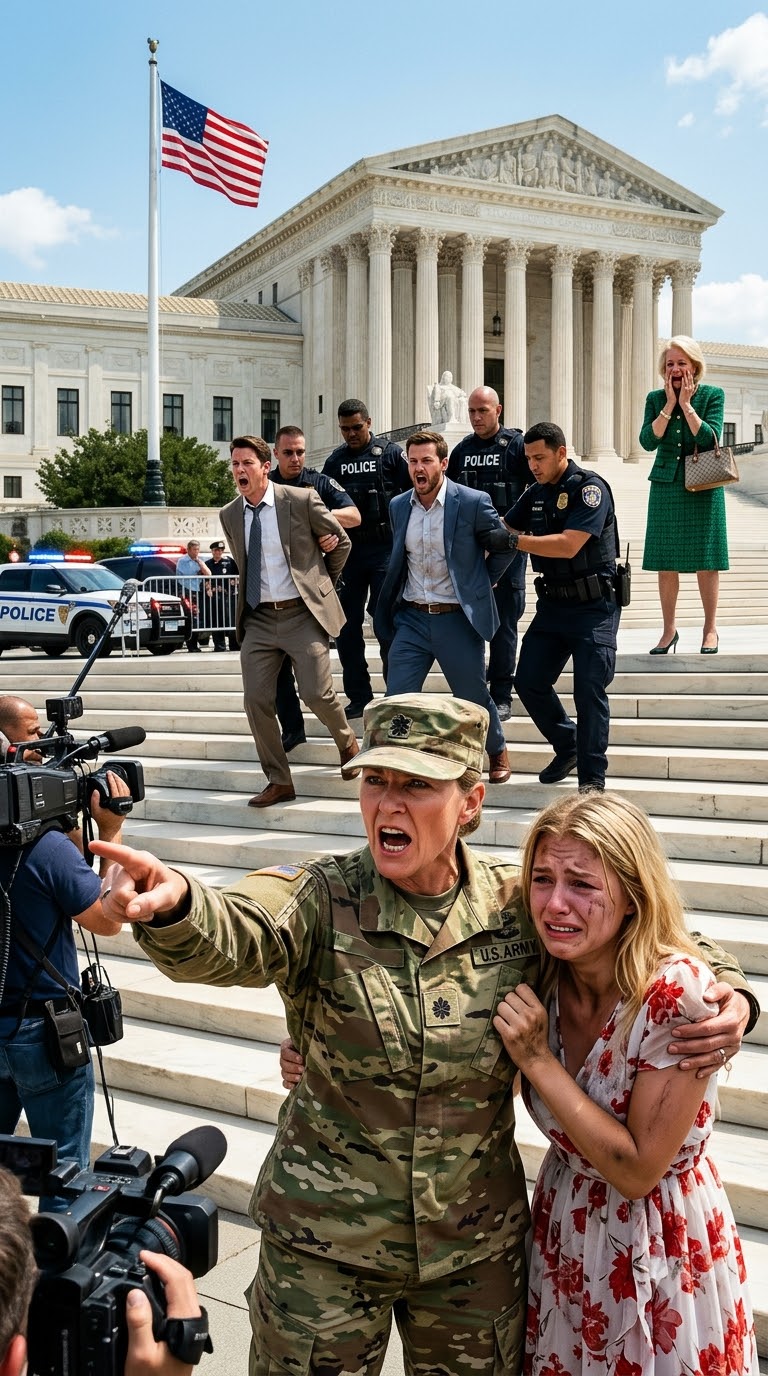
After the court adjourned, a swarm of local and national reporters gathered on the wide marble steps of the courthouse, shouting questions. I ignored them, keeping a protective hand on Emily’s back as we descended.
Halfway down, Emily stopped. She turned to me, the autumn wind catching her hair.
“You know what’s weird, Mom?”
“What’s that, sweetie?”
“I thought… I thought this moment would feel bigger. Heavier.”
I looked at her, noting the strength in her jaw. “The sentencing?”
“Yeah.” Emily glanced back over her shoulder toward the heavy oak doors of the courthouse. “They spent my entire childhood acting like they were gods. Acting like every single person in this state should be terrified of them. And now? They just look like sad, old men in ugly orange suits.”
A television reporter shoved a microphone toward us, shouting my name. I didn’t break stride, guiding Emily through the crowd.
At the bottom of the steps, standing quietly near a black town car, was Colonel Nathan Cole.
He was in civilian clothes—a sharp gray suit—but his posture was unmistakable. He had flown in from D.C. without telling me.
I raised a single eyebrow as we approached him. “You came all this way for a sentencing hearing, Nathan?”
Cole offered a rare, understated shrug. “I had some leave accumulated. Figured I’d take in the local Missouri scenery.”
Emily stepped forward and threw her good arm around him in a tight hug. “Thank you, Colonel.”
Cole looked momentarily startled, patting her awkwardly on the back. “For what, Emily?”
“For making those phone calls. For saving me.”
Cole gently pulled back and looked over Emily’s shoulder at me. “Emily, I made exactly three phone calls from a comfortable desk in Germany.” He nodded toward me. “Your mother orchestrated the rest. She tore this town down to the studs.”
I shook my head, rejecting the praise. I looked back up at the courthouse, thinking of the web of people who had risked everything.
“No, Nathan,” I said softly. “Evan Brooks risked his entire career and his freedom. Detective Ramirez sacrificed her badge to save the evidence. Laura Bennett and the federal investigators followed the trail relentlessly. The prosecutors built an airtight cage.”
I turned and looked deeply into my daughter’s eyes. “And Emily… Emily survived it. She didn’t break. That’s why we won.”
Cole smiled faintly, crossing his arms. “Spoken like a true officer, Hale. That sounds exactly like the concluding paragraph you’d put in an official After-Action Report.”
For the first time in over a year, I threw my head back and genuinely laughed.
That evening, as the sky bruised into shades of violet and gold, Emily and I drove out past the city limits of Fairmont.
We pulled over on the shoulder of the highway, parking beside the desolate stretch of Daniel’s forty-three acres. The sunset stretched magnificently across the open, wild fields.
In the months following the unsealing of the federal indictments, the state’s highway bypass project had been officially announced. Almost overnight, Emily had been bombarded with incredibly lucrative buyout offers from commercial developers, eager to pave over the land and erect gas stations and strip malls.
She had rejected every single one of them.
Instead, she had utilized her control of the trust to legally subdivide the property. She donated the most valuable, highly visible portion—the acreage directly bordering the new main road—to a non-profit foundation.
We stood by the chain-link fence, looking at the newly erected wooden placard driven deep into the soil. I read the painted letters aloud.
THE EMILY HALE REGIONAL RESOURCE CENTER: FOR VICTIMS OF DOMESTIC ABUSE & CORRUPTION.
“Are you absolutely sure about this, Em?” I asked, leaning against the fence. “You could have set yourself up for life with the money from this parcel.”
Emily nodded, her gaze fixed firmly on the horizon. “They wanted this land so badly because they thought everything in this world had a price tag. They thought money and fear were the only currencies that mattered.”
She turned to look at the highway, where the Mercer family cronies and the remaining corrupt politicians would have to commute every single day.
“Let them drive past that sign,” she said, her voice ringing with quiet, absolute victory. “Let them see my name every single morning, and remind them that they lost.”
I smiled, pulling her into a tight embrace.
Months earlier, Margaret Mercer had laughed into a telephone receiver. My boys are untouchable.
I remembered standing in Colonel Cole’s office in Germany, listening to the hum of the base, hearing him promise that by morning, they would wish they had never touched her.
Cole had been a brilliant tactician, but he had been wrong about one minor detail.
It took much longer than a single morning.
It took an avalanche of undeniable evidence. It took the bravery of terrified witnesses stepping out of the shadows. It took a unified front of uncorrupted law enforcement.
Most of all, it took a daughter who flatly refused to disappear into the dark.
But eventually, the siege ended. In the rusted, broken town that the Mercer family believed belonged exclusively to them, every locked door was finally kicked open.
And for the first time in three decades, when Emily and I walked down Main Street, nobody stepped aside.