
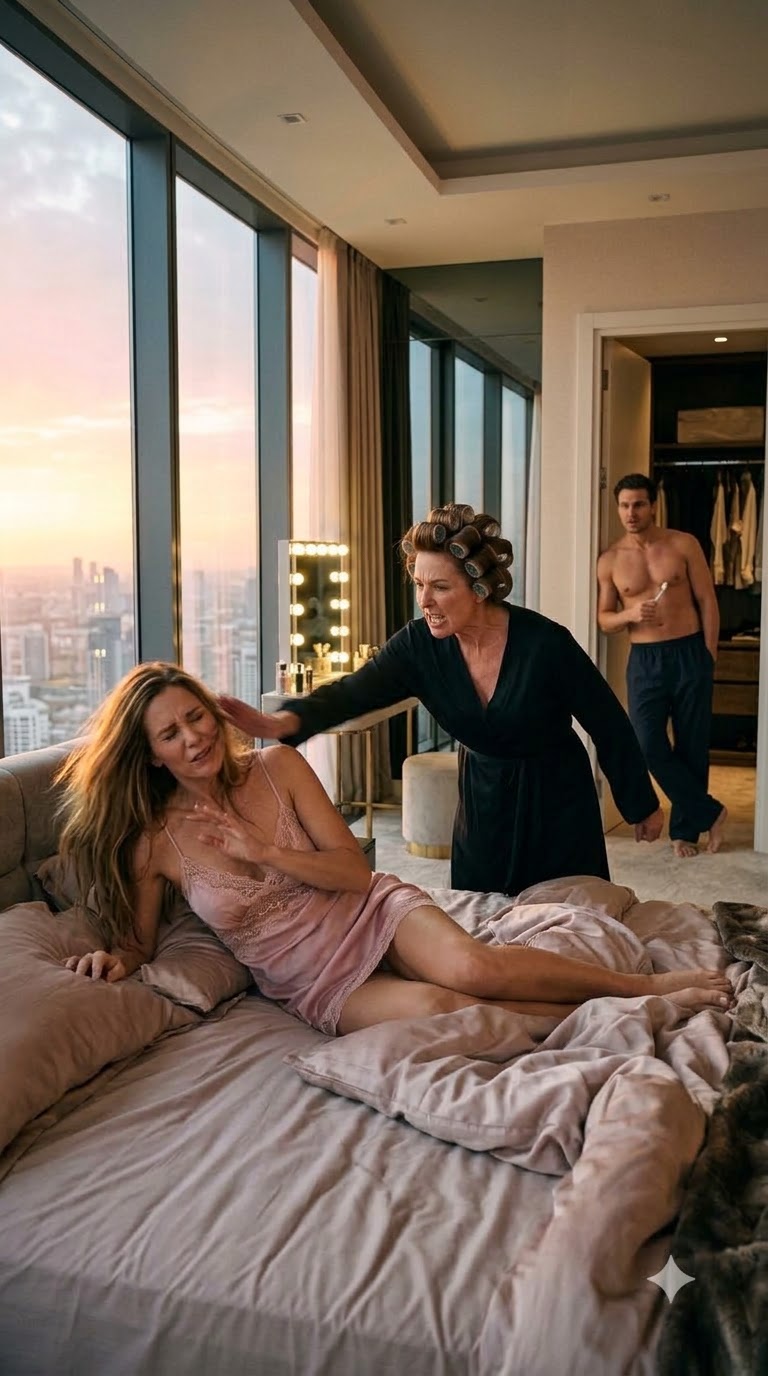
Chapter 2: The Invasion of Walcott Avenue
It began on the second Saturday in May. A rented, rust-spotted moving truck double-parked illegally on Walcott Avenue, its hazard lights pulsing like a warning I was too naive to heed. Mark had jogged down the three flights of stairs to meet it, deliberately omitting a critical piece of intelligence: the payload.
What my husband had sold me over dinner three weeks prior was a temporary, low-impact favor. “Six weeks, Rachel. Two standard suitcases,” he had sworn, his hand covering mine in a display of faux vulnerability. His parents, Diane and Walter, had supposedly sold their sprawling, aging house in Rockford. They simply needed a brief tarmac to land on while the finishing touches were applied to a sun-drenched, downsized condo waiting for them in Florida.
I had given my consent before the period hit the end of his sentence. I was desperate, you see, to be the mythical Good Daughter-In-Law. I wanted to be the seamless addition, the woman who effortlessly absorbed inconvenience without a whisper of complaint.
From my third-floor living room window, I watched the hydraulic lift lower a massive, claw-footed china cabinet. Then came Walter’s monstrous leather recliner. Then, the boxes. I counted them through the glass, my stomach slowly turning to lead. Fourteen heavy-duty, reinforced moving boxes. I hurried down to the sidewalk and counted them again, praying my astigmatism had played a cruel trick on me. It hadn’t.
Diane ascended the stairwell first, refusing to touch the banister. She bypassed me entirely without so much as a nod of greeting, marching directly into my kitchen. Immediately, she began throwing open cabinets and wrenching drawers off their tracks, scrutinizing the hinges and the shelving paper like a municipal health inspector touring a suspect diner.
Walter trudged up behind her, his breath coming in shallow rasps. He was a barrel-chested, gentle-eyed man who always looked slightly apologetic for taking up space. He took my hand, wrapping his calloused fingers around mine. “We are so deeply sorry to put you out, Rachel,” he murmured. “It is no small burden, taking in two old ghosts like us.”
I felt a genuine pang of affection for him in that moment. Down on the pavement, I confronted Mark about the sheer volume of cargo.
“Storage units cost a bloody fortune in the city,” Mark deflected, refusing to meet my eyes as he hoisted a floor lamp. “It’s just logistically easier to keep it together. Don’t make a thing out of it, Ra.” He pressed a dry kiss to my forehead, handed me a box, and turned his back.
So, I became a beast of burden in my own territory. I carried their lives up three flights. The fourth box I lugged up the stairs had Diane’s sharp, aggressive handwriting slashed across the top flap in thick black Sharpie. It read: Kitchen. KEEP.
By Wednesday afternoon, my kitchen had been annexed. I spent twenty minutes hunting for my own unbleached coffee filters. I finally discovered them banished to a dusty, bottom-tier corner cabinet, shoved ruthlessly behind my artisanal spices, my seasoned cast-iron skillet, and every ceramic mug I possessed.
In their place, Diane’s floral-patterned dishes reigned supreme on the eye-level shelves. Her porcelain flour and sugar canisters dominated my limited quartz counter space. Her monogrammed dish towel hung triumphantly over the handle of my oven door.
“I organized,” Diane announced, not bothering to turn away from the simmering pot on the stove. “You will thank me when you realize how inefficient you were.”
“The kitchen was working perfectly fine for me,” I said, my voice tight.
She let my mild rebellion hang in the humid air, letting it slowly suffocate. Then, she slowly turned, the wooden spoon dripping sauce onto the grates. “Tell me, Rachel. Why does the brass mailbox downstairs still read ‘Novak’?” Her eyes narrowed. “You have been a Hartley for three years. People walking by will assume my son is reduced to renting a meager room from a spinster.”
I had retained my maiden name for a multitude of reasons: it was stamped on my master’s degree, it was the identity attached to my professional reputation, and most importantly, it was the name on the thirty-year mortgage I paid every single month. I opened my mouth to articulate this.
Mark, seated at my kitchen table chewing a mouthful of his mother’s over-salted eggs, chuckled before I could form a complete syllable. “She runs a tight ship, Ra. You know that. Just let her have the kitchen. It makes her happy.”
I looked at my husband, complacently chewing. I looked at the rigid line of my mother-in-law’s shoulders. Then, I looked down at my beautiful, heavy skillet, exiled to the floorboards.
“Of course,” I whispered.
It was the very first time I uttered that phrase to her. I remember it vividly, purely because of how sickeningly frictionless it felt sliding off my tongue. But that evening, the surrender of the kitchen would prove to be merely the opening skirmish. As the sun set, Mark casually asked me the question that would seal my doom.