PART 4
The following morning, I arrived at Maître Perrin’s office ten minutes early.
I wore the same black dress.
This time, I didn’t choose it because I wanted to look strong. I chose it because I was tired of dressing like a woman who needed permission to exist.
Maître Perrin was waiting in the conference room with another man, a gray-haired specialist in financial investigations named Monsieur Laurent.
A thick folder lay between them.
“Madame Delmas,” the lawyer said, “before Mathieu arrives, I need you to understand something. Your husband suspected serious financial misconduct, but suspicion is not proof of every allegation. We have enough documentation to investigate further, and we must allow that process to take its course.”
I nodded.
“And the medical forms?”
“The hospital has confirmed that certain authorization records require further examination. There is no evidence at this stage that anyone deliberately caused your husband’s death.”
I was relieved to hear it, yet the words left me uneasy.
Gérard had been ill. His heart had been failing for months. I had watched him grow weaker every day.
I didn’t want to believe that someone had used his illness for personal gain.
But I wanted the truth more than I wanted another comforting lie.
At ten o’clock, Mathieu entered the room.
He looked exhausted. His expensive suit was wrinkled, and dark circles shadowed his eyes.
For a moment, I saw the little boy who used to run toward me after school.
Then he looked at the folders.
His expression hardened.
“You’ve been busy,” he said.
“I’ve been trying to understand what your father left behind.”
“You mean what he stole from me.”
Maître Perrin interrupted.
“Mr. Delmas, your father signed a valid will. Any challenge must be based on evidence, not assumptions.”
Mathieu ignored him.
He stared at me.
“You have his house, his apartments, his investments, and his shares. What more do you want?”
“The truth.”
He laughed without humor.
“Truth? You want to talk about truth after pretending to be my mother for twenty-five years?”
The words struck exactly where he intended.
I lowered my eyes for a moment.
Then I looked back at him.
“I never pretended to be your mother, Mathieu. I loved you as one.”
His jaw tightened.
“Then why are you doing this to me?”
“I’m not doing anything to you. I’m asking questions about money that disappeared from your father’s company.”
The color drained from his face.
For the first time, he didn’t have an immediate answer.
Monsieur Laurent opened the folder and placed several documents on the table.
“These transfers were made over four years,” he explained. “Some were recorded as loans, others as consulting fees. We need clarification regarding the companies that received the payments.”
Mathieu glanced at the papers.
“I was authorized to manage certain accounts.”
“By whom?” the investigator asked.
“My father.”
“Do you have written authorization?”
Mathieu hesitated.
“My father trusted me.”
“That wasn’t the question.”
The silence grew uncomfortable.
Finally, Mathieu leaned back.
“My father knew I was taking money. It was compensation for the work I did. He always intended to give me the company.”
Maître Perrin opened another folder.
“Then you should have no difficulty explaining why you attempted to transfer ownership of two properties before your father’s death, using documents that indicated he was no longer capable of managing his affairs.”
Mathieu’s face turned red.
“He was ill!”
“He was also receiving independent medical assessments,” the lawyer replied. “Those assessments did not support your claim that he lacked capacity at that time.”
Mathieu suddenly stood.
“This is ridiculous!”
He turned toward me.
“You don’t know what happened in that house. You have no idea how much pressure I was under.”
I remained seated.
“Then tell us.”
He opened his mouth.
For a moment, I thought he might finally confess everything.
Instead, he pointed at me.
“You were always his favorite. You came into our lives, and suddenly everything became about you. He trusted you with everything, while I was expected to wait for my own father’s death before I could inherit what should have been mine.”
My heart ached.
There it was.
The truth beneath all the anger.
Mathieu had spent his life believing that love was a limited resource. If his father loved me, he imagined there must be less love left for him.
And when Gérard began making decisions about the estate, Mathieu saw those decisions not as his father’s wishes but as a personal rejection.
I spoke gently.
“Your father didn’t leave you nothing.”
Mathieu looked away.
“He established a separate provision for you in his estate. Maître Perrin can explain the terms.”
The lawyer nodded.
“Your father provided for you through a designated inheritance, subject to the estate’s legitimate obligations. However, he did not leave you control of the entire company or the trust belonging to Élise.”
Mathieu stared at him.
“What provision?”
Maître Perrin slid a document across the table.
Mathieu read it.
His shoulders dropped slightly.
It wasn’t the fortune he had expected, but it was not nothing. Gérard had left him enough to build a life without depending on the family company.
For several seconds, I saw uncertainty cross his face.
Then he looked at me again.
“You knew about this?”
“No.”
“And now you’re going to let the investigation destroy me?”
I took a breath.
“Your father asked for the truth to be established. I won’t hide evidence, Mathieu. But I won’t lie about you either. If there is an explanation for those transactions, you should give it. If you made mistakes, you should take responsibility for them.”
He shook his head.
“You always did know how to sound righteous.”
“No,” I said. “I simply know what it feels like to spend years being blamed for things I never did.”
His expression changed.
For a moment, he looked as though he might say something meaningful.
Then he gathered his papers and left without another word.
As the door closed, I realized that I had been holding my breath.
Maître Perrin offered me a glass of water.
“You handled that well.”
I shook my head.
“I don’t know whether I handled it well. He’s still the boy I raised.”
“And that is precisely why this is difficult.”
I looked at the empty chair where Mathieu had been sitting.
“Yes,” I whispered. “It is.”
But the investigation had only begun.
And the next discovery would reveal that the greatest secret in Gérard’s life had never been the money.
It had been the promise he made to my father.
Two weeks passed.
During that time, I learned more about Gérard’s business than I had learned in twenty-five years of marriage.
I discovered that he had built his company from a small workshop into a successful regional enterprise. I learned about the partners who had betrayed him, the debts he had repaid, and the employees whose families depended on the business.
I also learned that Mathieu’s financial decisions had placed the company under considerable strain.
Some transactions were legitimate but poorly documented. Others appeared to have been designed to conceal where the money had gone.
The investigators continued examining the records, and the appropriate authorities were informed where necessary.
I refused to make accusations before the evidence was complete.
That was one lesson Gérard had finally taught me, even if he had taught it too late.
Then, one afternoon, Maître Perrin called.
“Madame Delmas, we have located the original agreement between your father and Gérard.”
I sat down.
“What does it say?”
“Your father helped Gérard recover the company after discovering that a former partner had defrauded him. In exchange for his assistance, Gérard agreed to place a portion of the company’s shares in trust for your benefit when you became an adult.”
I closed my eyes.
“My father never told me.”
“He may have believed that the arrangement would never need to concern you. He did not ask Gérard to provide for you as a condition of marriage. The agreement was made years before you met.”
“And the trust is valid?”
“The documentation supports its validity, though certain accounting matters still need to be finalized.”
I stared out the window at the street below.
All those years, I had thought I had entered the Delmas household as a stranger who had been lucky enough to find a place.
But my father had helped build the foundation beneath that house.
Not because he wanted wealth for me.
Not because he wanted me to marry a rich man.
He had simply helped another person when that person needed help.
And Gérard had carried that promise for years.
“What happens now?” I asked.
“We need to complete the transfer and settle the outstanding accounting issues. I also believe you should read the final page of the original agreement.”
“The final page?”
“Yes. Your father wrote a personal statement before signing it.”
My throat tightened.
“Could you send me a copy?”
“I will arrange it.”
That evening, the document arrived.
I read the agreement first, slowly and carefully.
Then I turned to the final page.
My father’s handwriting was faded, but I recognized it immediately.
I do not ask Monsieur Delmas to make my daughter wealthy. I do not ask him to give her a life without hardship. No parent can promise such a thing.
I ask only that, if our paths ever cross again, he remembers that every human being deserves to be treated with dignity.
If my daughter ever comes to work in his home, let her be valued for who she is, not merely for what she can do.
And if she ever leaves that home, let her leave with her head held high.
I pressed the paper against my chest.
For the first time since my father’s death, I felt close to him again.
I remembered the small kitchen in our village. The smell of warm bread. The sound of rain against the windows.
I remembered him telling me that money could buy a comfortable bed, but it could never buy the peace of knowing you had done the right thing.
I had believed him.
Then I had spent twenty-five years trying to earn the approval of people who measured my worth by the size of my bank account.
I laughed through my tears.
“Oh, Papa,” I whispered. “You knew me better than I knew myself.”
But the letter also made me realize something else.
My father had never intended for me to become a servant to another family’s expectations.
And neither had Gérard.
Whatever mistakes my husband had made, I would not allow his final gift to become another chain around my life.
I decided that the company would be managed independently while the investigation continued. I would not use the inheritance to punish Mathieu, and I would not hand over control simply because he was angry.
The business had employees who deserved stability.
They had families to feed and mortgages to pay.
They had nothing to do with the mistakes of the Delmas family.
If I was going to inherit the company, I would take responsibility for it.
For the first time, I began asking questions not about what I had received, but about what I could do with it.
And that decision would soon lead me to the most unexpected conversation of my life.
It was nearly a month after Gérard’s funeral when Mathieu appeared at my door.
He was alone.
No expensive car waiting outside. No polished shoes or carefully arranged tie.
He wore a dark jacket and looked as though he hadn’t slept properly in days.
I opened the door but did not step aside immediately.
“What do you want, Mathieu?”
He looked down.
“Can I come in?”
I hesitated.
Then I moved away from the doorway.
He entered the living room and stopped in front of the photograph of his father.
For a long time, neither of us spoke.
Finally, he said, “I found something in his study.”
I folded my hands in my lap.
“What?”
“A letter. It was addressed to me.”
He removed a folded sheet of paper from his pocket.
“I didn’t open it until last night.”
He handed it to me.
I looked at the handwriting.
Gérard had written two letters before his death, perhaps more. One to me, and one to the son he had raised.
“Have you read it?” I asked.
Mathieu nodded.
His eyes were red.
“He told me he knew about the money.”
I waited.
“He said he had known for months that I was moving funds between accounts. He said he had given me opportunities to explain myself, but I kept telling him everything was under control.”
He swallowed.
“He said he wasn’t angry because I wanted money. He was angry because I had convinced myself that being his son meant I was entitled to take whatever I wanted.”
I looked at the letter in my hands.
That sounded like Gérard.
Proud, direct, and painfully honest when he finally decided to stop hiding behind silence.
Mathieu sat down.
“I told myself I was protecting my future. The company was supposed to be mine eventually. I thought you were going to inherit everything and leave me with nothing.”
“But your father had already provided for you.”
“I know.”
He covered his face with both hands.
“I know that now.”
The room was quiet except for the distant sound of traffic.
Then Mathieu spoke again.
“When I was little, I used to wait for my father to come home. He was always working. After my mother died, he didn’t know what to do with me. I thought that if I was successful enough, he would finally look at me the way he used to look at her.”
My chest tightened.
I remembered the little boy who had stood outside Gérard’s study with a drawing in his hands, waiting for his father to finish a phone call.
I remembered taking the drawing and praising it because Mathieu had begun to cry.
I had never known what he carried inside him.
“I saw how much he loved you,” Mathieu continued. “And I hated you for it.”
He looked at me.
“You were always there. You knew what he liked for breakfast. You knew when he was worried. You knew how to make him laugh when nobody else could. I thought you had taken the place that belonged to my mother.”
I didn’t answer immediately.
Then I said, “I never wanted to take her place.”
He nodded, tears filling his eyes.
“I know that now.”
“No, Mathieu. I need you to understand something. I loved you because you were you. I didn’t need you to call me Mother. I didn’t need you to choose me over the woman who gave birth to you. I only wanted you to know that you were never alone.”
His face crumpled.
“And I treated you like you were nothing.”
I felt the familiar ache in my chest, but I refused to hide it behind a smile.
“Yes,” I said softly. “You did.”
He began to cry.
Not the angry tears of a man who had lost an inheritance.
These were the tears of someone who had finally seen the damage he had caused and could no longer pretend it belonged to someone else.
“I am sorry,” he whispered.
For years, I had imagined hearing those words.
I had imagined him standing before me, acknowledging the birthdays he had forgotten, the cruel remarks he had made, and the countless times he had treated me as though my love were an obligation.
But when the apology finally came, it did not erase the past.
It simply opened a door.
“I cannot promise that everything will be the same,” I told him. “I cannot pretend those twenty-five years didn’t hurt.”
He nodded.
“I understand.”
“And I will not conceal what happened with the company. If you made mistakes, you must take responsibility for them.”
“I know.”
“But if you are genuinely sorry, you can begin by telling the truth.”
He looked at me for a long time.
Then he nodded again.
“I will.”
Over the following weeks, Mathieu cooperated with the investigation. He provided documents, answered questions, and acknowledged transactions that he had previously attempted to justify.
The investigation established that he had improperly diverted company funds. Some of the money was recovered, and the remaining losses were addressed through a legal settlement. He also faced the consequences required by the authorities and agreed to repay what he owed.
It was not a magical transformation.
He did not become a different man overnight.
There were difficult conversations, uncomfortable truths, and days when I questioned whether allowing him back into my life was wise.
But he stopped asking me to rescue him from the consequences of his choices.
For the first time, he began trying to repair what he had broken.
And that mattered more than any apology.
Several months after Gérard’s death, Maître Perrin invited me to his office once more.
The remaining estate documents had been reviewed, and the legal arrangements concerning the trust were nearing completion.
I expected to sign papers.
Instead, the lawyer handed me a small envelope.
“Your husband asked me to give you this after the principal matters had been resolved.”
I recognized the handwriting.
Another letter.
I opened it carefully.
My dear Élise,
By now, you have probably learned more about my business than you ever wanted to know.
You may also have learned things about me that have disappointed you.
I cannot change what I did. I cannot return the birthdays when I allowed Brigitte to humiliate you, or the evenings when I watched you clear the dinner table while everyone else continued talking.
I cannot give you back the years when you wondered whether you were truly my wife or simply the person who kept my household running.
But I can tell you what I should have told you long ago.
You were never responsible for making yourself worthy of this family.
You were worthy before you ever entered my home.
I stopped reading.
My vision blurred.
I took a moment before continuing.
When I first met you, I believed I was offering you a position. I thought you would help me raise my son and bring order to a home that had become unbearably lonely.
I never imagined that you would become the person who taught me what a family was supposed to mean.
You did not love me because I was wealthy. You did not stay because you feared losing your home. You stayed because you believed that love meant showing up, even when the person you loved made it difficult.
I benefited from your kindness for far too long without asking whether you were happy.
I hope that, after my death, you will finally ask yourself that question.
Are you happy, Élise?
I lowered the letter.
For twenty-five years, I had measured my life by how well I cared for other people.
Was the house clean?
Was dinner ready?
Was Mathieu doing well?
Was Gérard comfortable?
Had I avoided upsetting Brigitte?
I had spent so long trying to be the perfect wife that I had forgotten to ask whether I wanted the life I was living.
The letter continued.
Do not turn my inheritance into a monument to our marriage. Do not keep every room exactly as I left it because you fear that moving forward means forgetting me.
Sell the house if you wish. Keep it if you wish. Travel. Learn something new. Laugh loudly. Wear the clothes you once thought were too beautiful for an ordinary day.
And if you fall in love again someday, do not let my memory stand in your way.
You have already given me more years than I deserved.
Now give yourself the years I cannot give you.
With all the love I should have shown you more openly,
Gérard.
I folded the letter and held it in my hands.
For the first time, I did not cry because I had lost him.
I cried because I had finally understood that loving someone did not require me to remain trapped inside the life we had built together.
Gérard had left me money, property, shares, and documents.
But his final letter gave me something more valuable.
Permission to become myself.
Not the wife.
Not the caretaker.
Not the woman who quietly endured every insult because she was afraid of losing her place.
Just Élise.
A woman who still had time.
A year after Gérard’s death, I sold the large family house.
It was not an easy decision.
Every room held a memory.
The kitchen where Mathieu had once made a terrible attempt at baking a cake for my birthday. The staircase where Gérard had waited for me with a bouquet of flowers after our first anniversary. The garden where we had spent a rare summer evening laughing together while the lights flickered above the terrace.
I did not sell the house because I hated those memories.
I sold it because I no longer needed to live inside them.
I kept a smaller apartment in Lyon, close to the river, and arranged for the company to be managed by experienced professionals while I remained involved in major decisions.
I also established a foundation to help young people from modest backgrounds access vocational training and financial education.
I named it The Open Door Foundation.
When the lawyer asked why, I smiled.
“Because everyone deserves a chance to build a life without having to beg someone else for permission.”
The foundation began modestly.
We helped a handful of students pay for training courses, transportation, and essential equipment. Over time, more donors joined, and the program expanded.
I did not put my name on the building.
I did not ask for photographs or newspaper articles.
I had spent enough of my life wanting other people to recognize my worth.
I no longer needed an audience.
As for Mathieu, our relationship changed slowly.
He did not call me every day, and I did not expect him to.
Sometimes he visited for coffee. Sometimes we went weeks without speaking.
He continued to face the financial consequences of his actions, but he stopped pretending that the consequences were someone else’s fault.
One afternoon, he arrived carrying a small box.
“I found this while clearing out Father’s study,” he said.
Inside was a child’s drawing.
Two adults stood beside a little boy beneath a yellow sun. The figures were badly proportioned, and the house looked like a crooked square.
I recognized it immediately.
It was the drawing Mathieu had made when he was six.
On the back, in a child’s handwriting, were three words:
My family forever.
I sat very still.
“I thought I’d thrown it away years ago,” Mathieu said. “Father kept it.”
I touched the faded paper.
“He was proud of you.”
Mathieu looked down.
“I wish I’d understood that when he was alive.”
“So do I.”
He swallowed.
“I also wish I’d understood what you were to me.”
I looked at him.
“You don’t have to pretend I’m your mother, Mathieu.”
“I know.”
He paused.
“But if you still want me to call you that, I’d like to try again.”
I felt something inside me loosen.
Not all the pain disappeared.
It never would.
But I could finally see the difference between forgiving someone and pretending nothing had happened.
I reached across the table and took his hand.
“You may call me whatever feels true to you,” I said. “Just make sure your actions tell the same story.”
He nodded.
And for the first time in many years, I believed he understood.
That evening, after he left, I placed the drawing in a frame beside the photograph of Gérard.
I did not display it as proof that our family had been perfect.
I displayed it because it reminded me that love could be real even when people failed to protect it.
And that sometimes, if people were willing to face the truth, it could begin again in a different form.
Two years after Gérard’s death, I returned to the small village near Limoges where I had grown up.
The house where my father had lived was no longer ours. Another family had bought it long ago, and the garden had changed.
But the old church remained.
So did the narrow street where I had ridden my bicycle as a child, and the bakery where my father used to buy me a warm pastry on Sunday mornings.
I walked slowly through the village, carrying a small bouquet of white flowers.
I stopped at my father’s grave.
For a long time, I said nothing.
Then I knelt and placed the flowers against the stone.
“Papa,” I whispered, “I finally understand.”
The wind moved softly through the trees.
“I understand why you helped Gérard. I understand why you never asked for anything in return. And I understand why you wanted me to hold my head high.”
I wiped my eyes.
“I spent so many years believing that if I was patient enough, kind enough, and useful enough, everyone would eventually see me.”
I took a breath.
“But you knew something I had forgotten.”
I smiled through my tears.
“My worth was never theirs to decide.”
For the first time since my husband’s death, I felt no need to ask why everything had happened as it had.
Some questions would never have answers.
I would never know whether Gérard could have become a better husband if he had faced his fears earlier. I would never know whether Mathieu would have made different choices if he had understood his father’s love.
And I would never recover the years I had spent believing that silence was the price of belonging.
But I could choose what came next.
I could honor my father without turning his kindness into an obligation.
I could remember Gérard without allowing regret to govern the rest of my life.
And I could forgive Mathieu without surrendering my boundaries.
That afternoon, before leaving the village, I sat outside the bakery with a cup of coffee and a warm pastry.
I watched a young mother help her little daughter climb onto a bicycle.
The girl fell, scraped her knee, and began to cry.
Her mother knelt beside her, brushed the dust from her hands, and helped her stand again.
The child threw her arms around her mother’s neck.
I smiled.
For a moment, I remembered Mathieu at five years old, frightened and lonely after losing his mother.
I remembered the first time he had called me Maman.
And I realized that, despite everything, those moments had not been wasted.
The love had been real.
The pain had been real too.
Both could exist without one erasing the other.
My phone vibrated.
It was a message from the foundation’s director.
The first group of students had completed their vocational training. Several had already found jobs, and one young woman had been accepted into a university program she had once believed was beyond her reach.
I read the message twice.
Then I looked toward the church tower rising above the village.
For twenty-five years, I had thought my greatest achievement was keeping the Delmas family together.
I had believed that if I could only be good enough, I would finally become someone they could not live without.
I had been wrong.
My greatest achievement was not the fortune I inherited.
It was not the company I helped preserve.
It was not even the foundation that carried my father’s values into the world.
It was the moment I finally understood that I could love people without disappearing inside their lives.
That evening, I returned to Lyon.
My apartment was filled with sunlight, and the windows were open to the soft spring air.
I placed my father’s photograph on the shelf beside Gérard’s letter.
Then I opened the wardrobe.
The black dress was still there.
I took it out, folded it carefully, and placed it in a box.
Not because I wanted to forget the woman who had worn it.
But because I no longer needed to prove that I was strong.
I had learned to be strong in quieter ways.
By telling the truth.
By setting boundaries.
By choosing kindness without accepting humiliation.
And by understanding that forgiveness did not mean giving someone permission to hurt me again.
That night, I sat beside the window and watched the lights of Lyon appear one by one.
I thought of Gérard.
I thought of my father.
And, for the first time in a long time, I thought about myself without feeling guilty.
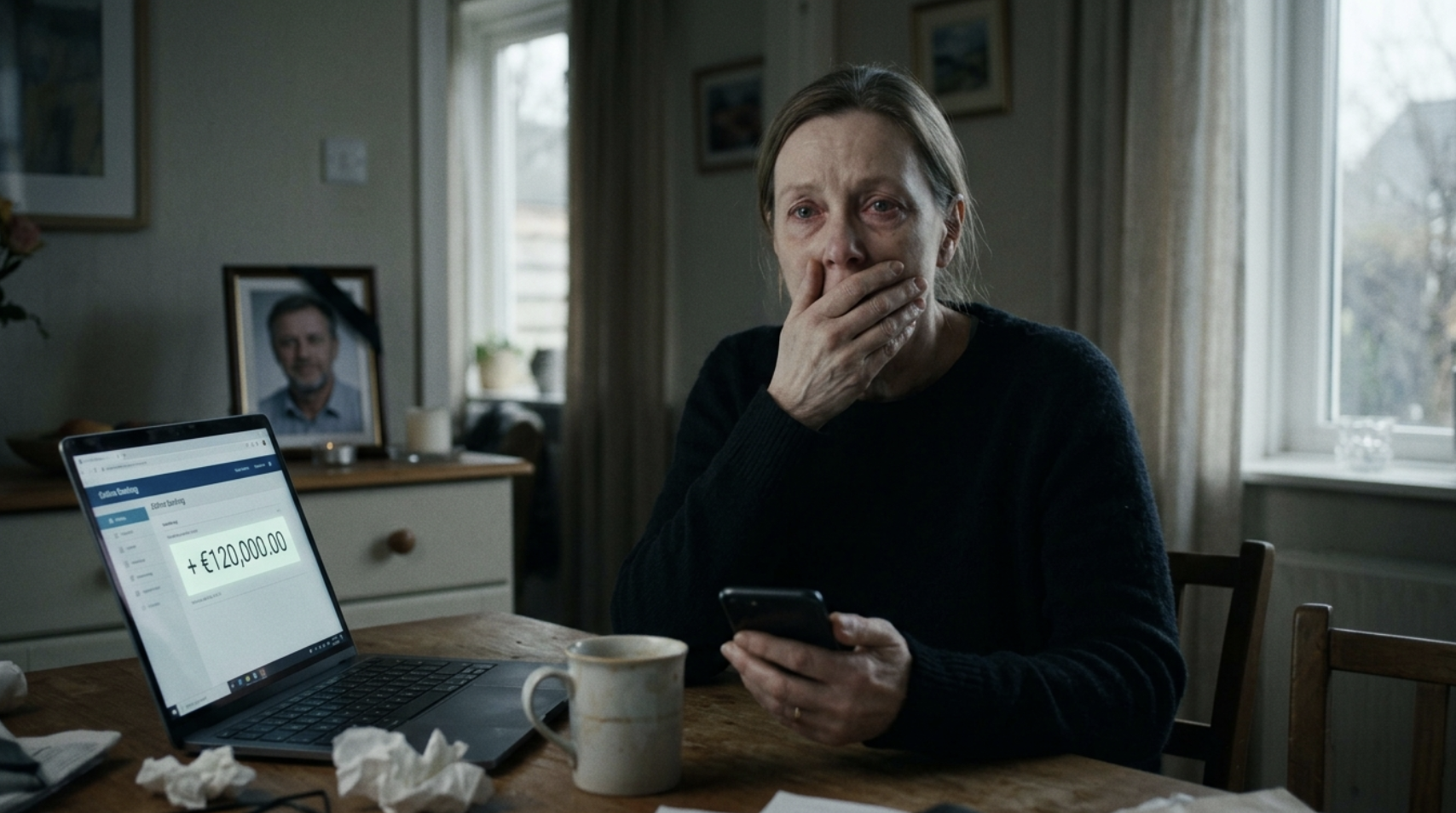
My husband had left me €120,000 in a bank account the morning after his death.
At first, I believed it was his final insult—a sum intended to erase twenty-five years of love and sacrifice.
Then I believed it was a clue to a terrible secret.
In the end, it was something else entirely.
It was the beginning of a life I had never allowed myself to imagine.
I could not change how my marriage had begun, how it had wounded me, or how it had ended.
But I could decide what those years would mean.
Gérard had left me his fortune because he wanted to correct a wrong he had allowed to continue for too long.
My father had left me something far more enduring: the belief that a person’s dignity should never depend on their wealth, their usefulness, or the approval of a family.
And I finally understood both gifts.
I was no longer the woman waiting to be accepted into the Delmas family.
I was Élise Delmas.
I had loved.
I had lost.
I had endured.
And now, at last, I was free.
The €120,000 had not been the price of my twenty-five years with Gérard. It had been the first key to the door I had been afraid to open.
And on the other side of that door, I finally found myself.