PART 5
For a while, life became wonderfully ordinary.
And after everything I had been through, ordinary felt like luxury.
Andrew and I learned how to be married again.
Not the way we had been before.
Better.
Slower.
More honestly.
There were no secrets about money anymore.
No hidden accounts.
No unexplained withdrawals.
No “Mom needs help” appearing on our credit card statement.
We had separate accounts, a shared household account, and complete transparency.
It sounds terribly unromantic.
But after twelve years of financial secrets, spreadsheets became one of the most romantic things in my life.
Andrew also started therapy.
At first, he hated it.
He would come home from his sessions and sit on the couch staring at the floor.
Then one evening, he looked at me and said:
“My therapist asked me a question I couldn’t answer.”
“What question?”
“Who would I be if I stopped trying to make my mother happy?”
I looked at him.
“And?”
He smiled sadly.
“I don’t know yet.”
“That’s okay.”
He reached for my hand.
“I think I’m starting to find out.”
And he was.
Slowly.
Theresa Disappears
Theresa stopped contacting us.
For nearly eight months, there wasn’t a single phone call.
No angry messages.
No relatives calling on her behalf.
No surprise visits.
Nothing.
At first, I thought it was peaceful.
Then I realized something was wrong.
I received a letter from a social worker.
Theresa had been struggling financially.
Her legal problems had drained what little money she had left.
Richard had stopped helping her.
The family members she had manipulated for years had grown tired of being asked for money.
She had moved into a small apartment across town.
She was alone.
Andrew wanted to visit her.
I told him he could.
“I won’t stop you.”
He looked at me.
“Will you come?”
I thought about it.
“No.”
He nodded.
He didn’t pressure me.
That was how I knew he had changed.
Before, he would have said:
“She’s my mother.”
As though those three words automatically erased everything she had done.
Now he simply said:
“I understand.”
The Call
Three weeks later, Andrew called me from his car.
His voice sounded strange.
“Carla?”
“What happened?”
“I just left Mom’s apartment.”
I sat down.
“How is she?”
He was silent for several seconds.
“She’s sick.”
My heart tightened.
“How sick?”
“Very.”
I didn’t ask for details.
I knew where the conversation was going.
“She asked about you.”
I closed my eyes.
“What did you tell her?”
“That you were okay.”
He paused.
“She asked if you hated her.”
I looked out the window.
“No.”
“That’s what I told her.”
I swallowed.
“I don’t hate her.”
“Do you forgive her?”
That question was harder.
“I don’t know.”
He nodded.
“That’s what I told her too.”
The Last Visit
A week later, Theresa sent me a letter.
Only three sentences.
I know I don’t deserve your forgiveness.
But I would like to see you once.
Not as your mother-in-law. Just as Theresa.
I read it several times.
Then I showed Andrew.
He didn’t say anything.
He simply waited.
The next afternoon, I drove to her apartment.
It was a tiny place.
Nothing like the enormous house she had once claimed was hers.
No expensive furniture.
No designer decorations.
No vacation brochures.
Just a small table.
Two chairs.
A photograph of Andrew as a little boy.
Theresa was sitting by the window.
She looked older than I remembered.
Much older.
She stood when she saw me.
“Carla.”
“Theresa.”
She gestured toward the chair.
“Please.”
I sat.
For several seconds, neither of us spoke.
Finally she said:
“I owe you an apology.”
“Yes.”
She looked surprised.
I smiled faintly.
“You don’t have to convince me you don’t.”
She looked down.
“I was jealous of you.”
That wasn’t what I expected.
“Why?”
“Because Andrew loved you.”
I frowned.
“He loved you too.”
“No.”
She shook her head.
“Not the way I wanted.”
She took a breath.
“I spent my entire life believing my son belonged to me.”
Her voice cracked.
“When he married you, I thought I was losing him.”
“You didn’t lose him.”
“I know that now.”
She wiped her eyes.
“But instead of becoming part of his new family, I tried to destroy it.”
I didn’t respond.
“I convinced myself you were taking him away.”
She looked at me.
“But the truth was…”
Her voice broke.
“I was pushing him away myself.”
For the first time, I saw something in Theresa I had never seen before.
Not anger.
Not arrogance.
Fear.
A frightened woman who had spent decades turning fear into control.
“I am sorry,” she whispered.
I looked at her.
“I accept your apology.”
She started crying.
“But accepting it doesn’t mean everything goes back to how it was.”
“I know.”
“It doesn’t mean I forget.”
“I know.”
“And it doesn’t mean I trust you.”
“I know.”
She nodded.
“Then that’s enough.”
What She Gave Me
Before I left, Theresa called me back.
“There is something I want you to have.”
She opened a drawer and pulled out a small envelope.
Inside was a photograph.
It was from our wedding.
I was standing beside Andrew.
Young.
Happy.
Theresa stood behind us.
She looked genuinely happy in the picture.
“I forgot about this,” I said.
“I didn’t.”
She smiled.
“You were beautiful that day.”
I looked at the photograph.
“So were you.”
She laughed softly.
“I don’t think anyone has called me beautiful in years.”
I stood.
“Maybe you should start being kinder to people.”
She smiled.
“I probably should have started with you.”
“Yes.”
She nodded.
“I wish I had.”
The Unexpected Inheritance
Three months later, Theresa died quietly in her sleep.
Andrew was devastated.
Despite everything, she was still his mother.
I went to the funeral.
Not because I had forgotten.
Not because everything was forgiven.
Because I wanted Andrew to know he didn’t have to grieve alone.
After the service, Richard approached me.
He looked uncomfortable.
“I owe you an apology too.”
I raised an eyebrow.
“Yes.”
He sighed.
“I knew what she was doing.”
I stared at him.
“How much?”
“More than I admitted.”
“Why didn’t you stop her?”
He looked away.
“Because I thought I was protecting my sister.”
“You were protecting her from consequences.”
“Yes.”
He handed me a folder.
“She left this for you.”
I opened it.
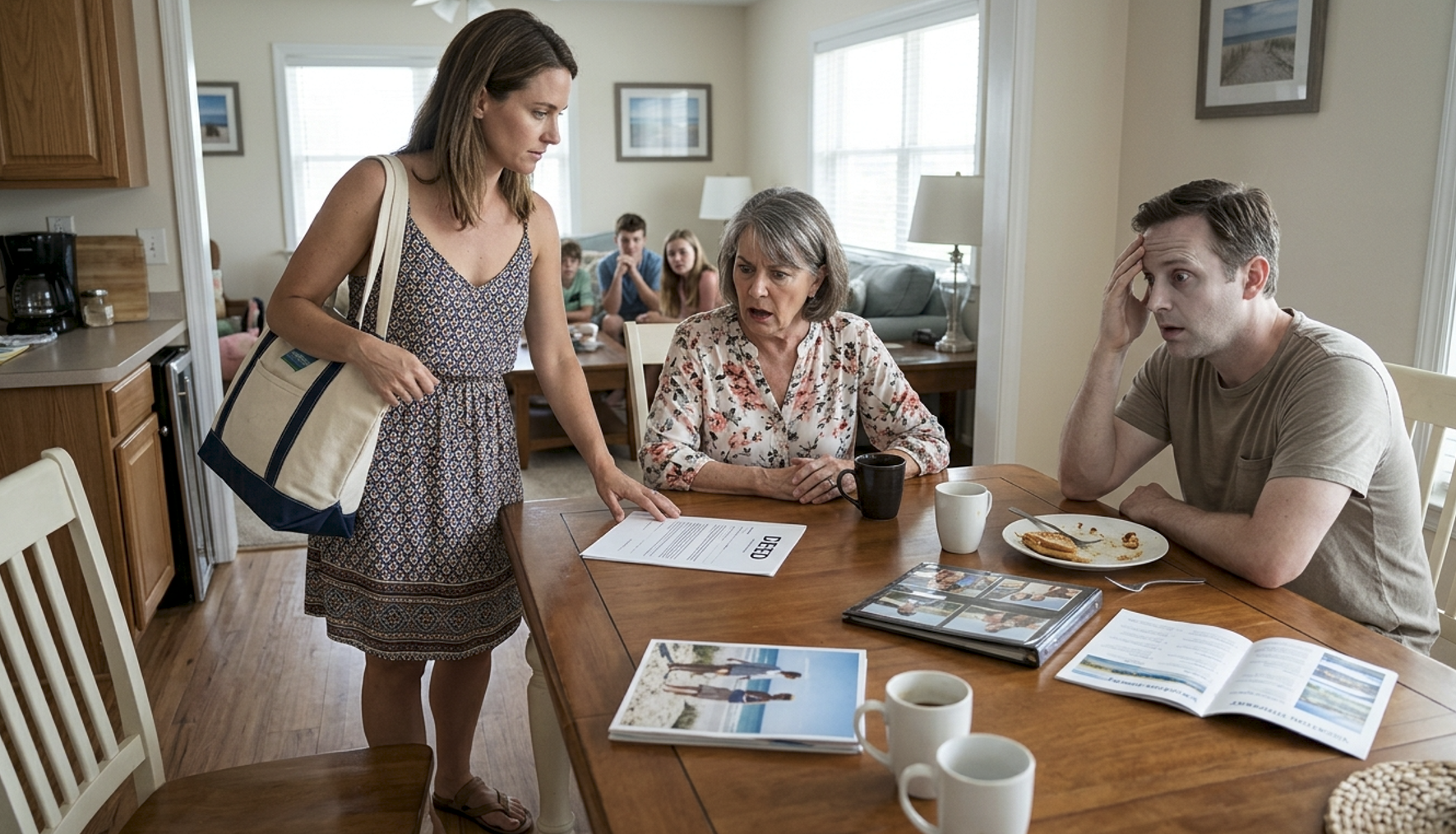
Inside was the deed to a small piece of land.
Not valuable.
Not compared with my house.
But there was a handwritten note.
Carla,
You once told me family isn’t about blood.
I didn’t understand.
I do now.
I can’t give you back the years I took from you.
So I won’t pretend this makes us even.
This is simply my way of saying: I finally understand that something can belong to someone without being mine.
Take care of my son.
And take care of yourself.
—Theresa
I read it twice.
Then folded it carefully.
I didn’t keep the land.
I sold it.
And donated the money to a women’s shelter.
When Andrew asked why, I said:
“Because I don’t need anything from your mother.”
He smiled.
“You never did.”
Five Years Later
People sometimes ask whether I regret marrying Andrew.
The answer is complicated.
I regret the years I spent accepting disrespect.
I regret every time I stayed silent because I was afraid of causing conflict.
I regret believing that being a good wife meant endlessly proving my worth to people who had already decided I wasn’t enough.
But I don’t regret loving Andrew.
Because he eventually became someone different.
Someone better.
Today, we have two children.
A little girl named Emma.
And a son named Noah.
They know their grandmother only through photographs.
One afternoon, Emma found the old wedding picture.
“Mommy?”
“Yes?”
“Who’s that?”
“Your grandmother.”
She studied the picture.
“She looks happy.”
I smiled.
“She was.”
“Did she love you?”
I thought about the question.
Then I answered honestly.
“I think she learned how.”
Emma looked confused.
“Can people learn how to love?”
I kissed her forehead.
“Sometimes.”
She smiled.
“I’m glad she learned.”
“So am I.”
The Family Vacation
Every summer, Andrew and I take our children somewhere new.
Not because we need expensive vacations.
Because we want them to experience the world.
And because I want them to grow up knowing that family trips are supposed to create memories.
Not hierarchy.
Not exclusion.
Not control.
Last summer, we returned to Miami.
The same beach where I had once sat with my mother after being told I wasn’t family.
I watched Emma and Noah run toward the water.
Andrew stood beside me.
“Do you ever think about that day?”
“All the time.”
“Do you wish you’d handled it differently?”
I smiled.
“No.”
He looked surprised.
“Really?”
“No.”
I looked at the ocean.
“That day taught me something.”
“What?”
“Sometimes rejection is actually an invitation.”
“To what?”
“To stop begging for a place where you aren’t valued.”
Andrew took my hand.
“And build your own.”
I smiled.
“Exactly.”
The Restaurant
That evening, we went to dinner.
Our children sat between us.
My mother sat across from Andrew.
There were no arguments.
No tension.
No one criticizing anyone’s clothes.
My mother raised her glass.
“To family.”
Emma lifted her juice.
“To family!”
Everyone laughed.
Andrew looked at me.
His eyes were warm.
I reached across the table and squeezed his hand.
For years, I thought family was something other people could grant you.
Theresa taught me that lesson the hard way.
She told me I wasn’t family.
She believed blood gave her ownership.
She believed money gave her control.
She believed my marriage made me an outsider.
But she was wrong.
Family isn’t the people who demand access to your home.
It’s not the people who expect your wallet to stay open.
It’s not the people who use guilt as a leash.
Family is the people who make room for you.
The people who protect your dignity.
The people who apologize when they’re wrong.
The people who don’t make you earn your seat at the table.
And sometimes…
the strongest family you build begins after you walk away from the one that hurt you.
The Final Lesson
Years ago, Theresa told me:
“Daughters-in-law aren’t family.”
I carried those words for a long time.
They hurt.
But eventually, I understood something.
She wasn’t defining me.
She was revealing herself.
She showed me exactly what kind of person I never wanted to become.
So I chose differently.
I became a wife who listened.
A mother who apologized.
A daughter who respected boundaries.
A friend who showed up.
And a woman who stopped confusing sacrifice with love.
As the sun disappeared over the Miami horizon, Emma grabbed my hand.
“Mommy, come look!”
I followed her toward the water.
Andrew stayed behind for a moment.
Then he called out:
“Carla!”
I turned.
He smiled.
“I love you.”
Years earlier, those words would have been enough to make me stay.
Now they meant something different.
Because love wasn’t just something he said.
It was something he had finally learned to prove.
I smiled back.
“I love you too.”
Then I ran toward my children.
Toward my husband.
Toward the family we had built ourselves.
And for the first time in my life, I didn’t wonder whether I belonged.
I knew I did.
Because this time…
I wasn’t sitting at someone else’s table.
I had built my own.
And everyone sitting there had earned their seat.