PART 4
I drove to Sarah’s house with my mind racing.
The folder.
My name on it.
Chloe asking about my custody schedule.
Mom giving her a copy of my key.
Someone keeping a list of the times I was away.
None of it made sense.
Not yet.
Sarah opened the door before I even knocked.
She looked worried.
“Leo is okay,” she said immediately. “My mom is with him.”
I nodded.
“Where’s the folder?”
She turned and walked toward the kitchen.
“It was in the back of a drawer. I found it about two weeks ago.”
“Why didn’t you tell me?”
“Because I didn’t know what it was.”
She placed a thick brown folder on the table.
My name was written across the front.
ETHAN VANCE.
The handwriting looked familiar.
I opened it.
The first page was a printed copy of my apartment lease.
My second thought was that someone had simply taken a photograph of it.
Then I saw the next page.
It was a copy of my work schedule.
The next was Leo’s custody calendar.
Then came a list of dates.
My business trips.
Late work nights.
Weekends when Leo stayed with Sarah.
Dates when I had been out of town.
I looked at Sarah.
“Where did you get this?”
“I told you. It was in a drawer.”
“Whose drawer?”
“Chloe’s.”
My stomach dropped.
“You went through Chloe’s things?”
“No. She left a box here when she helped me move last year. I forgot about it. Two weeks ago, I was looking for an old tax document and found this folder inside.”
“Why didn’t you open it?”
“I did.”
She pointed to another page.
“This is when I realized it was about you.”
I turned the page.
There were photographs.
My apartment building.
My front door.
My car.
Leo walking beside me.
Sarah picking him up.
My mother standing outside the building.
And then…
Chloe.
Holding a key.
I felt cold.
“She took these?”
“I don’t know.”
I kept turning pages.
Then I found something worse.
A handwritten note.
Apartment can be used when Ethan is away.
Mom has key.
Need code after lock change.
Leo’s room would work for kids.
I read it twice.
Then a third time.
Sarah whispered, “Ethan?”
I couldn’t answer.
Another sheet fell from the folder.
It was an email printout.
The sender was Chloe.
The recipient was someone named Michael.
I recognized the name.
Michael was a realtor.
The email said:
“Can you estimate what this apartment could rent for if we took over the lease? Ethan is rarely there on weekends.”
I looked up.
“Why would she care what my apartment could rent for?”
Sarah shook her head.
“I don’t know.”
I kept reading.
Another email.
This one was more recent.
“Derek’s parents don’t like staying with us. If we can use Ethan’s place regularly, it solves the problem.”
Regularly.
Not this weekend.
Regularly.
Then I found the final page.
A handwritten note dated three days earlier.
“Need Ethan out by next month.”
I stopped.
“What does that mean?”
Sarah looked over my shoulder.
“I don’t know.”
I read the sentence again.
Need Ethan out by next month.
Then I noticed something underneath.
It was written in different handwriting.
“Mom says he’ll eventually give in.”
My heart sank.
I knew that handwriting.
It was Mom’s.
I sat down.
For years, I had believed my family simply saw me as the easy one.
The flexible one.
The one who would say yes.
The one who didn’t complain.
But now I realized something.
They weren’t asking because they believed they had the right.
They were asking because they believed I would eventually surrender.
And if I didn’t?
They planned to make me.
Sarah touched my shoulder.
“What are you going to do?”
“I don’t know yet.”
“Yes, you do.”
I looked at her.
“You always say you don’t want conflict,” she continued. “But this isn’t conflict. Someone is trying to take control of your home.”
She was right.
I took photographs of every page.
Then I asked Sarah to keep the original folder somewhere safe.
“I’ll make copies,” I said.
She nodded.
I left her house at 8:10.
On the drive home, my phone rang.
Mom.
I ignored it.
Then Dad.
Ignored.
Then Chloe.
Ignored.
Then a message appeared.
You are destroying this family.
I almost replied.
Instead, I put the phone down.
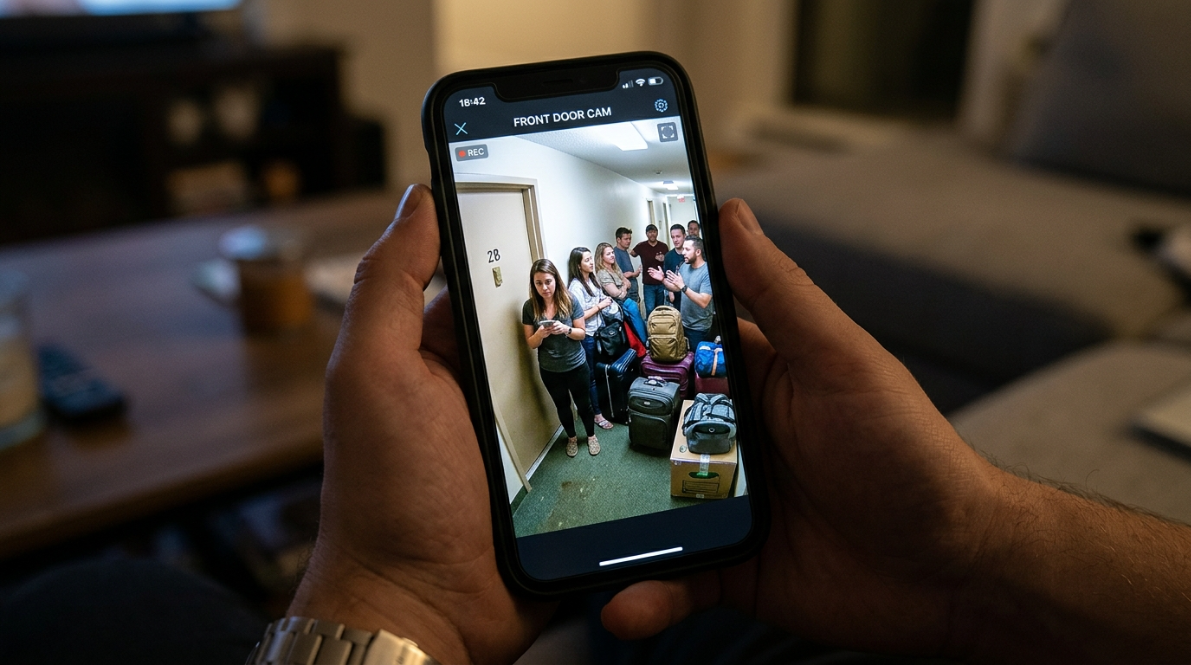
When I arrived at my apartment, I checked the security footage.
Nothing.
I entered.
Everything looked normal.
Then I noticed something.
The kitchen cabinet was open.
I was certain I had closed it.
I checked the bedroom.
Nothing.
Then Leo’s room.
His dinosaur box had been moved.
My blood ran cold.
I checked the camera.
The last movement had happened at 4:59 p.m.
Before Chloe and the others arrived.
I opened the footage.
At 4:59, the elevator doors opened.
Mom walked into the hallway.
She stood outside my apartment.
She tried the old key.
It didn’t work.
Then she looked directly at the camera.
She knew it was there.
She pulled out her phone.
A few minutes later, she left.
But before leaving, she placed something on the floor.
A small envelope.
I had never noticed it.
I went to the door.
There was nothing there.
Then I remembered.
I had entered through the garage entrance earlier.
I checked the footage from the other camera.
Mom had left the envelope beneath the mat.
I opened the door.
There it was.
I picked it up.
Inside was a handwritten note.
“Ethan, call me. We need to talk before this gets worse.”
I didn’t call.
Instead, I sent one message.
“Do not come to my apartment again without my permission.”
She responded instantly.
“You’re threatening your mother?”
“No. I’m setting a boundary.”
“You’ve become cruel.”
“No. I’ve become careful.”
There was no response.
For the first time in years, I felt strangely calm.
The next morning, I called my landlord.
I told him everything.
He advised me to formally document the unauthorized access and to provide him with copies of the messages.
Then I contacted the building security office.
They reviewed the footage.
They found something I hadn’t noticed.
Over the previous six months, Mom had entered the building eleven times.
Chloe had entered seven times.
Sometimes together.
Sometimes separately.
Every time, they had come when I wasn’t home.
I felt sick.
But there was more.
On three occasions, they had entered my apartment.
The smart lock had prevented them from entering after I changed it.
The building manager gave me copies of the relevant access records.
I saved everything.
Then I did something I should have done years earlier.
I called an attorney.
Not because I wanted to destroy my family.
Because I wanted to protect myself.
The attorney reviewed the messages, camera footage, access logs, and folder.
He looked at me.
“You’ve been extremely patient.”
“I don’t want my family arrested.”
“Then don’t make that your goal.”
“What should my goal be?”
“Making sure they understand that your home is not community property.”
That sentence stayed with me.
My attorney helped me send a formal written notice to my mother and Chloe.
They were no longer permitted to enter my apartment without my express written permission.
They were not permitted to use copies of keys.
They were not permitted to represent themselves as authorized occupants.
And they were not permitted to interfere with my lease.
The response came from Dad.
“You’re taking legal action against your own mother?”
I replied:
“No. I’m taking legal steps to protect my home.”
He called immediately.
I answered.
“You’ve gone too far,” he said.
“No.”
“You’ve embarrassed Chloe.”
“She embarrassed herself.”
“She has children.”
“So do I.”
Silence.
Then Dad said something I never expected.
“Your mother gave her the key because she thought you’d eventually let them stay.”
I closed my eyes.
“So you knew?”
“Yes.”
“How long?”
He hesitated.
“About the weekend.”
“That isn’t what I asked.”
Another silence.
“Dad.”
Finally, he said:
“She mentioned wanting to use the apartment more often.”
“How often?”
“I don’t know.”
“Did you know about the folder?”
“No.”
I believed him.
At least partially.
“Dad,” I said quietly, “why did nobody ever ask me?”
He sighed.
“Because you always said yes eventually.”
That hurt more than I expected.
Not because it was cruel.
Because it was true.
I had taught them that my no didn’t mean no.
I had taught them that if they pushed long enough, I would surrender.
But I wasn’t going to teach Leo the same lesson.
“I won’t do this anymore,” I said.
Dad was quiet.
Then he asked:
“Does this mean you’re cutting us off?”
“No.”
“Then what does it mean?”
“It means if you want to be part of my life, you have to respect me.”
He didn’t answer.
I ended the call.
That afternoon, Chloe showed up at my apartment building.
Security stopped her in the lobby.
She called me.
“Ethan, this is insane.”
“You’re not authorized to enter.”
“I just want to talk.”
“You can talk from the lobby.”
She started crying.
“I can’t believe my own brother is treating me like a criminal.”
“I don’t think you’re a criminal.”
“Then let me upstairs.”
“No.”
She wiped her face.
“You’re really going to do this?”
“Yes.”
She lowered her voice.
“Do you know what Derek thinks of you now?”
“I don’t care.”
“You should.”
“Why?”
“Because he thinks you’re selfish.”
I looked at her through the lobby camera.
“Chloe, you invited eight people into my home without asking me.”
“I thought you would say yes.”
“That is the problem.”
She stared at me.
Then something changed in her expression.
Not anger.
Fear.
“Did you find it?”
I froze.
“What?”
“The folder.”
She immediately realized what she’d said.
I didn’t move.
“What folder?”
She said nothing.
I asked again.
“What folder, Chloe?”
She looked toward the security desk.
Then back at the camera.
“I have to go.”
She turned.
“Chloe.”
She stopped.
“Who was Michael?”
She slowly turned around.
Her face went pale.
That was all the confirmation I needed.
She left.
That evening, I called Mom.
She answered.
“Did Chloe tell you I found the folder?”
Mom didn’t respond.
“Mom?”
Finally she whispered:
“What do you want?”
“The truth.”
“You don’t understand.”
“Then explain it.”
She started crying.
“It wasn’t supposed to become this.”
“What wasn’t?”
“Chloe was struggling.”
“With what?”
“Derek’s family.”
I waited.
“She wanted to impress them,” Mom said. “She wanted them to think she had a place downtown.”
“So she lied about having access to my apartment.”
“Yes.”
“And the folder?”
Mom cried harder.
“She started keeping track of when you were away.”
“Why?”
“I don’t know.”
“You do know.”
Another long silence.
Then she said:
“Chloe wanted you to move.”
My heart stopped.
“Why?”
“Because she and Derek were considering moving closer to downtown.”
I couldn’t understand.
“She wanted my apartment?”
“Not exactly.”
“Then what?”
“She wanted your lease.”
I stared at the wall.
“She thought she could convince you to give it up.”
“And if I refused?”
Mom didn’t answer.
“Mom.”
“She thought you could be pressured.”
The room became very quiet.
I finally understood.
The weekend wasn’t an isolated act of selfishness.
It was a test.
They wanted to see whether I would surrender.
If I did, Chloe would have proven she could control the apartment.
If I didn’t, they had planned to keep pushing.
I felt something inside me break.
Not anger.
Trust.
“I love you,” I told Mom.
She began crying.
“But I don’t trust you anymore.”
“I understand.”
“No, you don’t.”
I ended the call.
For the first time in my adult life, I didn’t feel guilty afterward.
Weeks passed.
The situation eventually reached its natural conclusion.
Chloe apologized.
Not immediately.
Not sincerely at first.
Her first apology was:
“I’m sorry you felt disrespected.”
I rejected it.
A week later, she came back.
This time she said:
“I was wrong.”
I listened.
“I thought because you were my brother, your home was partly mine.”
“It isn’t.”
“I know.”
“You violated my privacy.”
“I know.”
“You involved Mom.”
“I know.”
“And you planned to push me out.”
She looked down.
“I was scared.”
“Of what?”
“Of Derek’s family.”
She explained that Derek’s parents had been constantly criticizing their house, saying it was too far from downtown and too small for extended family gatherings.
Chloe had become obsessed with proving herself.
Instead of admitting that they couldn’t accommodate everyone, she tried to use my apartment.
She had convinced herself that because we were siblings, she had a right.
She didn’t.
I told her that forgiveness would take time.
But I also told her I didn’t hate her.
She cried.
“I don’t want to lose you.”
“You won’t,” I said. “But things have to change.”
They did.
Mom returned every copy of my keys.
Dad apologized.
Derek apologized too.
He admitted he had assumed Chloe had permission.
Susan and Robert never apologized.
But that was okay.
I didn’t need their approval.
I needed peace.
A month later, I changed my apartment security again.
Not because I was afraid.
Because I had learned something.
Boundaries aren’t walls designed to keep everyone out.
They’re doors.
And you get to decide who has a key.
That Sunday, Leo and I made dinosaur-shaped pizza.
He put far too much cheese on it.
Then he looked at me.
“Dad?”
“Yeah?”
“Is Aunt Chloe allowed to come here now?”
I smiled.
“She can come if we invite her.”
He nodded seriously.
“So you decide?”
“Yes.”
He thought about it.
“That’s good.”
“Why?”
“Because it’s our home.”
I looked around the little apartment.
The crooked pictures.
The toy dinosaurs.
The pizza flour scattered across the counter.
The tiny fingerprints on the refrigerator.
It wasn’t much.
But it was ours.
And for the first time, I understood that protecting it wasn’t selfish.
It was necessary.
Six months later, I received another text from Chloe.
“Can we come over Sunday?”
I smiled.
Then I typed:
“Yes. Come at 2.”
A few seconds later, she replied:
“Thank you.”
That word mattered.
Because for the first time, she had asked.
And for the first time, I had answered.
Not because I was pressured.
Not because I was afraid of disappointing my family.
But because I wanted her there.
That was the difference.
My family had spent years believing love meant unlimited access.
I finally understood that real love could include boundaries.
You could love someone deeply and still tell them no.
You could forgive someone without giving them permission to hurt you again.
And sometimes, the strongest way to save a family wasn’t by surrendering.
It was by finally teaching everyone how to respect the word no.
As Leo and I carried our dinosaur pizza to the table that Sunday, I looked at the smart lock on the front door.
It was still there.
Quiet.
Unremarkable.
But to me, it represented something much bigger.
The moment I stopped being the person everyone expected to give in.
And became the person who finally understood that my home, my time, and my life were mine to share—not things other people could simply take.
And that was the real ending to the story.
Not that my sister lost a weekend.
Not that my family was embarrassed.
Not even that I won the argument.
I won something much more important.
I finally learned that saying no didn’t make me a bad son, a bad brother, or a bad father.
Sometimes, saying no was the very thing that allowed you to become a better one.