PART 4
For the next few weeks, things between Denny and me were different.
Not broken.
Different.
There is a difference, and I think people who have lived long enough understand it.
Some things break loudly.
A glass falls from your hand.
A door slams.
Someone says something cruel, and everyone knows the exact second everything changed.
But other things break quietly.
A little piece at a time.
A missed phone call.
A secret kept too long.
A person who stops telling you things because they have decided they know how you will react.
That kind of break is harder to fix because nobody can point to the exact moment it happened.
You just wake up one day and realize you are standing on pieces.
After that Sunday dinner, Denny did not come over for a few days.
I expected that.
Truth has a way of making people uncomfortable before it makes them better.
I did not call him.
That was difficult.
Mothers are not built to sit still when their children are hurting.
Every part of me wanted to pick up the phone and say:
“Are you okay?”
“Did you eat?”
“Are you mad at me?”
But I stopped myself.
Because I realized something.
For forty-two years, every time Denny fell, I had rushed to catch him.
But somewhere along the way, I forgot that children who are never allowed to fall never learn how to stand.
On Thursday evening, my phone rang.
His name appeared.
I stared at it for a moment.
Then I answered.
“Hello, sweetheart.”
There was silence.
Then:
“Hi, Mom.”
His voice sounded tired.
Not angry.
Just tired.
“How are you?”
“I’m okay.”
A pause.
Then he said:
“I went to the bank.”
I sat down.
“What for?”
“I started looking at everything.”
I knew what he meant.
“Everything?”
“Yeah.”
He exhaled.
“The house. The loans. The credit cards. The things we bought because we thought we deserved them.”
His voice cracked slightly.
“Mom, I don’t know why I became that person.”
I looked out my kitchen window.
The same window I had stood beside while wondering what my son was hiding.
“Denny…”
“No, let me say it.”
I stayed quiet.
“I kept telling myself I wasn’t lying. I told myself I was just waiting for the right time to tell you.”
He laughed bitterly.
“But there was never a right time, was there?”
“No,” I said softly.
“No.”
He was quiet again.
“I think I was afraid.”
“Of what?”
“That you would be disappointed.”
I closed my eyes.
Because that sentence told me everything.
He had spent so much energy avoiding my disappointment that he created something much worse.
“I would have understood struggling,” I said.
“I know.”
“I would have understood wanting a nicer house.”
“I know.”
“I would have even understood making a bad financial decision.”
“I know.”
My voice softened.
“But I cannot understand being turned into someone you needed to hide the truth from.”
He whispered:
“I know.”
This time, he really did.
The following Sunday, Denny came over alone.
No excuses.
No dessert box.
No pretending.
Just my son standing at my door holding a folder.
“What’s that?” I asked.
He looked embarrassed.
“Everything.”
He came inside.
We sat at the kitchen table.
The same table.
Funny how furniture remembers things.
This table had held birthday cakes.
Homework.
Christmas cookies.
Arguments.
Tears.
And now, accountability.
He opened the folder.
“I made a list.”
I looked down.
Expenses.
Debt.
Payments.
Plans.
Real numbers.
Not stories.
Not emotions.
Numbers.
“I sold the boat,” he said.
I looked up.
“You had a boat?”
He looked down.
“Yeah.”
I almost laughed.
Not because it was funny.
Because suddenly the nineteen thousand dollars made even less sense.
“The boat was a mistake.”
“Denny.”
“I know.”
He rubbed his hands together.
“I know what you’re thinking.”
“No, you don’t.”
He looked at me.
“I’m thinking I raised you to be kind.”
His eyes became wet.
“And somewhere along the way, I forgot to teach you that kindness has to include honesty.”
He nodded slowly.
“I’m sorry.”
We sat there quietly.
Then he said something I did not expect.
“I want to apologize to Max.”
I looked at him.
“For what?”
“For making him part of it.”
That mattered.
More than the money.
More than the house.
Because children carry things adults leave behind.
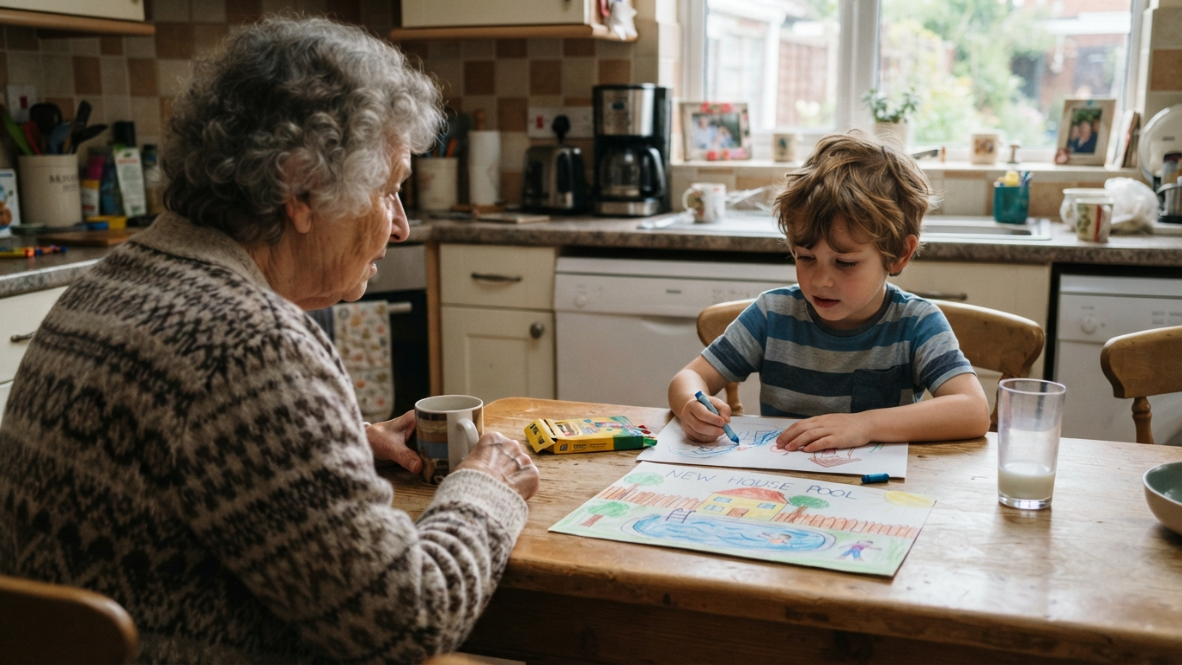
A seven-year-old should not have to memorize which truths are safe to tell Grandma.
The next weekend, Denny brought Max over.
We sat in the backyard.
The sun was warm.
Max was drawing again.
Of course he was.
Children return to what makes them happy.
After a while, Denny sat beside him.
“Buddy?”
Max looked up.
“Yeah?”
“Remember when you drew the pool?”
Max smiled.
“Yeah. Daddy said it was a secret.”
Denny swallowed.
“I shouldn’t have asked you to keep secrets from Grandma.”
Max looked confused.
“Why?”
“Because Grandma loves us. And families should tell each other the truth.”
Max thought about that.
Then he nodded.
“Okay.”
Children are amazing.
Adults create complicated wounds.
Children often heal them with one simple sentence.
Later that afternoon, I stood near the fence watching Max run around the yard.
Denny came beside me.
“Mom?”
“Hmm?”
“I know things won’t go back to normal.”
I looked at him.
“No.”
He nodded.
“I know I have to earn trust again.”
“Yes.”
Another pause.
“Will I?”
I knew what he was asking.
Not “Will things be easy?”
Not “Will you forget?”
He was asking:
“Is there still a place for me?”
I looked at my son.
The same eyes.
The same little boy who once held my finger walking across a parking lot.
“Yes,” I said.
His shoulders relaxed.
“But earning it is your job.”
“I know.”
“And forgiving is mine.”
He smiled sadly.
“I love you, Mom.”
“I love you too.”
Then he surprised me.
He hugged me.
Not the quick hug he usually gave when leaving.
A real one.
The kind where people hold on because they know they almost lost something.
Months passed.
Things changed.
Denny did not become perfect.
Nobody does.
But he became honest.
And that mattered.
He called when he was struggling.
Not when he needed money.
When he needed advice.
There was a big difference.
One year later, Max invited me to his new house.
Yes.
The house with the pool.
The house that had once been the symbol of everything hidden.
I stood in the backyard watching him swim.
Denny walked over with two cups of lemonade.
“You know,” he said, “I almost didn’t invite you here.”
I looked at him.
“Why?”
“Because I was ashamed.”
I smiled.
“And now?”
He looked around.
“Now I think this house should be a place where we tell the truth.”
I took the lemonade.
“That is a much better foundation than concrete.”
He laughed.
A real laugh.
The kind I had missed.
Later, when I got home, I found something in my mailbox.
A letter from Denny.
I opened it.
Inside were three sentences.
Mom,
I spent years thinking you were the person who would save me. I was wrong. You were the person who loved me enough to let me save myself.
Thank you for not giving up on me.
I folded the letter carefully.
Because that is what mothers do.
We keep things.
Old drawings.
Old photos.
Old letters.
Even old pain.
Not because we want to suffer.
Because every scar tells us we survived something.
And that blue crayon pool?
I still have it.
Max’s drawing sits framed on my kitchen wall.
People who visit ask:
“Is that your grandson’s first picture of a house?”
I smile.
“No.”
They look confused.
“Then what is it?”
I look at the little blue rectangle.
The little stick figures.
The secret that almost divided a family.
And I say:
“It’s the picture that reminded us a house is not built with walls.”
I touch the frame gently.
“It is built with trust.”
And after everything…
we finally learned how to build again.
I thought that was where the story ended.
For a while, I truly believed it.
The secret had come out.
The apologies had been made.
The family had found its way back to the same table where everything had started.
But life has a funny way of reminding us that healing is not a straight road.
Sometimes you think you have reached the destination, and then another mile appears in front of you.
Three years passed after the day I found out about Kestrel Landing.
Three years since the blue crayon pool.
Three years since I learned that the hardest thing a mother can do is love her child without rescuing him from every consequence.
Denny was different.
Not perfect.
But different.
He paid me back every dollar.
Not because I demanded it.
Not because I threatened him.
Because one afternoon he showed up at my door with an envelope.
“What is this?” I asked.
He smiled.
“The first payment.”
I shook my head.
“You don’t have to do this.”
“Yes, I do.”
“Denny—”
“No, Mom.”
He looked at me.
“I need to.”
And that was when I knew he finally understood.
The money was never really about the money.
It was about respect.
Every month after that, he sent a payment.
Sometimes small.
Sometimes bigger.
But always on time.
And every month he called.
Not texted.
Called.
“Mom, how are you?”
Not:
“Mom, can you help?”
There is a world of difference between those two questions.
Then one Tuesday morning, my phone rang.
It was Denny.
I answered immediately.
“Everything okay?”
There was a pause.
That mother instinct.
The one that never disappears.
“Mom…”
His voice sounded strange.
“What happened?”
“It’s Dad’s old things.”
I froze.
His father had been gone for twelve years.
“What about them?”
“I was cleaning out the storage room.”
“And?”
“I found something.”
I sat down.
“What?”
“Something that belonged to you.”
I almost laughed.
“Denny, your father left boxes of things. There are probably hundreds of things that belong to me.”
“No.”
His voice became softer.
“This is different.”
“Come over,” I said.
An hour later, he arrived carrying an old wooden box.
I recognized it immediately.
It had scratches on the side.
A broken brass latch.
My husband had built it when we were first married.
I had not seen it in years.
“Where did you find this?”
“Behind some old shelves.”
He placed it on the table.
My kitchen table.
Of course.
Everything important in this family somehow returned to this table.
Denny opened it.
Inside were letters.
Photographs.
Receipts.
Small things that looked meaningless to anyone else.
But not to me.
A movie ticket from our first date.
A hospital bracelet from when Denny was born.
A tiny blue sweater I knitted when he was a baby.
My hands started shaking.
“Why did Dad keep all this?”
Denny picked up an envelope.
“Because he loved you.”
I looked at him.
“He wasn’t good at saying things.”
Denny smiled sadly.
“No.”
His father had been a quiet man.
A good man.
But quiet.
The kind of man who showed love by fixing a broken door instead of saying “I love you.”
The kind who worked overtime without telling anyone.
The kind who thought providing was the same as expressing.
Denny handed me the envelope.
“Read this.”
I opened it.
My husband’s handwriting appeared.
The date was two months before he died.
My dear,
If you are reading this, I probably waited too long to say things I should have said every day.
My breath caught.
I know I was not always the husband you deserved. I know I spent too much time working and not enough time telling you how much you carried for this family.
I wiped my eyes.
But I want you to know one thing. You gave our son something I could never give him. You gave him a heart that cares.
I looked at Denny.
He looked away.
Sometimes caring people get hurt because they believe everyone deserves the same kindness they give. Protect your heart, but never close it.
The room became blurry.
I continued reading.
And if our son ever makes mistakes, remember this: children do not stop being children when they grow tall. They still need love. But love does not mean removing every stone from their path. Sometimes the stones teach them how to walk.
I stopped.
Because those words felt like they had been written for Denny.
For me.
For everything that happened.
Denny was crying quietly.
“I think Dad understood you better than I did.”
I folded the letter.
“Your father was a wise man.”
“No.”
He shook his head.
“He was a good man.”
We sat together.
Two generations.
Two people who had hurt each other.
Two people who were still choosing each other.
After a while, Denny said:
“Mom?”
“Yes?”
“I need to tell you something.”
My heart jumped slightly.
Old fears return faster than we expect.
“What?”
He smiled a little.
“Relax. I’m not asking for money.”
I laughed.
A real laugh.
The first one in a while.
“Good start.”
He smiled.
“Actually, I was offered a promotion.”
“That’s wonderful!”
“But I almost turned it down.”
“Why?”
“Because it means more responsibility.”
I looked at him.
“And?”
“And I realized something.”
“What?”
“I spent years avoiding responsibility while pretending I was protecting my family.”
He looked at the old letter.
“I don’t want to be that person anymore.”
I reached across the table.
“Then don’t be.”
Simple.
Sometimes the best advice is the simplest.
A few months later, something happened that surprised everyone.
Max wrote a letter.
He was ten years old by then.
His handwriting was still messy.
His spelling was still imperfect.
But the message was clear.
He gave it to me during Sunday dinner.
“Grandma, I made this for you.”
I opened it.
At the top was a drawing.
Not a pool.
Not a house.
A table.
Four chairs.
A family sitting together.
Underneath, he wrote:
Grandma, thank you for teaching Dad that telling the truth is better than hiding.
Thank you for always loving us.
I hope when I grow up I can be brave like you.
I looked at Denny.
He was already crying.
“Did you help him write this?” I asked.
He shook his head.
“No.”
I looked back at Max.
“You wrote this yourself?”
He nodded proudly.
“I wanted you to know.”
And that was the moment I realized something.
The secret that almost destroyed us had also taught us something.
Families are not held together because nobody makes mistakes.
Families are held together because people are willing to face them.
The next morning, I took the old blue crayon drawing out of its frame.
I did not throw it away.
I placed it beside Max’s new drawing.
The first showed a house built on a secret.
The second showed a home built on honesty.
Both came from the same child.
Both came from the same family.
And maybe that is the most important lesson I ever learned.
People are not defined by the moment they fail.
They are defined by what they do after.
My son once hid a house with a pool from me.
But years later, he gave me something much more valuable.
Not money.
Not a gift.
Not an apology.
He gave me the truth.
And sometimes, after everything has been lost…
the truth is where a family finally begins.
CONTINUE READ NEXT PART… 👇