Chapter 6
I heard later from a friend of a friend that she was the oldest person in her class. That the instructor made her practice on a training device four times because her hands were shaking. That on the last day, when the instructor walked through what happens to a child’s airway during anaphylaxis, Patricia had quietly left the room and sat in her car for twenty minutes.
I don’t know if it changed her. I hope it did. Not for my sake. For the sake of the other grandchildren who still spend weekends at her house.
Some things fell apart. Other things were built.
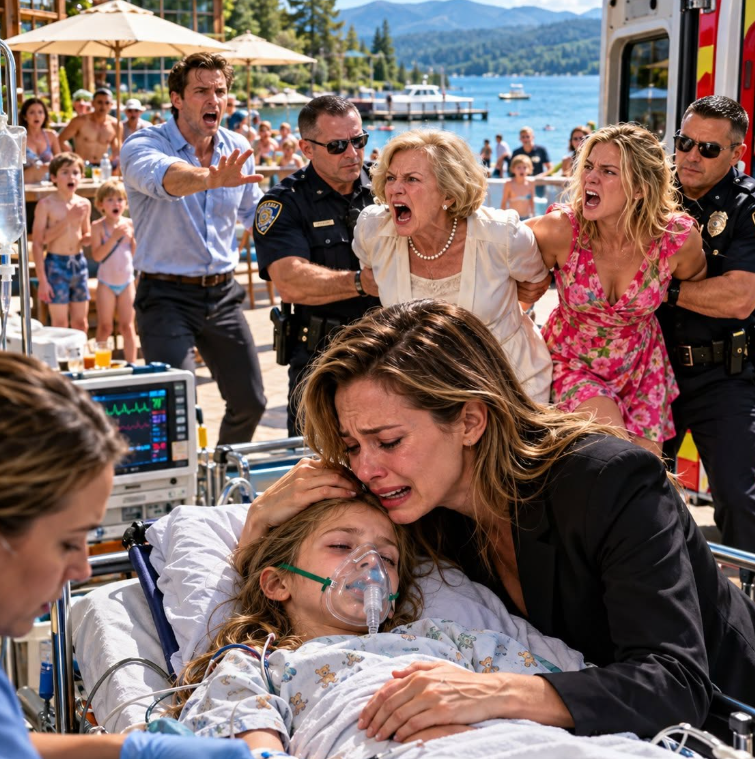
Mrs. DeLuca, our seventy-eight-year-old neighbor, turned out to be the reason Lily was alive. When Claire dropped Lily off, Mrs. DeLuca had been told Lily was “just a little tired.” She’d set her up on the couch with a blanket and gone to make tea. When she came back ten minutes later and saw Lily’s lips, she didn’t hesitate. She had dialed 911 at the exact moment the dispatcher from my call was trying to reach her. She stayed on the floor beside Lily, holding her hand and talking to her, until the paramedics came through the door.
“She kept saying she was sorry,” Mrs. DeLuca told me, her voice trembling. “Over and over. Sorry for being trouble. I told her, ‘Sweetheart, you are no trouble at all. You are a child.'”
Lily started calling her Grandma Rose after that. Mrs. DeLuca pretended to protest the first time. By the third time, she was keeping Lily’s favorite peppermint tea in her cupboard, and every Sunday afternoon, the two of them sat on her porch working on a thousand-piece puzzle of the Italian coast.
Then there was Hannah Brooks, the school nurse.
After the incident, the Westbrook Elementary principal asked Hannah to help review the school’s emergency procedures. What she found was a gap nobody had ever thought about: the policy allowed a listed emergency contact to sign out a student at any time, even during an active medical emergency. There was no rule that said a symptomatic child had to be released only to paramedics.
Hannah wrote a new one.
It said that any student showing signs of a serious allergic reaction must receive their prescribed epinephrine and be transported by emergency medical services, and that no family member, regardless of their status on the emergency contact list, could remove that child from campus before paramedics arrived.
The school district adopted it for all fourteen of its elementary schools. Then the neighboring district adopted it too.
The teachers started calling it Lily’s Rule.
Daniel and I didn’t fix everything overnight. I don’t believe that stories where people fix things overnight are honest.
We went to a family counselor twice a week for the first two months, then once a week after that. Some sessions were hard. In one of them, the counselor asked Daniel why he had turned his phone face down at the lake. He was quiet for a long time before he answered.
CONTINUE READ NEXT PART… 👇