
Chapter 6: The Zenith
I sat at my expansive, polished oak desk in my command office overlooking the sprawling, orderly base in Stuttgart. The morning sun illuminated the room, reflecting brightly off the silver eagles pinned to the collar of my uniform.
I was reviewing a highly classified logistics report for an upcoming joint NATO exercise.
My adjutant, a sharp, highly efficient Captain named Miller, knocked sharply on the open door frame, saluting before entering.
“Ma’am,” Captain Miller said, handing me a small stack of mail that had cleared the base security screening. “Personal correspondence, forwarded from your old address in the States.”
“Thank you, Captain,” I replied, taking the stack.
Resting on top of a few harmless bank statements and forwarded magazine subscriptions was a cheap, thin, heavily stamped manila envelope.
The return address in the top left corner bore a zip code from a decaying, industrial suburb in Ohio.
It was Julian’s handwriting. It was cramped, shaky, and small—a pathetic, broken scrawl, a far cry from the bold, arrogant signature he had used to sign the divorce papers that surrendered his children.
I looked at the envelope. It was undoubtedly a sprawling, desperate manifesto. It was a pathetic, gasping attempt to invoke the memory of a dutiful, submissive wife who had ceased to exist the moment he told me to “take the girls.”
He was likely begging for a financial handout to cover his mounting legal debts and bankruptcy filings. He was probably asking for forgiveness, crying about the brutal, humiliating reality of poverty and the betrayal of his mistress. Or, most audaciously, begging for a sliver of connection, a chance to speak to the daughters he had so casually, callously thrown away for a counterfeit son.
A year ago, the mere sight of his handwriting might have elicited a massive spike of residual anger, a phantom pain in my chest, or the deeply ingrained, toxic urge to open the letter, read his words, and justify my actions to him.
Today, it was nothing more than a minor administrative annoyance. It was junk mail from a ghost.
I didn’t feel a shred of curiosity. I didn’t owe my abuser closure. I didn’t owe him forgiveness, or an audience, or a second chance. True power, I had learned through fire and deployment, was not the ability to destroy your enemies; it was the ability to be utterly, profoundly indifferent to their suffering.
I didn’t even open the flap.
I picked up the envelope, leaned over, and dropped it directly into the heavy-duty, industrial cross-cut shredder beside my desk. I sat back in my ergonomic leather chair, sipping my black coffee, listening to the satisfying, mechanical whine as his words, his excuses, his apologies, and his entire existence were sliced into microscopic, meaningless confetti.
Three years later.
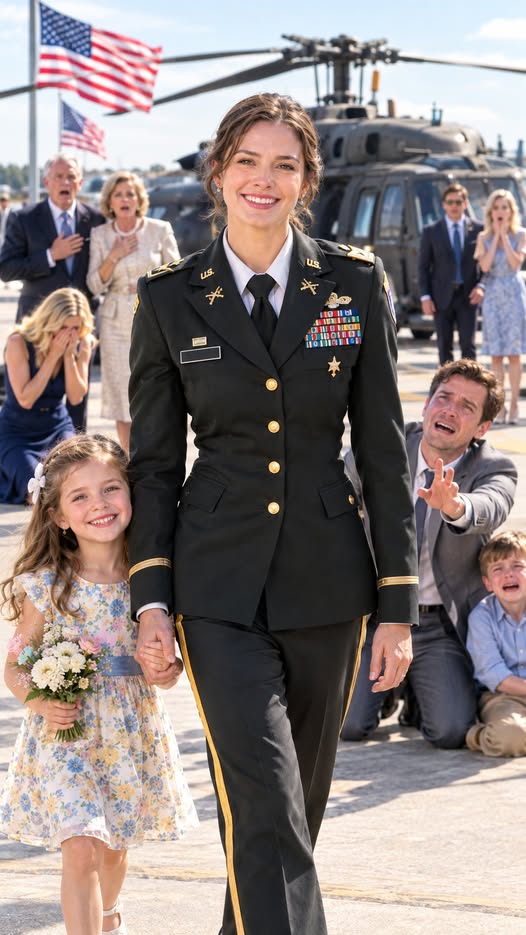
I stood in the grand, historic auditorium of the Pentagon in Washington, D.C. The room was packed with high-ranking military officials, politicians, and distinguished guests.
I was standing at attention under the bright lights, wearing my formal dress uniform. I was not wearing the silver eagles of a Colonel anymore. Pinned to my shoulders were the single, heavy silver stars of a Brigadier General.
Sitting in the front row, cheering wildly, their faces glowing with immense, unbroken pride and genuine happiness, were my daughters. Nora, now twelve, and Sophie, ten, were bright, fiercely confident, and entirely unburdened by the trauma of their early childhood. They stood up, saluting me with tears of pure joy shining in their eyes as the promotion order was read aloud.
We were at the absolute zenith of our lives. We were completely immune to the kind of parasitic manipulation that had once threatened to erase us.
Society conditions women—especially mothers—to swallow their humiliation, to uphold the image of the institution of marriage at all costs, and to believe that failing to produce a male heir or a “perfect” family is a tragedy to be endured. They assume that if a woman is quiet during a divorce, if she doesn’t fight for money or scream in a mediator’s office, she is compliant, defeated, fragile, and ready to be conquered.
They assume she is empty-handed.
But what Julian, Eleanor, and sociopathic narcissists exactly like them will never understand is the terrifying, explosive alchemy of a mother who realizes she is holding the launch codes.
When you discard a woman’s daughters as defective merchandise, when you flaunt your betrayal and your pregnant mistress in her face, and when you arrogantly demand she disappear, you do not assert your dominance. You do not prove your superiority.
You strip away her mercy.
You teach her how to weaponize her silence. You teach her how to lock the gates of the global economy, how to call in the armed forces of the United States government, how to dismantle your empire with surgical, tactical precision, and how to let you drown in the shallow, pathetic end of the pool you arrogantly thought you owned.
I smiled down at my girls from the stage, returning their salute, stepping fully and unapologetically into the brilliant, limitless light of our future.
I was completely at peace, fortified forever by the absolute, unshakeable knowledge that the most dangerous, devastating weapon on earth is a quiet woman who finally decides to put her uniform back on.