THE RED SUIT
My father was never a man who expressed himself easily.
He didn’t give emotional speeches or write long, sentimental letters. I can’t remember him ever saying “I love you” in the direct way people often expect parents to say it.
He was a civil engineer, and he approached almost everything—including emotion—the way he approached a bridge: use only what was necessary, but make sure whatever you built could carry the weight.
His language was action.
He showed up.
He attended every school performance I ever had, even when my only role was standing silently in the background. He sat through Eric’s baseball games in pouring rain, including seasons when my brother’s team barely won anything.
And when our mother left us when I was eleven and Eric was eight, Dad rearranged his entire life around raising us.
He didn’t make a speech about sacrifice.
He simply stayed.
For thirty-two years of my life, that was the most important thing I knew about my father.
He was there.
Then suddenly, he wasn’t.
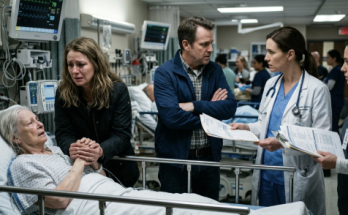
Dad was diagnosed with pancreatic cancer in March. By September, we understood how little time remained. For six months, Eric and I reversed the roles Dad had played our entire lives. We drove him to appointments, stayed beside him during difficult nights, and slowly learned what it meant to watch someone run out of time.
He died on a Tuesday morning in October.
He was sixty-eight.
He left behind his house, the lingering smell of his coffee and aftershave, two children who had been shaped by him more deeply than either of us understood—and one final secret.
That secret walked into his funeral wearing a bright red suit. :chatgpt-content-reference{index=”0″}
—
My younger brother Eric had always been complicated.
He was four years younger than me and had an extraordinary talent for doing the wrong thing for the right reasons.
He was late constantly, but if you called him and said you were struggling, he would drive four hours through a snowstorm without thinking twice.
He was blunt.
Stubborn.
Loyal.
And for most of his adult life, he and Dad could barely spend an hour together without irritating each other.
The problem was simple.
They were almost identical.
Same stubbornness.
Same pride.
Same laugh.
And, unfortunately, the same habit of becoming silent whenever they were hurt.
Five years before Dad died, Eric went through a painful divorce. Somewhere during that period, he and Dad had an argument.
Technically, everyone knew what the argument had been about.
But families understand that some arguments are never really about the thing that started them.
This one carried twenty years of misunderstandings underneath it.
Afterward, Eric and Dad remained polite.
They called on birthdays.
They saw each other at Christmas.
But something between them had closed.
I knew Dad regretted it.
Naturally, he never said so.
But during those final six months, I noticed how his expression changed whenever Eric’s name came up.
I noticed the phone calls that ended sooner than Dad wanted.
And one evening, I saw him sitting alone at the kitchen table, carefully writing something on a sheet of paper.
He would write.
Stop.
Think.
Then begin again.
I never asked what it was.
After his funeral, I wished I had.
The morning we buried Dad was cold and clear.
I arrived early wearing the black dress I had bought specifically for the funeral and a pair of shoes Dad had given me two birthdays earlier.
People slowly filled the chapel.
Then, after nearly everyone had taken their seats, the doors opened.
Eric walked in.
Every head seemed to turn.
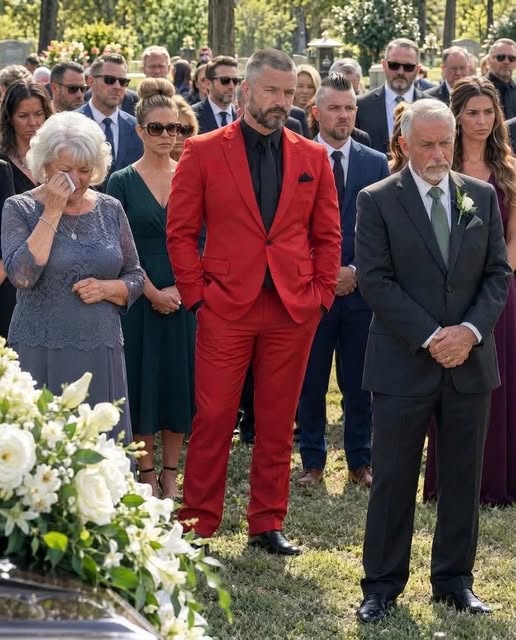
Because my brother was wearing red.
Not burgundy.
Not dark crimson.
Bright red.
A perfectly fitted, impossible-to-ignore red suit.
He walked to Dad’s casket, stood there silently for several seconds, then came and sat beside me.
I leaned toward him.
“What on earth are you wearing?”
“Not now, Sarah.”
“Dad would have hated this.”
That made Eric finally look at me.
His expression wasn’t angry.
It was strangely certain.
“No,” he whispered. “He wouldn’t.”
Then the service started.
I didn’t ask again.
But throughout the eulogies, I kept watching my brother.
The minister talked about Dad’s reliability, his steadiness, and his habit of making people feel that someone had remembered them.
Eric stared forward, his jaw tightening exactly the way Dad’s used to whenever he was trying to contain emotion.
For a moment, I remembered what years of arguments had made me forget.
Those two men had always been almost exactly alike.
Everything changed at the cemetery.
Dad’s longtime attorney, Herbert Lawson, approached us after the burial.
Mr. Lawson had handled Dad’s legal affairs for decades. He was seventy-three, meticulous, composed, and rarely surprised by anything.
Then he saw Eric.
More specifically, he saw the red suit.
He stopped walking.
His face lost its color.
“Where did you get that?”
Eric frowned.
“Why?”
“Just tell me.”
Eric hesitated.
“It was in Dad’s closet.”
I immediately looked at him.
“What closet?”
I had already gone through Dad’s main closet and the spare bedroom.
There had been no red suit.
“The downstairs one,” Eric said.
Dad’s study was downstairs.
And as far as I knew, Dad’s study didn’t have a closet.
Eric explained that while searching for Dad’s military papers for the funeral arrangements, he had run his hand along one of the bookshelves.
That was when he noticed something unusual.
A narrow section of the bookcase moved.
The entire shelf was mounted on hidden hinges.
Behind it was a small concealed closet.
Inside hung three garment bags.
Two contained black suits.
The third contained the red one.
Pinned to it was a note bearing Eric’s name.
Mr. Lawson stared at him.
Then he asked one strange question.
“Did you check the pockets?”
Eric shook his head.
Mr. Lawson pulled us away from the other mourners and began examining the jacket.
The pockets were empty.
Then his fingers stopped over Eric’s chest.
He pressed the lining.
Something crackled underneath.
Mr. Lawson looked at us.
“Your father told me I would know when the time came.”
He opened his briefcase and removed a tiny pair of scissors.
I stared at him.
“Time for what?”
He didn’t answer.
He carefully cut several stitches in the jacket lining.
Inside was a folded piece of heavy paper.
Eric took it.
His hands started shaking before he even finished unfolding it.
Then he read.
I watched his face change.
I had known my brother my entire life, but I had never seen that expression before.
It looked like someone had just returned something to him that he had stopped believing he would ever receive.
Later, Eric let me read part of the letter.
Some of it belonged only to him, and I will always respect that.
But I can tell you what Dad was trying to say.
He wrote about Eric’s divorce.
About their argument.
About all those silent years afterward.
And then Dad admitted something.
He had failed to show up.
Not physically.
Dad had always been there physically.
But during the worst period of Eric’s divorce, my brother hadn’t needed advice or solutions.
He had needed his father to say:
I see what this is costing you.
I know you’re hurting.
I’m here.
Dad had felt those things.
He simply hadn’t said them.
Eric interpreted his silence as judgment.
Dad eventually realized that two men who both hid pain behind silence had spent years misunderstanding each other.
In the letter, Dad apologized for assuming Eric somehow knew what he had never spoken aloud.
He admitted he had spent his life being better at showing love than explaining it.
And because he no longer had enough time to say those things face-to-face, he had found another way.
That was Dad.
He built things.
Bridges.
Structures.
Hidden compartments.
Solutions.
And now, with his time disappearing, he had built one last structure capable of carrying the words he had failed to say while he was alive. :chatgpt-content-reference{index=”1″}
A hidden closet.
A red suit.
A letter sewn into its lining.
All of it designed for Eric.
I turned to Mr. Lawson.
“You knew?”
“Not exactly.”
He explained that Dad had visited him in August.
Dad told him he had arranged something but refused to explain exactly what.
He simply said that when the moment arrived, there would be an unmistakable sign.
Mr. Lawson looked at Eric’s brilliant red jacket.
Apparently, Dad had been right.
“And what were you supposed to do?” I asked.
“Make sure Eric found what he was supposed to find.”
If Eric discovered the suit, Mr. Lawson was supposed to check that the plan had worked.
If Eric came to the funeral without it, Mr. Lawson had instructions to guide him toward Dad’s study afterward.
I almost laughed.
“He planned a backup plan?”
Mr. Lawson gave me a knowing look.
“Your father planned contingencies for everything.”
Of course he did.
Dad had spent his career calculating loads, stresses, weaknesses, and redundancies.
He had apparently approached reconciliation exactly the same way.
Later, I found Eric sitting alone on a cemetery bench.
The letter was still in his hands.
I sat beside him.
For several minutes, neither of us spoke.
Finally, Eric shook his head.
“He planned all of this.”
“Yes.”
“The hidden bookcase alone must have taken forever.”
“Probably.”
Then I asked the question that had been bothering me.
“Why red?”
Eric looked down at the jacket.
“That’s in the letter.”
Dad had ordered the suit specifically for him.
Why?
Because Dad had spent years watching Eric make himself smaller whenever he entered rooms where he feared he wasn’t wanted.
Dad didn’t want that happening at his funeral.
He wanted his son visible.
Impossible to overlook.
The note attached to the suit essentially told Eric to put it on and enter as though he belonged there.
Because he did.
Dad had ordered it in July using Eric’s measurements.
He never lived long enough to see Eric wearing it.
But Eric had followed the instruction anyway.
He had walked into a room filled with black and gray dressed in brilliant red without understanding why.
He simply trusted that Dad had a reason.
And Dad did.
Mr. Lawson eventually joined us carrying another folder.
“There’s more.”
Dad had called certain things in his estate his **non-monetary assets**.
He had left one for each of us.
Mr. Lawson handed us two envelopes and said Dad specifically wanted us to open them at the cemetery together.
Mine contained an old photograph.
Dad was young, wearing his military uniform.
But instead of standing stiffly for the camera, he was laughing.
Really laughing.
CONTINUE READ NEXT PART… 👇