Chapter 4: The Year of the Serpent
If your parent ever protected you from a disaster you didn’t see coming, I want to hear about it. But first, let me tell you how I weaponized my father’s ghost.
I did exactly what Walter Hollis taught me to do. I swallowed my rage, I went completely quiet, and I got to work.
I did not storm out of the study and throw the papers in Derek’s face. I desperately wanted to. I wanted to scream until my lungs bled. But I remembered my father’s cardinal rule: Never give your enemy the advantage of knowing what you know until the trap is already shut. If I confronted Derek, I would give him time to panic, to hide assets, to weave a new web of lies.
I took the folder, made three secure copies, and hid the originals in a safety deposit box Derek didn’t know existed.
The next day, I drove to the city and met with an elite estate litigator named Eleanor Sterling. I walked into her mahogany-lined office, sat the copies on her desk, and watched her read.
I watched this hardened, cynical lawyer go from polite sympathy to absolute, stunned reverence.
“My god,” Eleanor breathed, tracing my father’s trust structure with her pen. “Your father was a genius. This is the most aggressively hermetic trust I have seen in twenty years of practice. There is no angle, no loophole, no universe where your husband can touch a single cent of your inheritance.”
She then briefed me on how to legally untangle myself from Derek’s hidden debts, ensuring his radioactive finances wouldn’t contaminate my future. I took meticulous notes. I thanked her.
And then, I drove home, cooked a roast chicken, poured a glass of Pinot Noir, and asked my husband how his day at the office was.
For twelve agonizing months, I became a ghost haunting my own life. I became exactly what my father had been: the calm, observant sentinel who knows every secret and says absolutely nothing.
It was the most brutally isolating year of my existence. I was mourning my father. I was mourning the death of my reality. And I had to carry both of those rotting corpses with a bright, supportive smile across a hundred ordinary dinner tables.
There were evenings I would look at Derek across the kitchen island, watching him laugh at a text message on his phone, looking so comfortable, so incredibly oblivious. The urge to grab a carving knife and drive it into the granite countertop was overwhelming. I hated him for the decade he stole from me. But I hated myself more for defending him to the only man who truly loved me.
But I held the line. Because doing a thing correctly means doing it slowly.
As the months dragged on, the spell completely broke. It was a terrifying superpower. Everything Derek did became transparent. I could see the exact micro-second his eyes would shift before he casually steered a conversation toward our “long-term financial planning.” I saw the predatory gleam when he suggested we “simplify things” by putting his name on my ancestral accounts.
Before the safe, I would have heard the voice of a devoted partner building a future. Now, I heard the scratching of a rat trying to find a crack in a concrete wall. He never found it. He couldn’t. But I watched him try, night after night, passing him the salt while he tried to rob me blind.
And then, there was the safe itself.
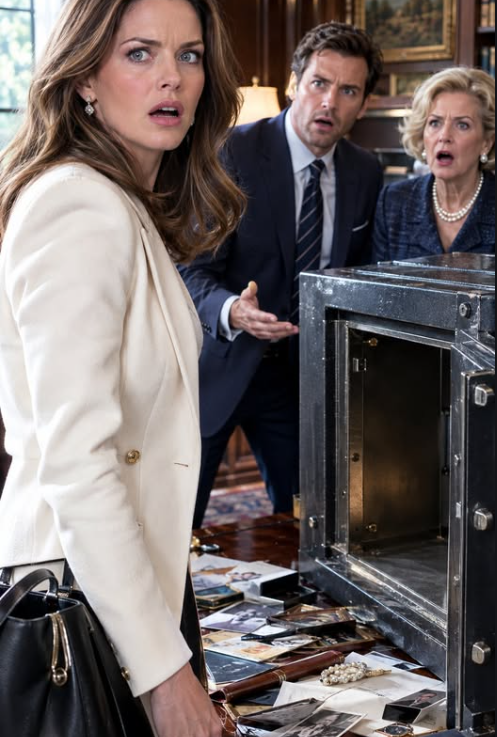
Once my father was gone, that iron box became an obsession for Derek and Judith. They circled it like vultures. To their greedy, unimaginative minds, a heavy safe bolted to the floor meant one thing: untraceable cash, bearer bonds, the hidden, tax-free fortune.
They wanted into that box with a physical desperation. And I knew that the day they finally breached it would be the day they signed their own death warrants.
I let them lead themselves to the slaughter.
Derek started bringing it up casually. “We really should clear that old safe out, Mary Ann. It’s an eyesore.” Then Judith would visit, eyeing the iron door like a starving wolf looking at a lamb. “Such a shame to let whatever your dear father left just rot in the dark, don’t you think?”
Every time they pushed, I offered just enough feigned hesitation to make them push harder. I wanted them to claim it. I needed them to break the lock with their own hands. There is a massive psychological difference between handing a con man his defeat, and letting him expend his own energy to crack open the box containing his doom.
It took Derek ten months to finally lose his patience.
One evening, a Tuesday, he stood in my father’s study. He puffed out his chest, adopting the tone of the man of the house making an executive decision.
“I’ve decided the safe is going to my mother,” he announced, his voice flat and challenging. “She’s family, Mary Ann. It’s just sitting there gathering dust. Whatever is inside belongs to Mom now.”
He stared at me, his chin raised, waiting for the hysterical wife to throw a tantrum. He was daring me to fight him for my own inheritance.
I looked at his arrogant, handsome face. And I felt a profound, chilling peace wash over my soul. He had just voluntarily marched into the kill-zone.
I looked him dead in the eyes and said four words.
“If that’s what you want.”
I was not surrendering. I was pulling the lever on the guillotine. My father had spent his dying days setting the trap; Derek was now begging to put his neck in the lunette. Who was I to deny him?
The next morning, Derek casually mentioned that his mother was sending a locksmith over. I nodded, kissed the air near his cheek—a phantom kiss for a phantom husband—and drove to work.
CONTINUE READ NEXT PART… 👇