PART 4
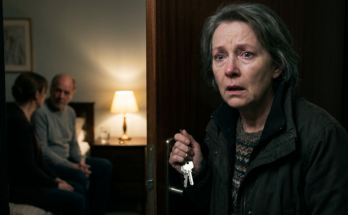
Grant’s words stayed in the hallway like smoke.
“I sold it.”
I stared at him.
“No.”
It was the only word I could produce.
He took a step toward me.
“Laurel, please listen.”
“No.”
I held the document tighter.
“You didn’t sell our house.”
“It wasn’t technically—”
“Don’t.”
My voice stopped him.
“Don’t stand there and explain legal technicalities to me. I want the truth.”
Grant looked toward the living room.
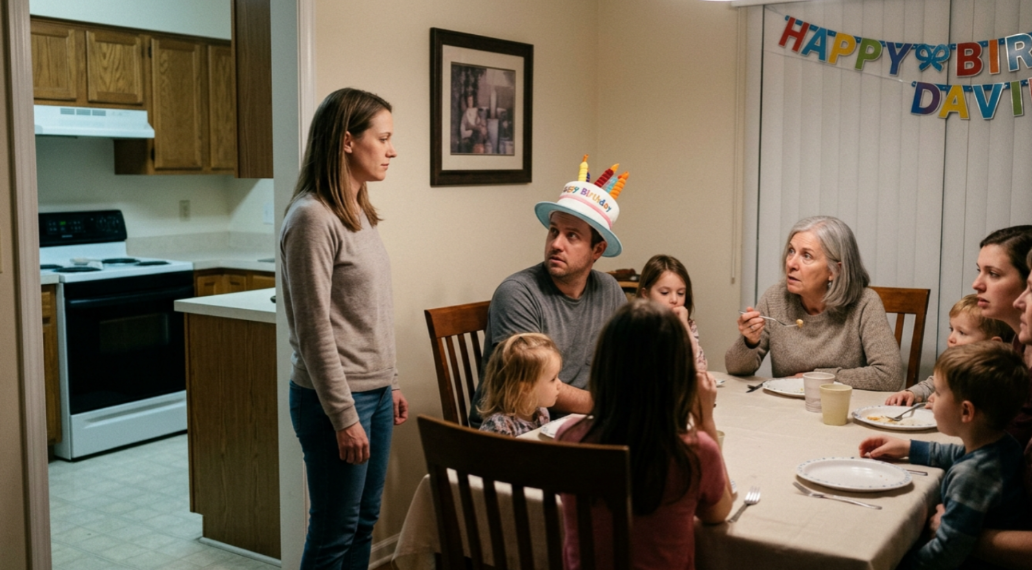
His family was still there.
His birthday guests.
The people he had invited into a home he had apparently already sold.
Denise walked toward us.
“What did you mean when you said the house was sold?”
Grant looked at her.
“Mom…”
She stepped closer.
“Answer her.”
Grant lowered his head.
“I signed a contract three months ago.”
My stomach turned.
“Three months?”
He nodded.
“Then why are we still living here?”
“Because the closing isn’t complete.”
I stared at him.
“When is the closing?”
He didn’t answer.
“When, Grant?”
“Next month.”
I felt my knees weaken.
I grabbed the edge of the desk.
Denise looked horrified.
“You sold the house without telling your wife?”
“I was going to tell her.”
“When?”
Grant’s eyes filled with tears.
“After I fixed everything.”
I almost laughed.
Not because anything was funny.
Because I had finally understood.
He had never intended to tell me.
He intended to fix the consequences quietly and continue pretending everything was normal.
He had been trying to outrun his own decisions.
And somehow, I had been paying for the running.
I looked at the document again.
“How much?”
Grant remained silent.
“How much did you sell it for?”
“Four hundred and twenty thousand.”
I stared at him.
“And how much did you owe?”
“About two hundred and sixty.”
“So where is the rest?”
His face changed.
I already knew the answer.
“You spent it.”
He looked away.
“How much?”
“Most of it.”
“On gambling?”
He nodded.
Denise covered her mouth.
Tessa had followed us into the hallway.
She heard enough.
“What?”
Nobody answered.
She looked at her brother.
“Grant, what did you do?”
He sank into the office chair.
“I thought I could win it back.”
Tessa’s face went pale.
“How long?”
“About two years.”
Miles whispered,
“Two years?”
Grant nodded.
I closed my eyes.
Two years.
For two years, while I had been waking before sunrise to work, baking orders until midnight, paying bills and trying to keep our household running, my husband had been gambling with money we didn’t have.
And I had blamed myself for every financial argument.
I had wondered whether I wasn’t earning enough.
Whether I was spending too much.
Whether I needed to work more.
But the problem had never been my contribution.
It had been the hole Grant kept digging.
I opened my eyes.
“What else?”
He looked at me.
“What?”
“What else don’t I know?”
He didn’t answer.
I stepped closer.
“What else?”
Denise spoke quietly.
“Grant, tell her everything.”
He stared at the floor.
“There are credit cards.”
“How many?”
“Three.”
“How much?”
He swallowed.
“About forty thousand.”
My hands went numb.
“And the house?”
“Ninety-six thousand.”
“And the credit cards?”
“Forty.”
I calculated quickly.
More than a hundred thousand dollars of debt.
And I had known none of it.
Then something occurred to me.
“What about the bank account?”
Grant looked up.
“What about it?”
“Our joint account.”
His silence was enough.
I rushed into the bedroom.
I opened my laptop.
The banking application loaded.
I clicked the account.
My breath caught.
There were withdrawals I didn’t recognize.
Hundreds.
Then thousands.
I scrolled through the transactions.
Online betting.
Cash withdrawals.
Transfers.
Over and over.
My name was on the account.
But I had never authorized those transactions.
I turned around.
“Did you use our joint account?”
Grant stood in the doorway.
“Yes.”
“How much?”
“I don’t know.”
“You don’t know?”
“I stopped keeping track.”
I stared at him.
“You stole from me.”
He flinched.
“I was going to replace it.”
“That doesn’t make it not stealing.”
He didn’t argue.
For once, he had no defense.
I walked past him.
Into the living room.
Everyone had gone silent.
I looked at the birthday decorations.
The cake.
The empty food containers.
The people who had arrived expecting a celebration.
I suddenly felt exhausted.
Not angry.
Not even shocked anymore.
Just exhausted.
I turned to Denise.
“I need everyone to leave.”
She nodded immediately.
Nobody protested.
Tessa gathered the children.
Miles quietly helped collect coats.
One by one, Grant’s family left.
No birthday celebration.
No arguments.
No dramatic shouting.
Just silence.
Denise was the last person at the door.
She stopped beside me.
“I am sorry.”
I nodded.
“I know.”
She looked at Grant.
“You need to understand something.”
He looked up.
“You didn’t lose your house tonight.”
Grant said nothing.
“You lost your wife’s trust.”
Then Denise left.
The door closed.
Grant and I were alone.
For several minutes, neither of us spoke.
Finally, he said,
“Are you leaving?”
I looked at him.
“I don’t know.”
He nodded.
“I understand.”
“No, you don’t.”
He looked at me.
“You keep thinking this is about whether I stay or leave.”
I walked to the kitchen.
“This is about whether I can ever believe another word you say.”
He followed.
“I can fix this.”
“How?”
“I’ll sell the car.”
“Which car?”
“Mine.”
“That won’t fix it.”
“I’ll work extra.”
“You already lied about working extra.”
He looked confused.
“What?”
“The nights you said you were working late.”
He stopped.
“I knew something was wrong.”
He said nothing.
“I just didn’t know what.”
He sat at the kitchen table.
“I was ashamed.”
“You should have told me.”
“I thought you would leave.”
I looked at him.
“And now?”
He stared at me.
“I think you’re going to leave anyway.”
I didn’t answer.
That night, I slept in the guest room.
I didn’t sleep much.
At 4:17 in the morning, I opened my laptop.
I downloaded every bank statement.
Every mortgage document.
Every credit card statement I could access.
I created folders.
I printed everything.
I made copies.
Then I called my sister, Mara.
She answered half asleep.
“Laurel?”
“I need somewhere to stay.”
There was a pause.
“What happened?”
“I’ll explain when I get there.”
“Come now.”
I packed a small suitcase.
Before leaving, I stood in the doorway of the bedroom.
Grant was asleep.
For a moment, I remembered the man I married.
The man who held my hand on our wedding day.
The man who promised we would build a life together.
I wondered when that man had disappeared.
Or whether I had simply stopped seeing the truth.
I left without waking him.
The next morning, I went to Mara’s house.
She opened the door and hugged me.
I cried for the first time.
Not because of the money.
Not because of the house.
Because I finally realized how lonely I had been inside my own marriage.
Mara made coffee.
I spread the documents across her dining table.
She looked through them.
Her expression changed.
“You need a lawyer.”
“I know.”
“And an accountant.”
“I know.”
“And don’t sign anything.”
“I won’t.”
She took my hand.
“Whatever happens next, don’t let him convince you that you caused this.”
I looked at her.
“I kept thinking I wasn’t doing enough.”
“You were doing too much.”
Those words broke something inside me.
For the first time in years, I allowed myself to believe it.
Over the next week, I met with an attorney.
I learned things I wished I had known years earlier.
The house sale was not yet final.
There were legal steps that could potentially delay or challenge the transaction depending on the ownership documents and the circumstances surrounding the sale.
The debt situation was more complicated than Grant had admitted.
Some debts were in his name.
Some were tied to accounts we shared.
And the money he had taken from our joint account could become part of the financial dispute.
My attorney told me one thing repeatedly.
“Do not make decisions out of anger. Make them with documentation.”
So I documented everything.
Meanwhile, Grant called constantly.
At first, I didn’t answer.
Then he left messages.
“I love you.”
“I can fix this.”
“I’ll go to counseling.”
“I’ll stop gambling.”
“I’ll sell everything.”
“I don’t want to lose you.”
I eventually answered one call.
He was crying.
“I’ll do anything.”
I asked,
“Why didn’t you do anything before?”
Silence.
“I don’t know.”
“That is the problem.”
He said,
“I was scared.”
“So was I.”
“I didn’t want you to think I was a failure.”
I closed my eyes.
“Grant, you didn’t have to be perfect.”
“I know.”
“You only had to be honest.”
He cried quietly.
Then he asked,
“Is there any chance?”
I thought about it.
“There might have been.”
He stopped breathing for a moment.
“But not anymore?”
“Not right now.”
“What does that mean?”
“It means I need to see what happens next.”
And I did.
The following month was difficult.
The sale of the house was delayed.
The attorney negotiated with the relevant parties.
The financial records revealed even more debts.
Grant had borrowed money from Miles.
He had taken cash advances.
He had sold several things without telling me.
He had even borrowed from a coworker.
His entire life had become a chain of temporary solutions.
One lie used to cover another.
One debt used to cover another.
Eventually, Grant entered a treatment program for gambling addiction.
He started attending meetings.
He found additional work.
He sold his car.
He moved into a small apartment.
And for the first time, he began paying his own bills.
But I didn’t move back.
Not yet.
Maybe not ever.
The legal process eventually prevented the house sale from being completed as originally planned.
The house remained tied up in negotiations while the debts were addressed.
Because my name was not on the original mortgage, there were complicated legal questions.
But because I had contributed substantial funds toward household expenses and there were joint financial accounts involved, my attorney helped protect my interests.
I learned something important during those months.
Marriage wasn’t supposed to mean one person disappearing into the other person’s life.
It wasn’t supposed to mean giving without limits.
And love wasn’t supposed to require ignoring reality.
I also discovered something else.
My baking business had become much more valuable than I realized.
Mara encouraged me to expand.
I began taking larger orders.
I created a website.
I rented a small commercial kitchen.
Within six months, I had more customers than I could handle alone.
The little business I had treated as “extra income” became my primary income.
I hired two part-time assistants.
I created a proper accounting system.
And I opened a separate business account.
For the first time in my life, I knew exactly where every dollar went.
One year after the birthday dinner, I returned to the old house.
Not to live there.
To collect the last of my belongings.
Grant was there.
He looked different.
Thinner.
Older.
But calmer.
He didn’t try to hug me.
He simply said,
“Thank you for coming.”
I nodded.
“How are you?”
“Better.”
“Are you still gambling?”
“No.”
“Counseling?”
“Yes.”
He nodded.
“I haven’t missed a meeting in nine months.”
I believed him.
But believing someone was changing wasn’t the same as trusting them again.
He looked toward the kitchen.
“Do you remember the birthday?”
I smiled faintly.
“How could I forget?”
“I’ve thought about it every week.”
“Why?”
“Because that was the night I finally had to look at myself.”
I didn’t answer.
He continued.
“I thought I was angry because you wouldn’t cook.”
“You were angry because I stopped making your life easy.”
He nodded.
“That too.”
He looked down.
“I was cruel to you.”
“Yes.”
“I don’t expect forgiveness.”
“Good.”
He almost smiled.
“I deserved that.”
I picked up the last box.
Before I left, he said,
“Laurel?”
I turned.
“I’m sorry.”
This time, I believed that he meant it.
But forgiveness and reconciliation were different things.
I could forgive him someday.
I didn’t have to give him my life again.
I left the house.
Outside, the afternoon sun was bright.
I put the box in my car.
For years, I had thought losing a house would destroy me.
Instead, losing that house had forced me to discover something I had forgotten.
I could build another one.
Not just a house.
A life.
A life where my work counted.
My money was mine.
My choices mattered.
And nobody could tell me I was lucky to be allowed to participate in my own marriage.
Two years later, I opened my own bakery.
The sign above the door read:
LAUREL’S TABLE
On opening day, Mara cried.
Miles came.
Tessa came.
Even Denise came carrying flowers.
Grant didn’t attend.
He sent a card.
Inside were only three sentences.
I am proud of you.
I am sorry I didn’t see your value when I had you.
I hope you never let anyone make you feel small again.
I kept the card.
Not because I wanted Grant back.
But because I wanted to remember how far I had come.
That evening, after the last customer left, I stood alone inside the bakery.
The ovens were still warm.
The smell of chocolate and cinnamon filled the room.
I looked around.
Everything had my name on it.
My business.
My work.
My choices.
My future.
I thought about that Thursday afternoon when Grant had looked at my groceries and told me:
“If you want to eat, pay for your own food.”
At the time, I thought he was taking something from me.
Years later, I understood something different.
He had accidentally given me the sentence that changed my life.
Because I did pay for my own food.
Then I paid my own bills.
I built my own business.
I rebuilt my confidence.
And eventually, I built a life where I never again needed someone else’s permission to know what I was worth.
The night of Grant’s birthday, the stove had been cold.
Everyone had arrived expecting me to serve them.
Instead, the truth was served.
And sometimes, the most important meal isn’t the one on the table.
It’s the one where you finally sit down with yourself and admit:
I deserve better.
And once you understand that, you stop begging people to value you.
You start building a life that does.