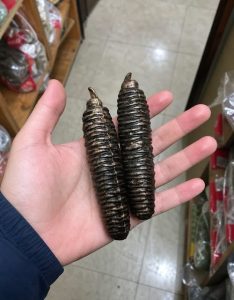
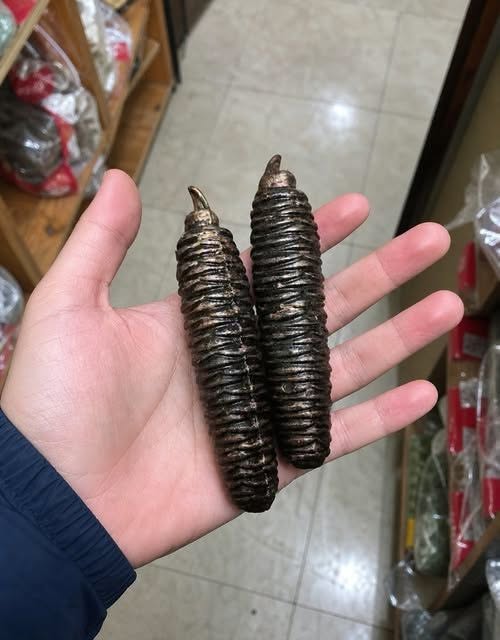
At first glance, the two strange objects looked like something that belonged in a box of old Christmas decorations.
They were dark, heavily ridged, almost cone-shaped, and each had a small curved piece at one end. They looked so unusual that the first reaction was laughter.
Then came the question:
“What on earth are these?”
My girlfriend found them while helping search through the house where her grandmother and her aunt had lived for practically their entire lives. It was the kind of house that seemed to contain a story in every cupboard, drawer, attic box, and forgotten corner.
Nothing had been thrown away without a reason.
Old photographs were stacked inside cabinets. Kitchen utensils from decades ago remained in drawers. There were boxes filled with things nobody had used for years but which somebody had apparently decided might be useful someday.
And then she discovered these.
They were lying among other forgotten household items, and because of their unusual appearance, they immediately stood out.
She sent me a photograph.
“Do you know what these are?”
I didn’t.
And that was the beginning of the mystery.
The strange objects
The photograph shows two elongated, dark brown or almost black objects resting in the palm of a hand.
Their surfaces are covered in dozens of tightly packed ridges, giving them the appearance of miniature pinecones, unusual pieces of wood, or even something handmade.
At the narrow end of each object is a small protrusion that curves outward.
That combination makes them particularly difficult to identify simply by looking at them.
They don’t resemble ordinary household decorations.
They don’t look like modern kitchen equipment.
And they certainly don’t look like anything most people would immediately recognize.
But that’s exactly what makes discoveries like this so fascinating.
Objects from older generations often had completely ordinary purposes that have become unfamiliar to younger people.
A tool that was once used regularly can become mysterious after a few decades.
A traditional household item can disappear from common use.
Something associated with a particular trade, craft, farming practice, food tradition, or regional custom can eventually become almost impossible to identify without someone explaining its history.
That’s why the safest answer isn’t to immediately declare, “This is definitely X.”
Instead, the objects themselves provide clues.
Why old houses are full of mysteries
The house makes this discovery even more interesting.
When several generations live in the same property for decades, the building becomes something more than a home.
It becomes an archive.
Every generation leaves something behind.
A grandmother may keep tools inherited from her parents. An aunt may store objects she hasn’t used since childhood. Someone might place an unfamiliar item in a cupboard because they remember seeing their mother use it.
Eventually, nobody remembers exactly where something came from.
That’s how ordinary objects become mysterious.
Imagine opening a drawer and finding a strange metal tool.
You might assume it’s broken.
But your grandmother might immediately know that it was used to repair something when she was young.
Or imagine discovering an old wooden object in an attic.
To a modern person, it could look decorative.
To someone who grew up in the house, it might have been an essential kitchen or gardening tool.
The passage of time changes the meaning of objects.
Could these be natural objects?
One of the first possibilities people might consider from the photograph is that the objects are dried natural materials.
Their repetitive ridges certainly make them look organic.
But appearances can be deceptive.
Some natural products develop remarkably regular textures after drying. Seeds, pods, roots, shells, and other plant materials can become dark and extremely hard.
In many cultures, dried natural materials have historically been kept for cooking, traditional remedies, crafts, decoration, or practical household purposes.
The small hook-like ends visible in the photograph make the mystery even more intriguing.
They could be part of the natural structure.
Alternatively, they might be attached components.
Without examining the objects directly, it would be impossible to say with confidence.
And that’s an important lesson when mysterious-object photographs circulate online: a visual resemblance isn’t proof of an identification.
The grandmother may hold the answer
Perhaps the most interesting part of this story isn’t the objects themselves.
It’s the possibility that someone in the family already knows exactly what they are.
If the grandmother is still around, she may recognize them immediately.
She might pick one up, turn it over in her hand, and say something as simple as:
“Oh, those? We used those years ago.”
And suddenly the mystery would disappear.
That moment happens surprisingly often with old family possessions.
Younger people see something strange.
Older relatives see something familiar.
That’s because memory is strongly connected to objects.
A particular tool can remind someone of a kitchen from their childhood.
A certain container can bring back memories of a parent.
An old piece of equipment can remind someone of work they did decades earlier.
What looks useless today may once have been part of everyday life.
The importance of asking before throwing anything away
Discoveries like this also highlight a common problem when old homes are cleaned out.
When people sort through decades of belongings, the natural temptation is to divide everything into three categories:
Keep. Donate. Throw away.
But there is a fourth category that deserves attention:
“Find out what this is first.”
That category can save historical objects from disappearing forever.
An unfamiliar tool might have belonged to a particular profession.
An old household item might represent a traditional way of doing something.
A handmade object could have sentimental value that isn’t obvious from its appearance.
Even something inexpensive can be irreplaceable if it is connected to family history.
Once an object is thrown away, its story can be lost with it.
The mystery becomes part of the family story
There’s something wonderful about finding an object nobody immediately recognizes.
It creates a small investigation.
People start asking questions.
Where did it come from?
Who bought it?
How long has it been here?
What was it used for?
Who remembers seeing it before?
Was it something Grandma used?
Did Auntie bring it home from somewhere?
Was it part of an old tradition?
Those questions can lead to conversations that might otherwise never happen.
Someone may suddenly remember a detail from childhood.
A photograph might be discovered showing the object in the background.
An old neighbor might recognize it.
A relative might know exactly what it was used for.
And eventually, the mysterious object may acquire a name and a history.
Why the photograph is so intriguing
The photograph itself captures the perfect moment in the investigation.
Two strange objects are being held in someone’s hand, but there is no obvious explanation.
Their dark, layered surfaces make them look almost manufactured, while their irregular shapes suggest something natural.
They appear old.
They appear well preserved.
And most importantly, they appear to have been kept deliberately.
That last detail matters.
People rarely preserve completely meaningless objects for generations without some reason.
Even if the original reason was simply, “We might need these someday,” that still tells us something about the people who lived in the house.
Older generations often had a different relationship with possessions.
Things were repaired rather than replaced.
Objects were reused.
Materials were saved.
Items that could serve a purpose were kept because nobody knew when they might be needed again.
Modern life has made many of those habits less common.
A reminder that ordinary life leaves clues behind
There is a bigger story hidden inside this seemingly simple discovery.
Homes preserve evidence of how people lived.
Not just through photographs and written records, but through objects.
A worn handle can reveal what someone used every day.
A repaired chair can show how long something was valued.
An old cooking utensil can reveal what meals were once prepared.
A mysterious object can reveal a tradition that younger generations have forgotten.
That’s why searching an old family home can feel almost like archaeology.
You’re not simply cleaning.
You’re uncovering layers of someone’s life.
So what are they?
The honest answer is: the photograph alone doesn’t provide enough evidence to identify the objects with certainty.
They may be a traditional item, a dried natural material, an old household implement, or something else entirely.
Their unusual ridged construction and small hooked ends certainly make them distinctive, but confidently naming them without additional information would be guessing.
And perhaps that’s what makes the discovery so entertaining.
For now, they’re simply the two mysterious objects found inside a house filled with decades of family history.
The real answer may be sitting in the memory of an older relative.
Maybe Grandma knows.
Maybe Auntie knows.
Maybe somebody will recognize them immediately.
And when that happens, the objects will stop being mysterious.
They’ll become something much more valuable: a physical piece of the family’s past.
Because sometimes the most fascinating discoveries aren’t expensive antiques or hidden treasures.
Sometimes they’re the strange little things that nobody thought were worth explaining—until someone finally asks, “What is this?”