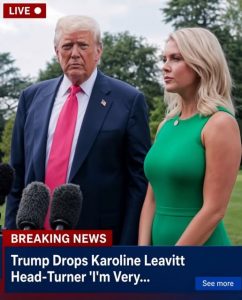
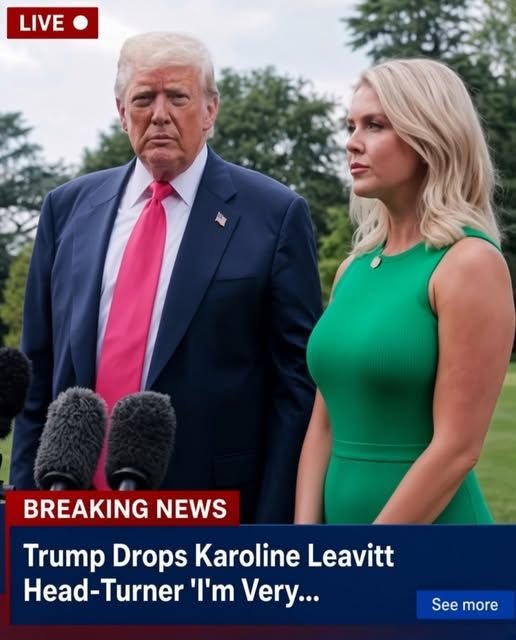
Trump Calls Karoline Leavitt “Irreplaceable” as She Prepares to Leave the White House

President Donald Trump has made clear that he does not view Karoline Leavitt’s departure from the White House press secretary’s office as an ordinary personnel change.
In a recent Fox News interview, Trump praised Leavitt and described her as “irreplaceable” when asked about the possibility of finding someone to take over her role. He also suggested that Fox News correspondent Alexis McAdams could potentially be considered for the position, turning an otherwise routine discussion about a replacement into an unexpected on-air moment. (TMZ)
The comments come at an important moment for Leavitt, who is preparing to leave the press secretary position at the end of August. Rather than disappearing from Trump’s political world, however, she is expected to remain involved as one of his outside advisers and continue working to advance his political agenda. (People.com)
Her departure therefore marks less of an exit from politics than a change in role.
A Remarkable Rise
Leavitt’s career has moved unusually quickly.
She became a prominent figure in Trump’s political operation before eventually becoming White House press secretary, a position that placed her at the center of one of the most demanding communications jobs in American politics.
She also made history as the youngest person to serve as White House press secretary. (Wikipedia)
The position requires much more than simply standing behind a podium.
A press secretary must defend administration policies, respond to hostile questions, communicate presidential priorities and attempt to maintain control of the news cycle.
For Leavitt, the job also meant regularly confronting reporters in a highly polarized political environment.
Her style was frequently combative, direct and closely aligned with Trump’s own political communication.
That approach earned her supporters who admired her willingness to confront journalists, while critics argued that the White House press operation had become unusually adversarial.
Regardless of political opinion, however, her visibility was undeniable.
Trump and Leavitt’s Political Relationship
Trump’s praise of Leavitt reflects the close relationship that developed between the president and his press secretary.
During her tenure, she became one of the most recognizable public representatives of the administration.
She often defended Trump’s policies in the briefing room and on television, and her ability to communicate the president’s message made her an important part of his political operation.
Recent reporting has emphasized that Leavitt’s departure does not represent a complete break with Trump.
Trump announced that she would remain one of his top outside advisers, while she is expected to continue playing a role in Republican politics. (People.com)
That arrangement makes sense given her experience.
She knows Trump’s political style.
She understands the administration’s messaging.
And she has spent years building relationships within the movement surrounding him.
Why She Is Leaving
The reason for Leavitt’s departure is closely connected to her family.
She recently became a mother for the second time, welcoming a daughter in May 2026.
After returning from maternity leave, she ultimately decided to leave the demanding White House position and spend more time with her children. (People.com)
Trump has publicly expressed his regret about losing her from the press secretary role.
During the Fox News interview, however, he also joked that he was concerned because Leavitt “likes her children more than she likes Trump.” (TMZ)
The remark attracted attention and criticism online, with some observers arguing that the joke trivialized a mother’s decision to prioritize family.
Others interpreted it as Trump’s characteristically informal way of acknowledging that he did not want her to leave.
Either way, the comment illustrated the unusual relationship between Trump and Leavitt.
“Irreplaceable” Is a Powerful Word
Calling someone “irreplaceable” carries particular weight when the person is leaving a high-profile position.
Trump’s comment suggests that he believes Leavitt brought something distinctive to the administration.
Finding another person capable of standing behind the White House podium is relatively straightforward.
Finding someone who combines political loyalty, communication skills, familiarity with Trump’s personality and the ability to withstand constant national scrutiny is considerably more difficult.
The White House has not yet announced a permanent successor.
That uncertainty has fueled speculation about who could take over.
Potential names discussed publicly have included television personalities, political commentators and senior administration figures. (The Times)
Trump’s suggestion that Fox News correspondent Alexis McAdams could do the job added another unexpected name to the conversation. (TMZ)
A Press Secretary Unlike Many Before Her
Leavitt’s tenure also represented a changing approach to White House communications.
Traditional press briefings have historically been structured around questions from established news organizations.
Leavitt’s White House made a point of elevating newer and alternative media outlets as well.
That strategy reflected the broader transformation of political communication.
Presidents no longer rely exclusively on newspapers and television networks to reach voters.
Social media, podcasts, independent websites, livestreams and online personalities now play major roles.
Trump has long understood the power of direct communication, particularly through social media.
Leavitt’s role fit naturally into that environment.
She was not merely communicating with reporters.
She was communicating with a political audience watching from around the country.
The Pressure of the Briefing Room
Being White House press secretary is one of the most visible jobs in Washington.
Every briefing can become a national story.
A single sentence can dominate television coverage for hours.
A tense exchange with a reporter can become a viral clip.
An inaccurate statement can generate criticism from both journalists and political opponents.
Leavitt faced that pressure repeatedly.
She also inherited a political environment in which the relationship between the White House and the press was already deeply strained.
Her confrontational approach often intensified those disagreements.
Supporters saw that as evidence that she was willing to fight for the president.
Critics saw it as another example of political polarization.
But regardless of how people evaluated her style, she became an important figure in the administration.
A Young Official With an Unusually Large Profile
Leavitt’s age has also been part of her story.
She entered the White House at a remarkably young age and quickly became one of the most recognizable political communicators in the country.
That visibility is unusual for someone in her position.
Most White House press secretaries become nationally known after years of political experience.
Leavitt’s career accelerated much faster.
Her trajectory—from political communications work to Trump’s campaign and eventually the White House podium—demonstrated how quickly someone can rise within modern political movements.
Her departure therefore does not necessarily represent the end of her political career.
It may be the beginning of another phase.
What Comes Next?
According to recent reporting, Leavitt plans to return to MAGA Inc., Trump’s political super PAC, in September after taking some time for her family. She is expected to participate in political activities connected with the Republican Party’s upcoming midterm campaign. (People.com)
That means she will remain close to Trump’s political operation.
Her experience as a White House spokesperson could make her particularly valuable outside the administration.
Political campaigns need people who understand messaging.
They need people who know how to respond to criticism.
They need people who understand the media environment.
Leavitt now has experience in all three areas.
Her future could therefore involve campaign strategy, political communications, television appearances or perhaps eventually elected office.
Her political career is far from finished.
Who Can Replace Her?
That is the question now facing the administration.
Trump’s comments suggest that he is personally involved in the process.
The possibility of choosing someone from television is particularly interesting.
McAdams, whom Trump mentioned during the Fox News interview, has experience reporting on politics and interacting with senior officials. Trump even asked her directly whether she would consider the job. (TMZ)
Other potential candidates have also been discussed publicly.
The challenge for whoever takes the position will be enormous.
The new press secretary will inherit the expectations created by Leavitt’s tenure.
They will need to communicate Trump’s agenda while handling aggressive questioning from reporters.
They will also need to operate in an environment where almost every briefing can become viral content.
A Changing White House
Leavitt’s departure is part of a broader evolution within Trump’s administration.
Personnel changes are inevitable in any presidency, particularly as political priorities shift and officials move into new roles.
But communications positions are especially important because they shape how the administration presents itself to the public.
Leavitt became closely identified with Trump’s second presidency.
Her voice, mannerisms and confrontational exchanges with reporters became familiar to millions of Americans.
Replacing her will therefore involve more than simply finding another person who can answer questions.
The next press secretary will have to establish an identity of their own.
Her Legacy
How history evaluates Leavitt’s tenure will depend partly on political perspective.
Supporters will likely remember her as a loyal and energetic defender of Trump who was willing to confront hostile questioning.
Critics will remember her for controversial statements and a communications style that frequently clashed with traditional media.
Both interpretations are likely to remain part of the public record.
But there is another aspect of her legacy that is difficult to ignore.
She demonstrated how much influence a young political communicator can acquire in the modern media environment.
She used television, social media and the White House podium to build a national profile.
And she became a central figure in the administration’s public-facing operation.
More Than a Farewell
Trump’s description of Leavitt as “irreplaceable” gives her departure an emotional dimension.
For a president known for constantly evaluating his staff and publicly criticizing officials when they fall out of favor, strong praise can be significant.
Trump’s comments indicate that he sees Leavitt’s contribution as valuable even though she has decided to leave the position.
And perhaps the most important point is that she is not actually leaving his political world.
She is changing jobs.
Her decision reflects the complicated balance between public service, political ambition and family life.
After spending years building a political career, she now has two young children at home.
Choosing to step away from one of the most demanding jobs in Washington can therefore be understood as a personal decision as much as a political one.
The End of One Chapter
Karoline Leavitt’s time behind the White House podium is coming to an end, but her political career is not.
Trump has made it clear that he wants her to remain involved.
She is expected to continue advising him and return to political work with MAGA Inc. in September. (People.com)
Meanwhile, the search for her replacement continues.
Whoever takes her place will inherit a position that has become one of the most closely watched communications jobs in American politics.
But they will also face an obvious comparison.
Can they match Leavitt’s familiarity with Trump?
Can they command the briefing room?
Can they communicate effectively with both traditional journalists and alternative media?
And can they handle the intense scrutiny that comes with the job?
Those questions will shape the next chapter of the White House press operation.
For now, however, Trump’s message about his departing press secretary is unmistakable.
He believes Karoline Leavitt made a lasting contribution.
He does not want her completely out of the picture.
And while she may be leaving the podium, she is not leaving the political stage.
Karoline Leavitt’s White House chapter is ending—but her role in Trump’s political world appears far from over.