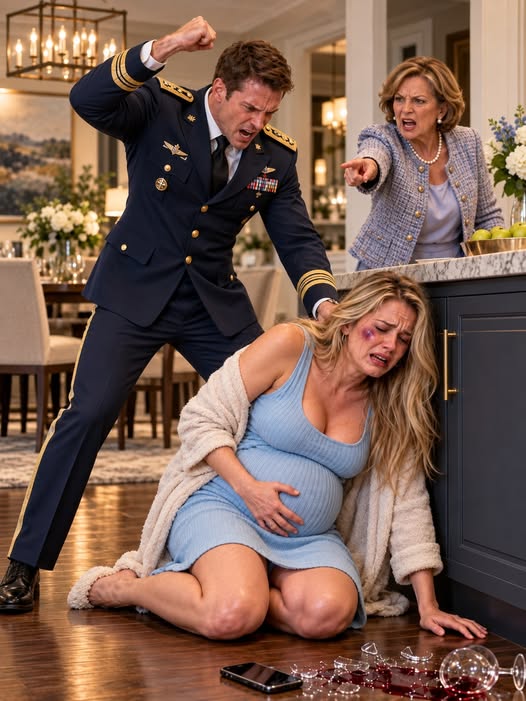
I came home after a twelve-hour shift, seven months pregnant, and my husband welcomed me with a slap that split my lip right in front of his mother.
Ten minutes later, I was on his kitchen floor with blood running down my legs, terrified that I was losing my baby.
Yet somehow, they still believed I was powerless.
That was the biggest mistake they ever made.
I arrived at our home in Alexandria, Virginia, at 8:20 p.m.
My feet were swollen, and my work uniform carried the exhaustion of twelve long hours.
I hadn’t even managed to close the front door.
Carter struck me across the face so hard that my shoulder crashed into the hallway wall.
“Do you have any idea how late it is, you useless bitch?” he yelled.
“Get into that kitchen and make dinner for my mother.”
His mother, Mrs. Eleanor, was sitting in the living room beneath a throw blanket, watching me with a faint, cruel smile.
“What are you standing there for?” she asked.
“Discipline starts before a child is even born.
A lazy mother will raise a lazy child.”
My baby gave a powerful kick.
I placed a hand over my belly and struggled to calm my breathing.
The sharp pains had begun earlier that morning.
But inside that house, nobody cared about suffering unless it was Carter’s or his mother’s.
So I walked into the kitchen.
I sliced onions through burning eyes.
Stirred a pot of beans with trembling fingers.
Cooked meat as hot grease splattered against my hands.
My stomach continued to tighten until it felt as hard as stone.
Meanwhile, Carter and his mother remained in the living room, watching television.
When dinner was finally ready, Mrs. Eleanor put a forkful of food into her mouth.
She chewed twice.
Then spit it onto her expensive china plate.
“This tastes disgusting.”
Carter hardly bothered to glance away from his phone.
“She manages to ruin everything.”
The metallic taste of blood still lingered on my lips.
“I got home late because I’m feeling really sick.”
Mrs. Eleanor pushed her chair away from the table.
“You’re feeling sick?
Well, I’m sick of having to support a freeloading, incompetent daughter-in-law just because she’s pregnant.”
“I have a full-time job too,” I replied.
Before I could react, she shoved me by the shoulder.
I staggered backward.
The edge of the granite countertop struck my lower back.
Agonizing pain shot through my abdomen.
My legs gave way.
Then I felt something warm trickling down them.
I lowered my eyes.
Blood was pooling beneath my uniform.
“My baby…” Carter rose from his chair.
But he wasn’t coming to help.
“Oh, don’t start that dramatic bullshit.”
I reached toward the phone I’d left on the kitchen island.
“I have to call 911.”
Carter moved faster.
He grabbed my phone and threw it across the kitchen.
It struck the hardwood floor, shattering the screen.
“You’re not calling anybody,” he snapped.
Mrs. Eleanor crossed her arms.
“If she loses that baby, it’ll be because she couldn’t take proper care of herself.
Don’t you dare let her blame us afterward.”
Another violent cramp forced me to bend over the countertop.
I tried to make my way toward my broken phone.
Carter blocked me.
He leaned so close that I could smell the food he’d been eating.
“Listen to me carefully,” he said.
“My uncle is a senior prosecutor in the D.A.’s office.
And I’m a practicing attorney.
You won’t win a damn thing against us.”
For two years, I’d lived with his yelling, his demands, and his mother’s constant contempt.
I prepared their food and waited until everyone else had eaten.
I endured their insults about my family, whom they dismissed as ordinary blue-collar people.
I’d tolerated it because I wanted to build a life that belonged to me— not one defined by my father’s position.
But there was something my father had told me years earlier that I’d never forgotten.
“Real power isn’t something you show off, sweetheart.
You only use it when there’s no other way.”
And standing in that kitchen, with my unborn son struggling inside me, I understood that the moment had finally arrived.
I raised my head.
Met Carter’s eyes without looking away.
“Then call my father.”
Carter burst out laughing.
Mrs. Eleanor joined him.
“Your father?” she sneered.
“You mean that pathetic country bumpkin who can’t even be bothered to visit?”
Carter retrieved my damaged phone and held it just inches from my face.
“Fine.
Let’s find out how that old man intends to drive his pickup truck all the way down here to save his little princess.”
He selected the contact labeled simply Dad.
Switched the call to speakerphone.
And tapped the call button.
The phone rang once.
Twice.
Three times.
On the fourth ring, my father answered.
“Sweetheart?”
His voice was steady and familiar, and for one terrible second, I nearly broke down.
Carter smirked.
“Well, well.
Is this the famous daddy we’ve heard so much about?”
There was a pause.
“Who is this?”
“Your daughter’s husband.
And before you start making threats, you should know I’m an attorney.
My family has connections in the district attorney’s office.
So whatever little story she’s told you, I suggest you think carefully before getting involved.”
My father didn’t respond immediately.
Then he asked, “Where’s my daughter?”
Carter glanced at me.
“Right here.
Being dramatic as usual.”
I tried to speak, but another contraction tore through my abdomen.
A cry escaped my throat.
My father’s voice changed.
“What was that?”
“Nothing,” Carter said.
“Put her on the phone.”
“She’s busy.”
“Carter.
Put my daughter on the phone.
Now.”
Something in his tone wiped the smile from Carter’s face.
He lowered the damaged phone toward me.
I could barely lift my head.
“Dad…” “I’m here, sweetheart.”
“I’m bleeding.”
Silence.
Then, very quietly, he asked, “How badly?”
“There’s blood everywhere.
My stomach hurts.
I think something’s wrong with the baby.”
“Are you alone?”
“No.
Carter and his mother are here.”
“Have they called an ambulance?”
I looked at Carter.
He shook his head sharply.
“No,” I whispered.
“Listen carefully.
Don’t try to stand.
Stay as still as you can.
I’m getting help to you.”
Carter snatched the phone away.
“That’s enough.
You’re upsetting her.”
My father spoke before Carter could disconnect.
“What’s the address?”
Carter laughed.
“You think I’m giving you my address so you can come play hero?”
“I know the address.”
For the first time, Carter hesitated.
My father continued.
“And I know exactly who you are.”
Mrs. Eleanor approached, her pearl necklace swaying against her expensive blouse.
“Who does this man think he is?” she demanded.
Carter shrugged.
“Some washed-up old nobody who thinks he can intimidate me.”
A second voice came through the speaker.
“Sir, Alexandria emergency communications has been contacted.
Police and EMS are being dispatched.”
Carter froze.
I heard another voice farther away.
“Governor’s office has been notified.
Your vehicle is ready.”
Mrs. Eleanor frowned.
“Governor?”
My father ignored her.
“Carter, my daughter is seven months pregnant and bleeding.
If you interfere with the emergency responders, that will be documented along with everything else you’ve done tonight.”
Carter’s expression hardened.
“Who the hell are you?”
My father answered with a calmness that frightened Carter more than shouting ever could.
“My name is Richard Whitmore.”
The name meant nothing to Mrs. Eleanor.
But Carter went completely still.
My father’s voice continued.
“I’m the Attorney General of the Commonwealth of Virginia.”
For a moment, nobody moved.
The television murmured from the living room.
Somewhere behind me, the kitchen faucet dripped.
Carter stared at the phone as if it had suddenly become dangerous.
Then he forced a laugh.
“That’s impossible.”
“Is it?”
“My wife’s father is some retired mechanic from the countryside.”
“No,” my father replied.
“My father was a mechanic.
I worked in his shop growing up.
And I’ve never been ashamed of that.”
Mrs. Eleanor’s face slowly drained of color.
Carter looked down at me.
“You never said—” “You never asked,” I whispered.
He opened his mouth, but my father interrupted.
“Carter, I won’t argue with you.
My daughter needs medical treatment.
Let the paramedics in when they arrive.”
Then his voice softened.
“Sweetheart, can you hear me?”
“Yes, Dad.”
“I’m coming.”
The call ended.
For several seconds, Carter simply stood there.
Then he turned on me.
“You set me up.”
I stared at him through tears.
“What?”
“You knew this would happen.
You’ve been waiting for some opportunity to destroy me.”
I tried to breathe through another wave of pain.
“Carter, please.
My baby…” “Don’t you dare pretend this is about the baby!”
He stepped toward me.
Mrs. Eleanor caught his sleeve.
“Carter.
Stop.”
He shook her off.
“She lied to us for two years!”
His mother looked at me with a hatred that had suddenly acquired something else.
Fear.
“Why didn’t you tell us who your father was?” she demanded.
I could barely keep my eyes open.
“Because I wanted you to love me for who I was.”
Neither of them answered.
And that silence told me more than anything they had ever said.
A distant siren cut through the night.
Then another.
Carter turned toward the front windows.
His face changed.
“Mom.
We need to clean this up.”
Mrs. Eleanor looked at the blood on the floor.
“What?”
“The kitchen.
The phone.
Everything.”
He crouched beside me.
His voice became unnaturally gentle.
“Listen, honey.
When the police get here, tell them you slipped.
You were dizzy after work.
You fell against the counter.”
I stared at him.
“You hit me.”
His eyes narrowed.
“Think about our family.”
I placed both hands over my stomach.
“I am.”
He gripped my wrist.
“I’m serious.”
“So am I.”
The first heavy knock came from the front door.
“Police!
Open the door!”
Carter released me.
He straightened his tie, wiped his palms against his trousers, and walked toward the entrance.
By the time he opened the door, he was wearing the expression he used in court.
Concerned.
Professional.
Respectable.
“Officers, thank God.
My wife had an accident in the kitchen.
She’s pregnant, and I’m worried she may have fallen—” A police officer pushed past him.
“Where is she?”
“Right there.
I was just explaining—” The officer saw me.
Then he saw the blood.
“EMS!
We need you inside!”
Everything happened quickly after that.
Two paramedics knelt beside me.
One checked my pulse while the other carefully examined my condition and asked how far along I was.
“Twenty-nine weeks,” I whispered.
“Any complications during the pregnancy?”
“Not until recently.
I’ve had pain since this morning.”
“Did you fall?”
I looked past the paramedic.
Carter stood near the doorway, watching.
Mrs. Eleanor pressed a handkerchief to her mouth.
For two years, their eyes had been enough to silence me.
Not anymore.
“My husband slapped me,” I said.
“His mother pushed me into the counter.
Then I started bleeding.”
The paramedic’s expression tightened.
He looked toward the officer.
“She needs immediate transport.”
Carter stepped forward.
“That’s not what happened.”
The officer raised a hand.
“Sir, stay where you are.”
“My wife is under a tremendous amount of emotional stress.
Pregnancy hormones can—” “Sir.
Stop talking.”
The paramedics began preparing the stretcher.
One of them leaned close.
“Ma’am, we’re taking you to the hospital.
Your baby still has a chance, but we need to move quickly.”
I clutched his sleeve.
“Please don’t let him die.”
“We’re going to do everything we can.”
As they lifted me, I saw another officer photographing the shattered phone.
Then the blood on the floor.
Then the countertop where I’d struck my back.
Carter’s voice rose behind us.
“I want you to understand that I know my rights!”
The officer didn’t appear impressed.
“Then I suggest you exercise your right to remain silent while we establish what happened.”
For the first time that evening, I saw Carter without the protection of his polished suit, expensive watch, or legal threats.
He looked small.
But I couldn’t afford to enjoy it.
Because as they carried me through the front door, another cramp seized my body.
And suddenly, I couldn’t feel my baby moving.
The ambulance doors slammed shut.
Inside, a paramedic placed an oxygen mask over my face while his partner spoke into the radio.
“Twenty-nine-week pregnancy.
Vaginal bleeding following reported abdominal trauma.
Severe abdominal pain.
Concern for placental abruption.”
I understood enough to be terrified.
Placental abruption.
I’d heard the term before.
It meant the placenta could be separating from the uterus, cutting off the baby’s oxygen supply.
“Is he dying?”
I asked.
The paramedic squeezed my hand.
“We can’t know that here.
The hospital team is getting ready for you.”
I turned my face toward the small window.
Alexandria’s streetlights streaked past.
Somewhere between the traffic signals and the sharp turns, my thoughts returned to the first time Carter had hurt me.
It had been six months after our wedding.
He’d thrown a coffee mug against the wall because I’d forgotten to buy his preferred brand.
Then he’d apologized.
He’d brought flowers.
Promised it would never happen again.
When his mother called me worthless during Sunday dinner, he’d told me she was old-fashioned and I shouldn’t take it personally.
When he controlled our spending, he called it financial planning.
When he demanded access to my phone, he called it trust.
And when he began slapping me, he called it discipline.
I had become so accustomed to explaining his behavior that I had almost forgotten how to recognize cruelty.
My baby’s life had finally made the truth impossible to ignore.
At the hospital, the doors opened into a blur of fluorescent lights and hurried voices.
A physician introduced herself as Dr. Rebecca Morgan.
She examined me while nurses started IV lines, took blood samples, and connected a fetal monitor.
Then I heard it.
A rapid heartbeat.
My son’s heartbeat.
I started crying.
“He’s alive?”
“For now, yes,” Dr. Morgan replied.
“But his heart rate is showing signs of distress, and your bleeding is concerning.”
She studied the ultrasound screen.
“We believe the placenta has partially separated.
We’re preparing for an emergency cesarean delivery.”
My stomach dropped.
“But he’s too early.”
“I know.
Our neonatal team is ready.
Right now, delivering him may be the safest option for both of you.”
I began trembling.
“Can you save him?”
She met my eyes.
“We’re going to give him the best possible chance.”
A nurse approached.
“Your father is here.”
I turned my head.
And there he was.
Not surrounded by cameras.
Not issuing orders.
Not wearing the expression of the powerful official whose photograph appeared in newspapers.
Just my father.
Richard Whitmore stood in the doorway wearing dark trousers and a gray sweater, his silver hair slightly disheveled.
His face crumpled when he saw me.
“Emily.”
I reached for him.
He crossed the room and took my hand.
For the first time in years, I allowed myself to cry like the little girl who used to run to him after falling off her bicycle.
“Dad, I’m scared.”
He kissed my forehead.
“I know.”
“I should’ve told you.”
He shook his head.
“We’ll talk about everything later.”
“What if my baby dies?”
His eyes filled with tears.
But he didn’t make promises he couldn’t keep.
Instead, he pressed my hand between both of his.
“Then right now, we let these doctors do their jobs.
And whatever happens, you will not face it alone.”
I held on until the anesthesiologist told him it was time.
As they rolled me toward the operating room, my father walked alongside the stretcher.
“Emily?”
I looked up.
“You remember what I told you about power?”
I nodded weakly.
“There’s something I should’ve added.”
“What?”
“Sometimes the strongest thing you can do is ask someone to help you.”
Then the operating room doors swung closed.
My son was delivered at 10:14 p.m.
I didn’t hear him cry.
That was the most frightening silence of my life.
I lay on the operating table, unable to see beyond the surgical drape, listening to the voices of people working to save him.
“Neonatal team ready.”
“Heart rate?”
“Starting respiratory support.”
“Come on, little guy.”
Seconds stretched into an eternity.
Then a physician appeared beside my head.
“Emily, your baby is alive.
He’s very premature and needs help breathing, but we’re taking him to the neonatal intensive care unit.”
I tried to speak.
Nothing came out.
All I could do was cry.
They brought him close enough for me to see his face.
He was impossibly small.
His skin was red, and his tiny chest moved beneath the assistance of a breathing device.
One of his hands opened briefly.
Five perfect fingers.
Then they carried him away.
I watched until the doors closed.
And whispered the name I had chosen for him months earlier.
“Noah.”
When I woke in recovery, my father was sitting beside my bed.
He stood immediately.
“Hey, sweetheart.”
My throat felt raw.
“Noah?”
“He’s in the NICU.
The doctors say he’s critically ill, but stable at the moment.”
I closed my eyes.
The words critically ill frightened me.
But stable gave me something to hold on to.
“Can I see him?”
“As soon as they say you’re ready.”
I noticed a man standing quietly near the window.
He wore a dark suit and carried a folder.
My father followed my gaze.
“That’s Mr. Bennett.
He’s an attorney who handles private family matters.
I asked him to be available if you wanted independent legal advice.”
I looked at the folder.
“Is Carter arrested?”
My father’s expression became careful.
“He was taken into custody after the officers completed their initial investigation.”
“And his mother?”
“She was questioned.
I don’t have a confirmed update on her status.”
I swallowed.
“Carter said his uncle would protect him.”
“I know.”
“Can he?”
My father pulled his chair closer.
“Emily, listen carefully.
My office cannot handle anything involving your husband.
I’ve already disclosed the conflict and arranged to be screened off from the matter.
The investigators and prosecutors must make their own decisions.”
I stared at him.
“Even after what he did?”
“Especially after what he did.”
He took my hand.
“If I misuse my position, Carter’s lawyer will turn the entire case into a story about political retaliation.
And I won’t give him that opportunity.”
I looked down at my hospital blanket.
“So we just trust the system?”
“We insist that the evidence be handled properly.
We hire competent counsel.
We tell the truth.
And we don’t let anyone intimidate you into silence.”
Mr. Bennett stepped forward.
“Emily, I’m here because your father asked whether I could advise you about your safety and your marriage.
You decide whether to retain me.”
I looked at my father.
For years, Carter had convinced me that an attorney was someone who used the law to frighten weaker people.
Now, for the first time, I understood the difference between knowing the law and respecting it.
“I want a divorce,” I said.
My father nodded.
“And I don’t want Carter anywhere near Noah.”
Mr. Bennett pulled out a chair.
“Then we’ll discuss the protective measures available to you and your son.”
I took a trembling breath.
“There are things I haven’t told anyone.”
My father went still.
“What things?”
I looked at him.
“The slap tonight wasn’t the first time.”
His eyes closed.
For several seconds, he said nothing.
When he opened them, they were wet.
“Emily, how long?”
“Almost two years.”
He lowered his head.
And that hurt more than I expected.
Not because he looked disappointed in me.
But because I realized how much he wished he’d known.
“I kept telling myself it wasn’t that bad,” I whispered.
“Every time I thought about leaving, Carter convinced me nobody would believe me.”
My father reached across the bed.
“I believe you.”
That was all he said.
And it was enough.
By the following afternoon, the first details of the investigation had begun to emerge.
The police had recovered my damaged phone.
Although the screen was shattered, its internal storage remained intact.
Investigators obtained a warrant to examine relevant data.
The last call in its history was to my father.
But that wasn’t the only evidence.
Our kitchen security camera had recorded part of the confrontation.
I had forgotten the camera existed.
Carter had installed it himself eight months earlier after complaining that household staff might steal from us.
He’d positioned it above the kitchen entrance, facing the island and dining area.
I remembered how proud he’d been of the system.
He’d told me it gave him complete control over what happened inside his home.
Now it had recorded what happened when he believed nobody important was watching.
The footage showed Mrs. Eleanor shoving me.
It showed me striking the counter.
It showed me collapsing.
And it showed Carter taking my phone while I begged to call 911.
There was audio, too.
Not every word.
Not every threat.
But enough to corroborate what I’d told the officers.
When Mr. Bennett explained this to me, I began shaking.
For years, Carter had insisted that my word would never matter against his.
Now his own camera had preserved evidence of what he had done.
“Will they really use it?”
I asked.
“If it’s authenticated and admitted, it could be significant,” he replied.
“Your medical records and the responding officers’ observations also matter.”
I stared at the photograph of Noah taped to my bedside table.
He had wires attached to his tiny body.
A breathing tube.
A knitted blue hat someone in the NICU had placed beside his incubator.
I wanted justice.
But more than anything, I wanted my son to grow strong enough to wear that hat.
Three days later, Carter tried contacting me through his attorney.
The message arrived as a formal letter.
He expressed concern for my health.
He claimed the events had been misunderstood.
He described his mother’s actions as an unfortunate attempt to steady me during a dizzy spell.
Then came the sentence that made my stomach turn.
My client hopes Emily will consider the long-term consequences of these allegations for their child’s future.
I read it twice.
Then handed it to Mr. Bennett.
“He’s threatening me.”
Mr. Bennett read the letter carefully.
“We’ll preserve it and address it through the proper channels.”
My father was standing near the window.
He turned.
“Emily, what do you want to do?”
I looked toward the NICU hallway.
“I want to see my son.”
He nodded.
“Then that’s what we’re doing.”
And for the next hour, Carter Whitmore did not exist in my world.
There was only Noah.
His tiny fingers.
The soft rhythm of the monitor.
And the nurse teaching me how to gently place my hands around his body without disturbing the tubes and wires.
When I whispered his name, his fingers curled around mine.
I didn’t know whether he recognized my voice.
But I chose to believe that somewhere inside that fragile little body, he knew his mother was there.
A week after the attack, Mrs. Eleanor’s attorney contacted mine.
She wanted to meet.
Not to apologize.
Not to ask about Noah.
She wanted to discuss a statement she believed would resolve an unfortunate family misunderstanding.
Mr. Bennett advised against meeting privately and forwarded the communication to the investigators handling the case.
Two days later, Eleanor gave a formal recorded interview with her attorney present.
I wasn’t there.
But months afterward, during the legal proceedings, I learned what she’d said.
She claimed she had merely touched my shoulder.
She claimed I’d stumbled because of my pregnancy.
She claimed Carter had taken my phone because I was hysterical.
Then investigators showed her the kitchen footage.
Her explanations changed.
Suddenly, she couldn’t remember exactly how she’d pushed me.
She couldn’t explain why Carter had blocked my way to the phone.
And when asked why no one in the house called for medical assistance while I was bleeding on the floor, she had no answer.
The woman who had lectured me about discipline before my son was born couldn’t find a single convincing explanation for her own behavior.
Two weeks after Noah’s birth, I was discharged from the hospital.
He wasn’t.
The doctors explained that he might remain in the NICU until close to his original due date.
Possibly longer.
His lungs were immature.
He needed respiratory support and feeding assistance.
There were concerns about infection, weight gain, and the complications that can affect babies born so prematurely.
Every morning, I woke terrified of a phone call.
Every evening, I sat beside his incubator until the nurses gently reminded me that I needed rest.
My father arranged for me to stay at his home, away from Carter.
The first night there, I stood in the guest bedroom and stared at the door.
It had a lock.
A simple brass lock.
I turned it.
Then unlocked it.
Then locked it again.
My father appeared in the hallway.
“Everything okay?”
I nodded.
He looked at my trembling hands.
“You know, you’re safe here.”
I tried to smile.
“I know.”
But after he went downstairs, I sat on the bed and cried.
Because safety felt unfamiliar.
I was used to listening for footsteps.
Used to identifying Carter’s mood by the way he closed doors.
Used to rehearsing explanations for things I hadn’t done wrong.
That night, I slept for six uninterrupted hours.
When I woke, sunlight was spilling across the floor.
And nobody was angry with me.
The weeks passed slowly.
Noah gained weight.
Then lost a little.
Then gained again.
He graduated from more intensive respiratory support to gentler assistance.
One afternoon, a nurse finally placed him against my bare chest for skin-to-skin contact.
He was so small that I was afraid to breathe.
“Just relax,” she whispered.
“He’s right where he belongs.”
I looked down.
His cheek rested over my heart.
For the first time since the attack, I felt something other than fear.
I felt hope.
Meanwhile, the criminal case continued.
The investigation uncovered more than the events of that single evening.
I provided photographs I’d secretly taken after earlier incidents.
There were text messages in which Carter apologized for hurting me and then blamed me for provoking him.
Bank records showed how he’d restricted my access to shared funds while continuing to demand that I contribute most of my salary toward household expenses.
None of it was as dramatic as the kitchen footage.
But together, it showed a pattern.
The marriage Carter had described as perfectly normal had been built on control.
And for once, I didn’t have to defend his behavior.
Carter’s uncle became an issue before the case ever reached trial.
His name was Thomas Whitmore, and he held a senior position in a local Commonwealth’s Attorney’s office.
Carter had spent years boasting about him.
He’d mentioned Thomas whenever I questioned him.
Whenever he wanted to frighten me.
Whenever he wanted me to believe that the law belonged to his family.
But when Thomas learned he had been named in Carter’s threats, he disclosed the family relationship and stayed out of the case.
An independent prosecutor was assigned to handle the matter.
Through my attorney, I later learned that Thomas had also provided a statement confirming Carter had repeatedly used his name in family conversations.
He denied ever promising Carter protection from criminal consequences.
It didn’t erase the fear Carter had caused.
But it exposed one of his oldest lies.
He hadn’t possessed unlimited influence.
He’d simply convinced me that he did.
Four months after the attack, Noah came home.
He weighed just over seven pounds.
He still needed close medical follow-up, and we were given a thick folder of instructions about feeding, monitoring, and appointments.
But he was breathing on his own.
Eating.
Growing.
And furious whenever anyone delayed his bottle.
The nurse who walked us to the hospital entrance smiled.
“He’s got a strong personality.”
I laughed.
It was a strange sound.
I hadn’t heard myself laugh like that in months.
My father was waiting beside his pickup truck.
The same old truck Mrs. Eleanor had mocked.
He’d refused to replace it despite years of people telling him that an attorney general should drive something more impressive.
He opened the rear door while I carefully secured Noah’s car seat.
Then he stood there looking at his grandson.
“Hello, little man.”
Noah yawned.
My father’s eyes filled with tears.
“Been waiting a long time to bring you home.”
As we drove away, I looked back at the hospital.
So many nights of fear.
So many prayers whispered beside a monitor.
So many moments when I’d wondered whether my son would ever see the world outside those walls.
Now he was sleeping in the back seat.
Alive.
And coming home with me.
The criminal case reached its decisive stage several months later.
By then, I was stronger.
Not completely healed.
There were still nights when I woke from nightmares.
Still moments when sudden noises made my heart race.
Still days when I blamed myself for not leaving sooner.
But counseling had begun helping me understand something important.
Surviving abuse hadn’t made me weak.
And protecting Noah didn’t require me to pretend I was never afraid.
Carter’s legal team initially challenged several pieces of evidence.
They questioned how the security footage had been obtained.
They argued about the meaning of his messages.
They tried to characterize our marriage as emotionally volatile on both sides.
But the physical evidence remained difficult to explain away.
The medical records documented my injuries.
The emergency responders testified about my condition.
The security footage established the sequence of events in the kitchen.
And my father, despite his position, played no role in directing the prosecution.
The case was about Carter’s conduct.
Not Richard Whitmore’s office.
Eventually, Carter negotiated a plea agreement.
He admitted to the assault and to preventing me from seeking emergency help.
The judge accepted the plea after reviewing the agreement and the factual basis presented in court.
Mrs. Eleanor faced a separate proceeding for her own actions.
She, too, entered a guilty plea to an assault charge.
Their sentences were different, reflecting the charges and circumstances of their respective cases.
Carter received a custodial sentence, followed by supervised probation and conditions restricting contact with me.
Eleanor received a suspended jail sentence, probation, and a requirement to complete an approved intervention program.
Neither outcome erased what had happened.
But neither of them walked away pretending it had been a harmless misunderstanding.
And Carter’s professional future was no longer something his family could quietly control.
His conviction was reported to the appropriate attorney disciplinary authorities.
The legal profession he had once used to threaten me would now examine whether he was fit to continue practicing it.
On the day of Carter’s sentencing, I sat in the courtroom wearing a simple navy dress.
My father sat several rows behind me.
Mr. Bennett was at my side.
Carter entered in a dark suit.
He looked thinner than I remembered.
For months, I had imagined this moment.
I thought I might feel triumphant.
Vindicated.
Perhaps even relieved.
Instead, I felt a deep, exhausting sadness for the life I once believed we were building.
Carter glanced at me.
Then looked away.
When the judge invited me to give a victim-impact statement, my hands trembled as I unfolded the paper I’d brought.
I stood.
“My name is Emily Whitmore.”
I paused.
“For two years, my husband told me I had no power.
He told me nobody would believe me.
He used his profession, his family, and my fear to convince me that I had nowhere to go.”
Carter stared at the table.
“On the night my son was born, I begged him to let me call for help.
He refused.”
My voice cracked.
I looked down at the paper.
Then set it aside.
“My son spent months in intensive care.
I watched machines help him breathe.
I watched nurses feed him through tubes because he was too small to eat on his own.”
I swallowed hard.
“No mother should have to wonder whether her child will survive because someone decided cruelty mattered more than compassion.”
The courtroom was silent.
“I used to think strength meant enduring whatever happened to me without asking for help.
I was wrong.”
I raised my eyes toward Carter.
“Strength meant telling the truth, even when I was terrified.”
For the first time, he looked directly at me.
I didn’t look away.
“You told me I would never win against you.”
I took a breath.
“This was never about winning.
It was about making sure my son and I could live without being afraid of you.”
When I sat down, my father reached forward and rested his hand briefly on my shoulder.
He didn’t speak.
He didn’t need to.
The divorce was finalized later that year.
The family court considered the documented abuse, the criminal proceedings, and Noah’s medical needs when making its orders.
I was granted sole legal and physical custody.
Carter was not permitted direct contact with Noah while the protective restrictions remained in effect.
Any future request to change that arrangement would require court review.
I didn’t celebrate.
I took the papers home, placed them in a folder, and put the folder away.
Then I picked up Noah from his play mat.
He was wearing a blue onesie covered in tiny stars.
He looked up at me and smiled.
And somehow that meant more than any document could.
One evening, nearly a year after the night in the kitchen, my father invited me into his study.
The walls were lined with books, framed photographs, and awards from his career.
But my favorite photograph had always been the smallest.
It showed him as a young man standing beside my grandfather in front of an old repair shop.
Both wore oil-stained work clothes.
Both smiled as if they owned the entire world.
My father noticed me looking at it.
“You know why I keep that picture there?”
“Because you loved Grandpa.”
“That too.”
He pulled out a chair.
“But mostly because I don’t ever want to forget where I came from.”
I sat across from him.
He looked at me for a long moment.
“Emily, I’ve been wanting to ask you something.”
“What?”
“Why didn’t you tell Carter who I was?”
I considered the question.
“Because when we first met, he liked that I worked hard.
He said he admired that I didn’t act entitled.”
My father nodded.
“And then?”
“Then he started talking about people like us.
People whose families had money or influence.
He said they were spoiled.
That they expected everyone to hand them things.”
I rubbed my hands together.
“I thought if he knew about your position, he’d think I was one of those people.”
“And after you married?”
I stared at the floor.
“By then, I didn’t want him to know because I was afraid he’d use it.”
My father’s expression softened.
“Use it how?”
“To impress people.
To ask for favors.
To make himself look important.”
I looked up.
“And once he started hurting me, I was ashamed to tell you.”
He reached across the desk.
“Sweetheart, you never had anything to be ashamed of.”
My eyes filled with tears.
“I kept thinking you’d be disappointed that I let it happen.”
He shook his head.
“I’m disappointed that someone I trusted to love you chose to hurt you.
I’m not disappointed in you.”
I began to cry.
He came around the desk and hugged me.
For a long time, neither of us spoke.
Then I whispered, “I’m sorry I kept you away.”
He kissed the top of my head.
“You’re here now.”
By Noah’s first birthday, our lives looked nothing like the future I’d once imagined.
We lived in a small townhouse not far from my father’s home.
I had returned to work on a manageable schedule.
I was building my own savings.
Learning to make decisions without wondering whether someone would punish me for them.
Some days were still difficult.
There were medical appointments.
Therapy sessions.
Court-related paperwork.
And moments when the past returned without warning.
But there were also ordinary, beautiful things.
Saturday morning pancakes.
Walks through the neighborhood.
Noah laughing whenever I made ridiculous faces.
My father falling asleep on the sofa with his grandson curled against his chest.
On Noah’s birthday, we held a small celebration in the backyard.
Nothing extravagant.
Just a few friends, family members, balloons, and a cake shaped like a little blue truck.
My father insisted on buying the truck cake himself.
“It’s only right,” he said.
“Apparently pickup trucks are a family tradition.”
I laughed.
He grinned.
Noah smashed both hands into the frosting.
Everyone cheered.
And for a moment, I stood there watching the people who had helped us survive the hardest year of our lives.
No one was shouting.
No one was looking for a reason to humiliate me.
Nobody demanded that I earn my place at the table.
I belonged there simply because I was loved.
Later that evening, after the guests had gone, I carried Noah upstairs and settled him into his crib.
He was already half asleep.
I brushed a strand of soft hair from his forehead.
“You know something, little man?”
His eyes fluttered.
“I used to think I had to be strong enough to handle everything alone.”
He made a sleepy little sound.
“But you taught me something different.”
I kissed his cheek.
“Being strong means knowing when to protect yourself.
And sometimes, it means being brave enough to let other people help.”
I switched on his night-light.
Then I walked downstairs.
My father was standing by the front door, holding his truck keys.
“Need anything before I go?”
I smiled.
“No, Dad.
We’re good.”
He studied my face.
Then smiled back.
For a moment, I remembered Carter standing over me in that kitchen, boasting about his connections while my son struggled inside me.
He had believed his title, his money, and his family’s influence made him untouchable.
He had mistaken my silence for surrender.
And he’d laughed when I asked him to call my father.
But in the end, my father’s most important gift hadn’t been his office, his reputation, or his connections.
It had been the certainty that I deserved protection, dignity, and a life free from fear.
Carter had tried to convince me I was powerless.
The truth was that I had spent years giving away my power to keep a marriage alive.
And the night I finally took it back, I didn’t do it for revenge.
I did it for the little boy who was now sleeping peacefully upstairs.
I closed the front door behind my father and turned the lock.
This time, the sound didn’t frighten me.
It meant Noah and I were safe.
And the life waiting for us on the other side of that terrible night was finally ours.
THE END.