PART 3
“I’m not going to speculate about your husband. Your father left instructions, and I intend to follow them. Can you be at my office at nine tomorrow morning?”
Advertisement
“Yes.”
“And Nora?”
“Yes?”
“Please don’t sign anything or make any financial commitments before we meet.”
Advertisement
My fingers tightened around the phone.
“I understand.”
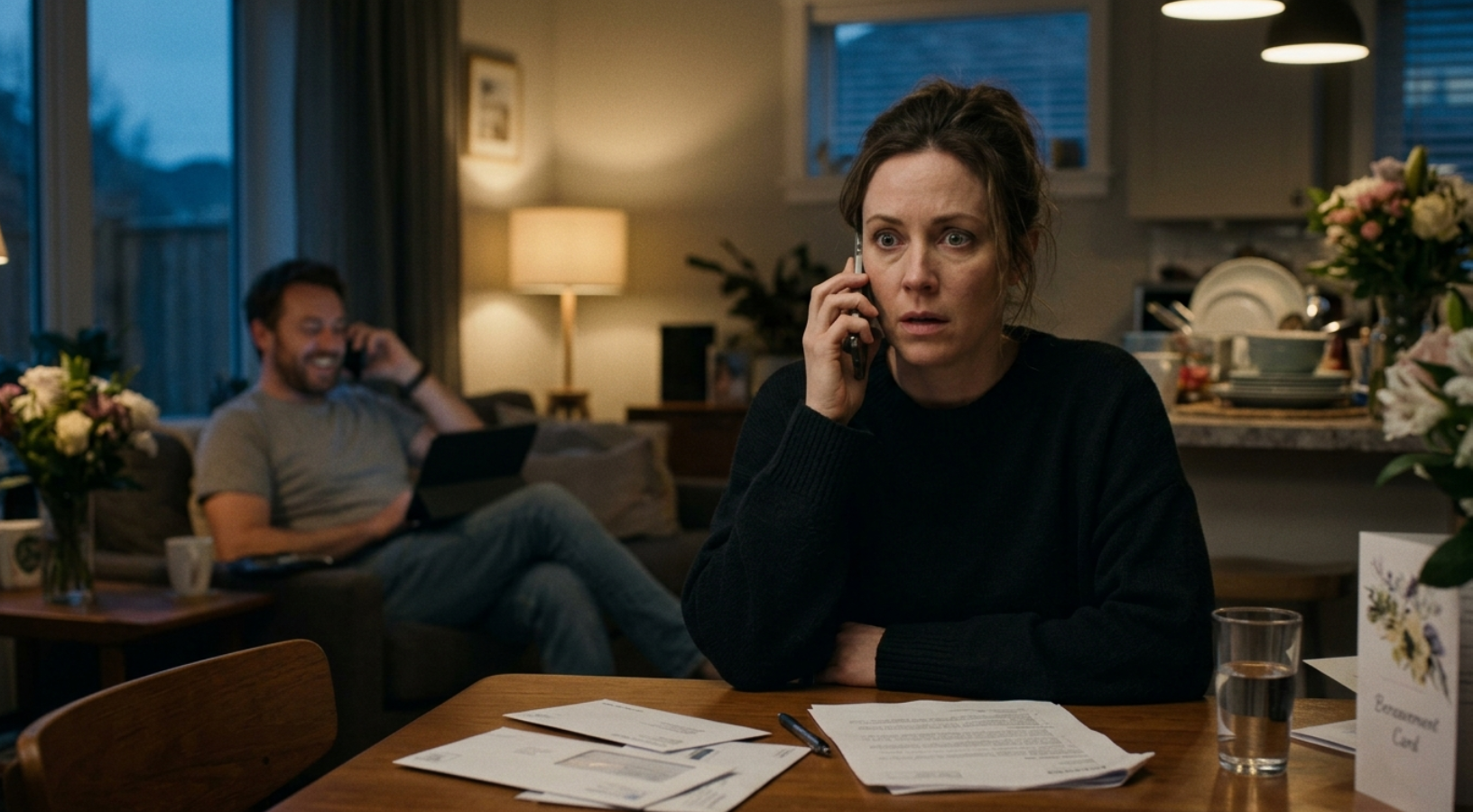
When the call ended, I remained in the kitchen for several minutes.
My father had been a careful man. He locked his workshop every evening, kept copies of important documents, and wrote the date on nearly everything he filed. Even when he was healthy, he had a habit of preparing for problems nobody else could imagine.
But why had he specifically instructed his attorney to ask whether someone had already started spending my inheritance?
I thought about Paul’s announcement that morning.
His resignation.
His plans for retirement.
The house he had promised Gloria.
The $200,000 he had offered Denise.
Then I remembered something else.
Two weeks before Dad died, Paul had asked me an unusual question while we were driving home from dinner.
“Did your father ever tell you who handles his investments?”
I had been looking out the window.
“Why?”
“Just curious. If something happened to him, somebody would have to manage everything.”
“He has an accountant and an attorney.”
“Right, but what about the properties? The company sale? Those kinds of things.”
“I don’t know, Paul. You’d have to ask him.”
Paul had laughed.
“Your father doesn’t exactly volunteer information, does he?”
At the time, I hadn’t thought anything of it.
Now, sitting alone in Dad’s house, I replayed that conversation until every word seemed suspicious.
I didn’t want to believe my husband had been waiting for my father to die.
After 22 years together, I couldn’t simply decide that every act of kindness had been a lie.
But I could no longer pretend I hadn’t noticed how quickly he had begun treating my future inheritance as his own.
I locked the back door and drove home.
Paul was sitting on the couch when I arrived, scrolling through his phone.
“Where have you been?”
“At Dad’s house.”
He nodded without looking up.
“Did you talk to Thomas Avery?”
My heart gave a small, uncomfortable jump.
“Yes. He called.”
“What did he say?”
“That we have a meeting tomorrow.”
Paul finally looked at me.
“We?”
I took off my coat.
“He asked me to come alone.”
His expression changed so quickly that I almost missed it.
“Alone?”
“Yes.”
“Why?”
“He said Dad left some documents he wanted to discuss with me personally.”
Paul put his phone down.
“That makes no sense. I’m your husband. If we’re talking about an inheritance, I should be there.”
“Thomas said Dad specifically requested that I come alone.”
Paul let out a humorless laugh.
“Your father never liked me.”
“That isn’t true.”
“Nora, he spent 22 years treating me like I was some temporary employee who happened to marry his daughter.”
I looked at him.
“Dad helped us buy our first house.”
“And I paid him back.”
“He refused to take the money.”
“Exactly. He always had to be the generous one, the man who knew better than everybody else.”
I didn’t answer.
Paul stood up and walked toward the kitchen.
“Well, whatever he left you, we’re going to have to discuss it together. I don’t want you walking into a lawyer’s office and making decisions without understanding the consequences.”
“I won’t.”
“Good.”
He opened the refrigerator, took out a bottle of water, and leaned against the counter.
“Did Thomas mention how much money we’re talking about?”
“No.”
“Not even an estimate?”
“No.”
Paul twisted the bottle cap.
“Strange.”
I watched him.
“You seem very interested in the amount.”
He looked at me as if I had insulted him.
“Of course I’m interested. My wife just lost her father. If he’s left her a substantial estate, it affects our future.”
“Our future?”
“Yes, Nora. Our future.”
He stepped closer and softened his voice.
“Listen. I know dinner was awkward yesterday. I probably shouldn’t have promised Denise that much money before we knew the details. But I was trying to help. She’s drowning in debt, and Mom is barely keeping up with her rent. We have an opportunity to make their lives better.”
“With money that hasn’t even been distributed.”
“It’s coming.”
“You don’t know that.”
Paul’s face hardened.
“Your father was wealthy.”
“He was comfortable.”
“He sold an entire manufacturing company.”
“And you have no idea what happened to the proceeds.”
Paul stared at me.
For the first time since I had known him, I felt that he wasn’t simply annoyed by my questions.
He seemed offended that I was asking them at all.
“Fine,” he said. “Let’s wait until tomorrow.”
He picked up his phone again.
“But don’t let a lawyer convince you that your own husband is somehow your enemy. That’s exactly how these people make money. They create fear, separate families, and charge thousands of dollars to solve problems that never existed.”
I went upstairs without answering.
That night, I barely slept.
At 2:17 a.m., I heard Paul moving around downstairs.
I came out of the bedroom and found him sitting at the dining table, his laptop open.
He quickly closed a window.
“What are you doing?”
“Work.”
“You quit your job.”
“I’m looking into something.”
He turned the laptop toward himself.
I stood there for a moment.
Then I asked the question that had been troubling me since dinner.
“Paul, did you tell anyone else that I was inheriting money?”
He looked up.
“Who would I tell?”
“I don’t know. Your friends? Someone at work?”
He gave a short laugh.
“Why would that matter?”
“Because you quit your job before we even knew what Dad left.”
“I told you. I’ve worked long enough.”
“Then why are you looking at houses for your mother?”
Paul closed the laptop.
“Because she deserves a better life.”
“And Denise’s $200,000?”
“She’s my sister.”
“Paul, please answer me. Have you already made financial commitments based on money you expect me to inherit?”
His face became expressionless.
“No.”
He said it so quickly that I almost believed him.
Then he added, “And I don’t appreciate being interrogated in my own home.”
Our home.
The house we had bought together. The mortgage we had paid together. The rooms we had painted on weekends while listening to music.
Yet suddenly, even that seemed to be something he could use to silence me.
I returned to the bedroom.
At 2:43 a.m., I heard him make a phone call.
His voice was low, but our house was quiet enough for me to hear fragments through the partly closed door.
“Tomorrow morning,” he whispered.
A pause.
“No, she doesn’t know yet.”
Another pause.
“I said I’ll handle it.”
I sat up in bed.
Then I heard the words that made my stomach tighten.
“Just give me until tomorrow afternoon.”
The call ended.
I stared into the darkness.
I wanted to ask him who he had been speaking to.
But I didn’t.
For the first time in our marriage, I decided that I would wait until I knew the truth before giving him another chance to explain it away.
At eight the next morning, I left for Thomas Avery’s office.
Paul was still in the shower.
I didn’t leave a note.
I didn’t tell him I was frightened.
I simply drove to the address Thomas had given me and parked outside a brick building in downtown Wheaton.
His office was on the third floor.
A receptionist led me into a conference room where a thick folder sat on the table.
Thomas stood when I entered.
He was in his late sixties, with silver hair and the kind of serious expression that made people instinctively lower their voices.
“Nora,” he said gently. “I’m sorry about your father.”
I felt my throat tighten.
“Thank you.”
He gestured toward a chair.
“Please sit down.”
I placed my purse beside me.
Thomas opened the folder but didn’t immediately show me its contents.
“Before we discuss the estate, I want to explain something about Leonard. Your father came to see me several months ago. He was concerned about the possibility that his death might create pressure on you to make financial decisions before you had time to understand your position.”
I stared at him.
“Pressure from whom?”
“He didn’t give me a definitive answer. He told me that people sometimes become very generous with money that doesn’t belong to them yet.”
I felt a chill move through me.
“That sounds like him.”
Thomas nodded.
“He was also very specific about your independence. He wanted you to have enough time and information to make your own decisions, without feeling obligated to satisfy anyone else’s expectations.”
I thought about Paul promising a house to Gloria.
Denise’s hug.
The way Paul had looked at me when I questioned him.
“What did Dad leave me?”
Thomas turned a page.
“Before I answer that, I need to tell you that the estate is more complicated than you may have been led to believe.”
I leaned forward.
“What does that mean?”
“Your father sold Shaw Manufacturing five years ago. The sale generated a substantial amount of money, but he didn’t keep all of it in cash. He reinvested in several businesses, maintained commercial property, and established a number of separate accounts and legal arrangements.”
I nodded slowly.
“That sounds like Dad.”
“Most of those arrangements are straightforward. One, however, requires particular attention.”
He slid a document across the table.
It contained my father’s name, a date, and several paragraphs I didn’t immediately understand.
“What am I looking at?”
“An estate planning memorandum. Your father prepared it after meeting with me. He wanted me to confirm that certain protections were still in place if he died before making additional revisions.”
I read the first paragraph.
Then the second.
My hands began to feel cold.
“Thomas, I don’t understand. Why would he need to protect the money from someone?”
“It’s important not to jump to conclusions. These arrangements can serve several purposes, including tax planning, asset management, and protecting a beneficiary from undue pressure.”
He paused.
“But there is something else you need to know.”
I looked up.
“Your father did not leave a single, unrestricted pool of money that could simply be divided among relatives at someone’s request.”
I thought of the $200,000 Paul had promised his sister.
“The inheritance isn’t available yet?”
“Some assets may be distributed after the required legal and administrative steps. Other assets are held under separate arrangements with their own terms. We need to establish exactly what belongs to the estate and what passes through those arrangements.”
He folded his hands.
“And I want to make one thing absolutely clear. No one should promise money, sign contracts, or commit estate assets before we know what can legally be distributed.”
I felt a knot form in my stomach.
“Paul already promised his mother a house.”
Thomas didn’t react dramatically.
He simply picked up his pen.
“When did he make that promise?”
“Two nights ago.”
“And his sister?”
“Two hundred thousand dollars.”
Thomas wrote something on a notepad.
“Did either of them receive money from you?”
“No.”
“Did you authorize any transfers, sign any documents, or give anyone access to your financial accounts?”
“No.”
“Good. Keep it that way until we’ve completed the review.”
I took a shaky breath.
“Thomas, why did Dad want you to ask whether anyone had started spending money they thought I inherited?”
For the first time, the attorney seemed to struggle with how to answer.
He closed the folder.
“Because Leonard told me he was worried that someone might treat your expected inheritance as if it were already theirs.”
I looked down at my hands.
Then I asked the question I had been afraid to ask since the funeral.
“Did my father know Paul was planning to retire?”
Thomas remained silent for several seconds.
“I cannot tell you what your father knew about your husband’s current decisions without reviewing the relevant records. But Leonard did leave me a sealed letter addressed to you.”
My heart began to pound.
“What’s in it?”
“His personal explanation of why he arranged his estate as he did. He instructed me to give it to you at this meeting.”
Thomas opened a smaller envelope and placed it in front of me.
My father’s handwriting was unmistakable.
For Nora. To be opened only after my death, when she is ready to understand.
I touched the envelope with trembling fingers.
I could almost hear Dad’s voice telling me not to rush, not to panic, and not to let anyone else decide what I should do.
I opened it.
Inside was a single sheet of paper.
Nora, my girl,
If Thomas is giving you this letter, then I am no longer there to explain things myself.
First, I want you to know that nothing in these papers is meant to make you afraid. I spent my life building things, and the last thing I want is for what I leave behind to become a burden.
But I learned something over the years that I wish I had understood when I was younger.
People can love you and still believe they are entitled to what you have.
Sometimes they don’t even recognize the difference.
I stopped reading.
My eyes blurred.
Dad had always been a practical man. He wasn’t the sort of father who wrote emotional letters or talked about his feelings.
Seeing those words in his handwriting felt like hearing him speak from the other side of a closed door.
I continued.
You have always been generous, Nora. You forgive quickly. You avoid arguments. You would rather carry a problem yourself than make someone you love uncomfortable.
That is a beautiful quality, but it can also make you vulnerable to people who mistake your kindness for permission.
I cannot choose whom you love. I would never ask you to do that.
What I can do is make sure you have choices.
Read everything Thomas gives you. Ask questions. Take your time.
And please remember that you do not owe anyone a decision simply because they are waiting for one.
Love always,
Dad.
I pressed the letter against my chest.
For several seconds, I couldn’t speak.
Thomas quietly handed me a box of tissues.
When I finally looked up, he had opened the larger folder again.
“There is one more thing, Nora.”
I wiped my cheeks.
“What?”
“Your father asked me to review a set of documents relating to a conversation he had with you and Paul several years ago. He believed it might become relevant after his death.”
I frowned.
“What conversation?”
“Do you remember your father offering to help you and Paul financially when you were considering purchasing your current home?”
“Of course. He offered to lend us money for the down payment, but Paul said we didn’t need it.”
Thomas nodded.
“Your father kept records of that discussion. More importantly, he kept records of several subsequent transactions involving his personal finances and your household.”
My stomach tightened.
“Why?”
“I’m still establishing the full context. I don’t want to draw conclusions before I’ve reviewed everything.”
He removed another document from the folder.
This one contained a bank transfer confirmation.
I recognized the account name.
It belonged to Paul.
I leaned closer.
The transfer had been made six years earlier.
The amount was $85,000.
The sender was Leonard Shaw.
I stared at the page.
“Dad gave Paul eighty-five thousand dollars?”
Thomas nodded.
“According to the records, your father transferred that amount after Paul approached him with a business proposal. The transfer was described as a loan, not a gift.”
I felt as though the floor had shifted beneath me.
Paul had never mentioned it.
Not once.
“Did Paul repay him?”
Thomas looked at the documents.
“That’s one of the questions I’m investigating.”
I shook my head.
“No. That can’t be right. Paul would have told me.”
Thomas didn’t challenge me.
He simply placed another page beside the first.
There was a handwritten note attached to it.
My father’s handwriting again.
Do not assume that Nora knows about this transaction. She was not present when the agreement was discussed.
My mouth went dry.
“Thomas, what was the business proposal?”
He looked directly at me.
“Your father invested in a company Paul wanted to establish. It was supposed to become a consulting business after Paul left his previous employer.”
I remembered that period.
Paul had spent months talking about becoming his own boss.
Then, suddenly, he abandoned the idea and took another corporate position.
When I asked why, he told me the timing wasn’t right.
I had never known Dad had given him money.
“Was the company ever established?” I asked.
“I’m checking the corporate records. At this stage, I can confirm the transfer occurred. I cannot yet tell you whether it was repaid, whether the funds were used as described, or whether there are other related transactions.”
I looked at the confirmation again.
Eighty-five thousand dollars.
A sum large enough to change a family’s future.
A sum my father had apparently lent my husband without my knowledge.
And now Paul was promising hundreds of thousands more from an inheritance he hadn’t even seen.
“Why didn’t Dad tell me?”
Thomas’s expression softened.
“Perhaps he wanted to avoid creating conflict between you and your husband. Perhaps he believed the matter had been resolved. I don’t know. Your father did not leave an explanation that answers that question.”
I sat back in my chair.
For the first time since Dad died, my grief was mixed with something else.
A terrible uncertainty.
I had spent 22 years believing I knew the man I married.
Now I was discovering that there were entire conversations, financial decisions, and promises I had never known existed.
Thomas closed the folder halfway.
“Nora, I want you to be careful. This does not prove that Paul has done anything wrong. But until we understand the documents, you should avoid making financial commitments based on assumptions about your inheritance.”
I nodded.
Then my phone vibrated.
Paul.
Where are you?
A second message arrived almost immediately.
I called Thomas’s office. His receptionist said you were there. Why didn’t you tell me you were going?
I stared at the screen.
I hadn’t told him because he was still asleep when I left.
Before I could respond, another message appeared.
Call me now. We need to discuss something important.
I turned the phone facedown.
Thomas noticed my expression.
“Is everything all right?”
“No,” I said quietly. “I don’t think it is.”
He gave me a moment before continuing.
“There is one final document your father asked me to review with you today. It concerns the structure of his estate and the conditions attached to certain distributions.”
He placed a clean sheet of paper in front of me.
“Before I explain it, I need to ask you something.”
I looked at him.
“What?”
“Has Paul ever asked you to sign a document concerning your father’s company, investments, or property? Anything that you might have considered routine paperwork?”
I searched my memory.
Then I remembered a night about eight months earlier.
Paul had come home carrying a thick envelope.
He had placed several papers beside my dinner plate and asked me to sign the last page.
“It’s just an authorization,” he had said. “Dad mentioned something about his property records, and I need to confirm a few details.”
I had been exhausted after work.
I had barely glanced at the pages.
I remembered asking him whether I needed to read the whole thing.
He had laughed.
“It’s standard paperwork, Nora. Nothing complicated.”
I hadn’t signed it that night because the baby-sitter had called, and I needed to pick up our granddaughter from my sister’s house.
The following morning, Paul told me he had found another way to handle it.
I had completely forgotten about the incident.
Until now.
I looked at Thomas.
“Yes,” I whispered. “He once asked me to sign something related to Dad’s property. But I never signed it.”
Thomas became very still.
“Do you remember what the document was called?”
“No.”
“Do you still have it?”
“I don’t know. It might be in our home office.”
He wrote something down.
“Please don’t search for it in a way that could create a confrontation. If you find it, keep the original safe and let me review it.”
I nodded, feeling increasingly unsettled.
Thomas gathered the documents into a neat stack.
“We’ll proceed carefully. There is no need to make accusations or decisions today.”
I stood, clutching my father’s letter.
At the door, Thomas spoke again.
“Nora, one more thing. Your father was very clear about this.”
I turned.
“He wanted you to understand that whatever you inherit, you are allowed to take your time. Nobody has the right to turn your grief into a deadline.”
I nodded.
Then I left.
Outside, the October air was cold enough to sting my cheeks.
I sat in my car and read Dad’s letter one more time.
People can love you and still believe they are entitled to what you have.
For 22 years, I had believed that being a good wife meant trusting Paul, avoiding unnecessary arguments, and making room for his family.
I had never considered that my silence might have allowed him to mistake my patience for agreement.
My phone rang.
Paul.
This time, I answered.
“Where are you?” he demanded.
“I’m leaving Thomas’s office.”
“What did he tell you?”
“About Dad’s estate.”
“And?”
“It’s complicated. There are documents he needs to review.”
Paul exhaled sharply.
“Of course there are. Lawyers always find a way to make simple things complicated.”
“Dad made specific arrangements.”
“What arrangements?”
“I don’t know everything yet.”
“Did he leave you money or not?”
I closed my eyes.
“Paul, my father died three days ago. Can you stop asking me that question?”
Silence.
Then he said, “I’m asking because we need to plan.”
“No. You’re asking because you’ve already made plans.”
“That is not fair.”
“Is it true that Dad lent you $85,000 six years ago?”
The silence that followed was so complete that I could hear the faint hum of traffic through my car window.
Finally, Paul spoke.
“Where did you hear that?”
I gripped the steering wheel.
“So it’s true?”
“Your father helped me with a business idea. It was years ago.”
“Why didn’t you tell me?”
“Because it didn’t work out.”
“Did you repay him?”
“That’s between me and your father.”
“No, Paul. It concerns our marriage.”
His voice hardened.
“I am not discussing this over the phone.”
“Then we’ll discuss it at home.”
I ended the call before he could respond.
For several minutes, I remained parked outside the attorney’s office.
I wanted to cry.
I wanted to call my father, even though I knew nobody would answer.
Most of all, I wanted to return to the version of my life in which my husband was simply a man who had made an insensitive announcement during a painful week.
But I couldn’t return to that life.
Because now I knew there were things Paul had kept from me.
And I had no idea how many more there were.
When I arrived home, his car was in the driveway.
I walked through the front door and found him waiting in the living room.
His laptop was open on the coffee table.
Beside it lay a printed document.
He looked at me without smiling.
“We need to talk.”
I set my purse down.
“About the $85,000?”
“About everything.”
He picked up the document and held it out.
“I want you to read this before you let your father’s lawyer fill your head with nonsense.”
I took the paper.
At the top was the name of a company I had never seen before.
Beneath it was a list of names, dates, and financial figures.
Then I saw a line that made my hands go cold.
Leonard Shaw — Outstanding Balance: $85,000.
I looked up at Paul.
“What is this?”
He rubbed his forehead.
“It’s complicated.”
I stared at the document.
“Then explain it.”
Paul opened his mouth.
For the first time in 22 years, he seemed unable to find the right words.
And as I watched him struggle, I realized that whatever happened next would not simply be about my father’s inheritance.
It would be about every secret that had survived inside our marriage.
And whether the man sitting across from me had ever intended to tell me the truth.
CONTINUE READ NEXT PART… 👇