
The Silent Ledger
Chapter 1: The Splintered Glass
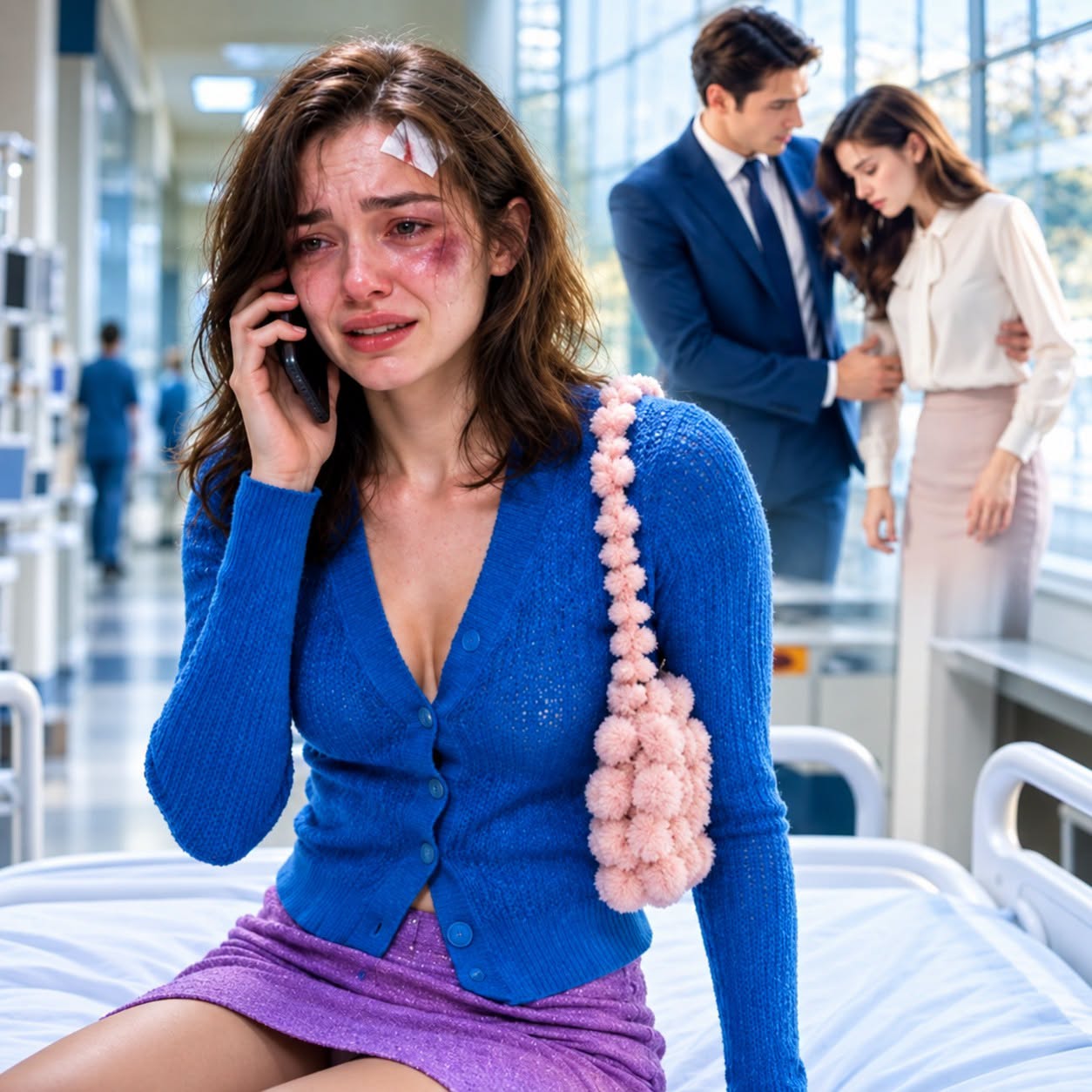
The fluorescent lights of the trauma bay had a peculiar, buzzing hum that vibrated directly against the base of my skull. It was a sterile, unforgiving glare that bleached every surface into shades of bone and surgical steel. Beneath me, the examination table crinkled with every shallow breath I drew, the stiff industrial paper sticking to the cold sweat on the back of my bare legs.
“Hold completely still, Mrs. Whitman,” the resident physician murmured, his breath smelling faintly of peppermint and third-shift espresso. “The laceration crosses the supraorbital ridge. If you flinch, the suture line won’t sit flat against the hairline.”
I did not flinch. Pain, I had come to realize over the course of seven years of marriage, was rarely an explosion. Pain was a quiet, creeping calculation. It was the icy draft under a locked door.
“Four stitches,” he announced a moment later, the sharp snip of stainless-steel scissors puncturing the quiet. “You were fortunate. Another two inches to the left, and the A-pillar of that delivery van would have caved in your temporal bone. Someone up there was watching over you.”
“The side curtain airbag deployed,” I said, my voice sounding like gravel grinding underfoot. “Automotive engineering watched over me.”
The nurse, a woman named Beverly whose identification badge was decorated with faded pastel butterflies, stepped forward with a damp gauze pad soaked in saline. She worked with practiced, maternal gentleness, lifting the matted strands of dark brown hair away from my forehead. The water in her small kidney-shaped basin turned the color of weak rust as she rinsed out the congealed crimson.
“Your emergency contact,” Beverly said softly, her eyes darting toward the curtain divider. “We paged the number on your intake intake file twice. An automated dispatch went out from the county EMS server when your vehicle was towed. Has your husband replied?”
My phone sat on the stainless-steel tray beside a discarded pair of nitrile gloves. The screen was smeared with fine road dust and a greasy thumbprint from when I had pulled myself through the passenger-side window into the October rain.
I had dialed Daniel three times while the paramedics were prying the driver’s door free with hydraulic spreaders.
The first call had rung through to his standard corporate voicemail: “You have reached Daniel Whitman, Managing Director of Vanguard Strategic Consulting. Please leave a message, or text for urgent scheduling.”
The second call had been summarily disconnected on the third ring—the curt, mechanical click of a call bounced directly to voicemail by a thumb pressing the side button of an iPhone.
The third call had not rung at all. He had engaged his ‘Do Not Disturb’ filter.
Then, exactly seven minutes before the doctor pierced my forehead with a curved needle, the screen had illuminated with a single notification.
A text message.
“Can’t make it to county general right now,” it read. “Jenna had an acute panic episode following the quarterly review. She is completely undone, hyperventilating, so I am driving her home to ensure she rests. You know how fragile her nervous system is. Take a cab home if discharged. We’ll talk in the morning.”
I had read those thirty-seven words until the syntax disintegrated. Until the individual letters ceased to function as English vocabulary and reassembled themselves into something far more ancient and definitive: a formal declaration of bankruptcy. Not financial, but moral.
“Mrs. Whitman?” Beverly asked again, hovering with a clean square of medical adhesive.
I picked up the phone, locked the screen, and placed it face down inside my leather handbag.
“He’s detained,” I told her, offering a practiced, razor-thin smile that didn’t disturb the fresh thread above my brow. “He has an obligation he considers indispensable.”
“Do you have someone else to drive you?” the nurse pressed, concern carving deep parentheses around her mouth. “You have a grade-two concussion. The doctor explicitly noted you cannot operate heavy machinery or remain unmonitored for the next twelve hours.”
“I am perfectly capable of monitoring myself,” I replied.
I signed the discharge paperwork with fingers that only trembled when I formed the letter W. I walked through the automatic sliding doors into the raw, misting darkness of 1:00 a.m. The taxi ride back to the historic district cost forty-two dollars. The driver smelled of cheap cigarillos and kept the radio tuned to an AM talk station where callers screamed about the imminent collapse of civilization. I looked out the smeared glass at the streetlights melting across the wet asphalt, feeling the strange, miraculous clarity that often accompanies severe trauma.
When an archway collapses, you do not curse the keystone for falling. You curse yourself for pretending the stone wasn’t already cracked down its marrow.
The taxi dropped me off in front of our three-story Georgian townhouse on Bridlewood Lane. The facade of weathered brick and leaded glass was magnificent—an immaculate specimen of high-end metropolitan architectural heritage. The wrought-iron gas lamps flanking the mahogany entrance flickered with an amber glow, casting long, cage-like shadows across the limestone steps.
I climbed the stairs slowly, one hand pressed firmly against the wrought iron for balance. The house was pitch-black.
I did not switch on the overhead lights. Instead, I moved through the foyer into the kitchen, illuminated only by the cold, bluish glow of the commercial wine refrigerator. I poured a glass of tap water, swallowed two generic acetaminophen tablets, and laid my discharge summary flat upon the polished white surface of the Calacatta marble island.
Beside the medical papers, I set the taxi receipt.
Then, I sat down on the high-backed leather stool and waited in the dark.
At exactly 1:18 a.m., the heavy brass latch of the front door clicked.
The heavy front door swung inward on its silent German hinges. Footsteps echoed through the foyer—deliberate, slightly unsteady, the rhythm of a man attempting to mimic sobriety while his shoes squeaked against wet oak parquet.
Daniel stopped dead in the kitchen archway. The sudden motion sensor clicked, flooding the marble island with warm recessed downlight.
He smelled of the night air, damp wool, and an unmistakable, sickeningly sweet veil of synthetic Madagascar vanilla—the signature fragrance worn by Jenna Vance, the twenty-six-year-old junior associate he had hired seven months ago over the explicit objections of his partners. Underneath the perfume lingered the sharp, industrial citrus of hotel-dispensed hand soap.
His overcoat was draped casually over one forearm. His Italian silk tie had been yanked loose, the top two buttons of his tailored shirt undone to expose his throat. His silver chronograph watch was missing from his left wrist.
“Claire?” he gasped, his body recoiling a half-step into the shadow of the hallway. “Good God. What are you doing sitting here in the dark?”
I didn’t blink. “I am waiting.”
His gaze finally dropped to my forehead, snagging on the stark, sterile white pad taped across my temple. His brows furrowed, not with grief, but with an acute, defensive annoyance.
“You’re home already?” he asked, stepping toward the refrigerator. “I told you I was going to head down to the hospital the second I got Jenna settled in her flat. She had a catastrophic breakdown, Claire. Her hands were turning blue from hyperventilating. I couldn’t just dump her on the sidewalk.”
“Jenna lives on Mercer Street,” I said evenly. “Mercer Street is an eleven-minute drive from the county emergency room. My car was struck at eight-forty p.m.”
Daniel paused with his hand on the refrigerator door, his profile hardening into the familiar, arrogant mask he wore during hostile client arbitrations.
“She needed someone to sit with her,” he said, his tone dropping into a patronizing register. “She was terrified. I stayed until she took an anti-anxiety tablet and fell asleep.”
“You stayed for four hours.”
He slammed the refrigerator door shut without taking anything out. “Don’t start, Claire. Do not start this tonight. I have had a twelve-hour workday followed by a medical emergency with my staff. I am exhausted.”
“I had a car accident, Daniel.”
“And you’re fine!” he snapped, tossing his brass key ring into the silver drop bowl by the pantry. The keys landed with a violent, piercing clatter. “You’re sitting right here. You have a scratch on your head. They put a plaster on it and sent you home in a taxi. Why do you always have to manufacture a theatrical crisis out of everything?”
I looked at his hands. Near the base of his right thumb was a faint, crescent-shaped smudge of coral lipstick that had been hastily rubbed with a wet cloth, leaving the surrounding skin irritated and pink.
“I needed four sutures,” I whispered. “My car was hit by a two-ton commercial van running a blind intersection. If my reaction time had been half a second slower, you would currently be identifying my body at the city morgue.”
Daniel blew out a long, theatrical breath through puffed cheeks. He ran both hands through his thick, salon-styled hair, then leaned across the marble island, fixing me with an expression of manufactured, long-suffering tenderness.
“I’m sorry,” he said, though his eyes remained entirely dispassionate. “I’m sorry you were scared. But Jenna needed me. She is young, she is completely unmoored in this city, and she doesn’t possess your… resilience. You are strong, Claire. You have always been strong. You handle logistics. You handle pain. You don’t need hand-holding.”
There it was.
The ultimate verbal trap of the emotional parasite. When they wish to excuse their abandonment, they crown you with competence. They call you strong so they can leave you to bleed in the dark without feeling like monsters.
“Strong,” I repeated quietly.
“Yes,” he said, taking my flat tone as an agreement, a surrender. He smiled, reaching across the counter to pat my forearm with a hand that still carried the scent of hotel toiletries. “Exactly. You’re my rock. You always have been. Now, please, take some ibuprofen and go upstairs to bed. We have the Vanguard Capital expansion dinner on Friday, and I need you rested.”
I slid my arm out from beneath his palm.
Slowly, without breaking eye contact, I reached into the pocket of my coat, pulled out my ring finger’s platinum band—the three-carat emerald-cut diamond flanked by baguettes—and set it down with a sharp, resonant clink atop my hospital discharge paperwork.
Daniel stared at the ring. The smug, conciliatory smile remained plastered on his face for three seconds before the geometry of his features began to fray.
“What is that supposed to mean?” he asked, his laughter thin and hollow.
“I am divorcing you,” I said.
The silence that followed was thick, suffocating.
Then Daniel let out a loud, incredulous bark of laughter that echoed through the empty kitchen.
“Are you out of your mind?” He shook his head, looking around the cavernous kitchen as if seeking an invisible audience to share in the absurdity. “You’re divorcing me? Just because I didn’t hold your hand in an emergency room waiting area for an hour? Over an ambulance ride and a couple of stitches?”
I looked into his eyes, completely devoid of tears, completely empty of rage.
“Yes,” I said.
His humor vanished instantly, replaced by a sudden, predatory sneer. “You’re having a hysterical reaction to a mild head concussion. Pack this melodramatic nonsense away, Claire. In the morning, you’ll realize how utterly pathetic you sound.”
He turned on his heel and began walking toward the stairs.
“Daniel,” I called out softly.
He paused on the bottom riser, not looking back. “What?”
“Do not sleep in my bedroom tonight.”
He sneered over his shoulder. “Your bedroom? Sweetheart, this is our house. Everything here is mine.”
I listened to his heavy wingtips ascend the oak staircase, the door to the primary suite shutting with an arrogant slam.
I sat alone at the island. I reached out and gently traced the edge of my diamond ring.
Daniel didn’t know about the high-resolution dual-lens dashcam that had recorded the crash—and recorded the phone calls that followed. He didn’t know about the private investigator’s dossier that had been sitting in the encrypted cloud storage of my personal laptop for forty-eight hours.
And, most critically, he didn’t know that the very ground beneath his expensive Italian shoes was made of quicksand he had spent three years mistaking for granite.